

Computer und IT

A Guide to UX Design and Development
Gain a thorough understanding of the two pillars of any User Experience project: the mission and the process. The mission is to keep the user in mind at each step or milestone as the developer progresses through the project. The process is how that mission is accomplished through collaboration and the use of research, design and development technologies. This book walks you through a developer's journey through the UX process, from start to finish.A Guide to UX Design and Development concentrates on the intersection of what is called “DesignOps” and “DevOps.” That intersection is where collaboration between all members of the team, including stakeholders and clients, occurs and neither DesignOps nor DevOps can go beyond being considered just buzzwords if they instead silo design and development. To highlight the UX Mission and illustrate the responsibility developers also hold for the user experience, authors Tom Green and Joseph Labrecque take you through a hypothetical project involving the development of a parking app for a municipal parking authority. As the book progresses, they concentrate on the developer's journey through the whole project from discovery to product release. In this journey, you will see how developers can make an impact and contribute to the user experience.This will include such topics as why there is a need for both a user journey map and a technical journey map. The authors explain why prototyping is not as complicated as it is made out to be because it is simply an early low-cost and disposable minimal viable product that gives the developer a deep understanding of the project's intent in support of the UX Mission. You will also explore the creation and use of design systems and why the developer's role is just as important as the people who create the design system. The role and responsibility of the developer in user testing is discussed in the context of a variety of testing and assessment methods conducted to achieve the UX mission.Finally, you’ll gain an understanding of how design and development deliverables are negotiated, prepared and sent out for research at each step of the process, and how the developer is involved.WHAT YOU WILL LEARN* Understand the evolving role of the developer in a team-based environment* Learn the five stages of the UX process * Discover the importance of collaboration and communication with stakeholders, designers, and developers at every stage of the process* Learn a variety of design and development documents created during the UX processWHO THIS BOOK IS FORDevelopers and designers involved in the UX Process, as well as developers trying to make sense of the confusing amount of information out there regarding their role in the UX process.TOM GREEN is a retired Professor of Interactive Multimedia through the School of Media Studies and IT at the Humber Institute of Technology and Advanced Education in Toronto, Canada. He has created over a dozen UX-based courses for LinkedIn Learning. One course--UX Design for Non-Designers, released 2 years ago--has been completed by over 35,000 learners throughout the world. Tom has written numerous books on UX design software for, among others, Apress, Que, Pearson Education, friendsofED, and New Riders. Along with his work with LinkedIn Learning, Tom has developed video-based training courses for Infinite Skills, Envato, Video2Brain, and others. He was the Graphics Software expert with the former About.com and has written hundreds of articles and tutorials for a variety of magazines and websites over the past 20 years. He has spoken and lectured at more than 50 international conferences and over a dozen universities throughout China and the U.S., including the University of Wisconsin, the Central Academy of Fine Arts in Beijing, WuHan Institute of Technology, and Shenzhen Polytechnic. In his spare time, you can catch him hiking a local trail or paddling across a lake in Northern Ontario.JOSEPH LABRECQUE is a creative developer, designer, and educator with nearly two decades of experience creating expressive web, desktop, and mobile solutions. He joined the University of Colorado Boulder College of Media, Communication, and Information as faculty with the Department of Advertising, Public Relations and Media Design in Autumn 2019. His teaching focuses on creative software, digital workflows, user interaction, and design principles and concepts. Before joining the faculty at CU Boulder, he was associated with the University of Denver as adjunct faculty and as a senior interactive software engineer, user interface developer, and digital media designer.Labrecque has authored a number of books and video course publications on design and development technologies, tools, and concepts through publishers which include LinkedIn Learning, Apress, Peachpit, Packt, and Adobe. He has spoken at large design and technology conferences such as Adobe MAX and for a variety of smaller creative communities. He is also the founder of Fractured Vision Media, LLC, a digital media production studio and distribution vehicle for a variety of creative works.Joseph is an Adobe Education Leader, Adobe Community Expert, and member of Adobe Partners by Design. He holds a bachelor’s degree in communication from Worcester State University and a master’s degree in digital media studies from the University of Denver.CHAPTER 1: THE UX PROJECT PROCESSGOALS:· Developan understanding the User Experience Design is broken into two parts- Mission and Process- and where Mission and Process intersect is where collaboration occurs.· Develop an understanding the User Experience Design is broken into two parts- Mission and Process- and where Mission and Process intersect is where collaboration occurs.· Present a Five-Step process involved in The UX project Process.· Understand the deliverables and documentation required for each phase of the UX Process.SUB TOPIC* The UX Mission* Why UX projects fail* The Collaborative UX Process* A brief review of the UX ProcessUX Process Deep Dive * ConclusionCHAPTER 2: DEFINING THE PROBLEMGOALS:· Learn the importance of research to define the problem or the potential market and users.· Discover the role of the developer in the research process.· Learn research is a continuous process in an Agile workflow.· Understand the deliverables and documentation required for each phase of the UX Process.SUB TOPIC* Why research is important for developers* The research process is continuous* Research and systems impact* Artifacts and deliverables* The Developer’s role in the research phase* ConclusionCHAPTER 3: DETERMINING THE SCOPE AND MVPGOALS:· Learn How to think big start small· Discover the raison d'etre of your product· Learn and prioritize high impact high urgency features· Understand how feature creep sets into a product’s Ethos· Understand and build a feedback loop after launchSUB TOPIC* Why scaling our view matters* How to define your product purpose and reason to exist* Diagram the prioritization matrix* Mind the customer gap* Generate new ideas grounded in user behaviours* ConclusionCHAPTER 4: THE PROTOTYPING PROCESSGOALS:· Understand the purpose of a prototype and its many uses.· Present an overview of the various prototyping tools and processes.· Discover the role of the developer in the prototyping process.· Learn prototypes are both a deliverable and are disposable.SUB TOPIC* What is a prototype?* The prototyping tools* Prototyping and collaboration* User Testing the prototype.* ConclusionCHAPTER 5: A VISIT TO THE LIBRARY: DESIGN SYSTEMS/CODE LIBRARYGOALS:· Learn why a Design System is the “single source of truth.”· Learn what is contained in a Design System.· Discover the role of the developer in the construction of a design system.· Understand the importance of getting the support of the organization.SUB TOPIC* What is a Design System?* Create an inventory of the elements for the design system* Establish the key rules and principles* Building the team.Build the elements contained in the Design System * The Developer’s role in the development of the Pattern Library* ConclusionCHAPTER 6: UX DESIGNGOALS:· Provide the developer with an understanding of the role of UX Design in the UX process.· Understand the skills and habits of UX Designers.· Discover how to proactively work with a UX Designer.· Learn how User Testing is a continuing process in the UX Design process.SUB TOPIC* What is UX Design.* The UX Designer’s dance between data and design* UX Design is a team-based sport.* Artifacts and deliverables* User Testing is an iterative process.* Conclusion.CHAPTER 7: UI DESIGNGOALS:· Understand UI Design is both visual and interaction design.· Discover the collaborative role of the developer in the UI Design process.· Understand how visual hierarchy and UI patterns are determined and created.· Learn the variety of UI design documents created that lead to the final designSUB TOPIC* UI Design is a process that supports the UX Mission* Understanding Users and their needs.* Developing a visual hierarchy and UI patterns* Developing and testing UI elements* The visual element principles of UI DesignUI Design is a Team Sport. * Conclusion.CHAPTER 8: DEVELOPMENTGOALS:· Learn the importance of structuring data· Discover the interplay Designers and Developers riff product interaction ideas with every ideation· Understand software sketching in an agile workflow· Understand and chose your process flow wisely (Basic, Agile, Scrum, and CMMI)SUB TOPIC* Opportunity for discovery of new interactions with data structure understanding* Co creation of Interactions with designers and developers* Software sketching is digital doodling in agile process* Agile process flow on the road to Getting the right design and the design right* ConclusionCHAPTER 9: DEALING WITH USER TESTINGGOALS:· Learn why User Testing is important.· Learn how to set usability testing goals.· Discover the variety of User Testing approaches.· Understand how what should be tested and when is decided.SUB TOPIC* Why research and testing is important.* User Testing goals and metrics* Choosing a test and who will participate.* The scripted test* Card Sorting Test* A/B Testing* How to test Mobile and Web projects.* Conclusion.CHAPTER 10: HANDOFF TO THE DEVELOPERGOALS:· Learn what UI elements are handed off to the developer.· Discover the importance of the designer/developer relationship in the process.· Learn why properly preparing content for platforms accelerates the development process.· Understand the role of the prototype in an efficient development process.SUB TOPIC* Preparing for handoff.* All platforms are not created equally.* How the Design System and the UI elements come together* The front end and back end come together.* Consistent feedback and iteration are critical.* ConclusionCHAPTER 11: RELEASE INTO THE WILD AND BEYONDGOALS:· Learn the importance user feedback once product launches.· Sculpt Analytics to make invisible insights visible.· Learn that products initially ship “good enough”.· Understand the Roadmap to future featuresSUB TOPIC* Early Adopters will help our understanding of product pivot* Visualizing with data insights crystalizes blind spots* Be agnostic different methodologies optimize for different goals* Ecosystems and scaling future features* Conclusion
Scripting
Die Kunst, Probleme in 10 Zeilen zu lösen. Das Praxisbuch für Administratoren und DevOps-Teams. Scripting ist die Kunst, Probleme in wenigen Zeilen zu lösen. Denn viele Aufgaben in der IT erfordern keine komplexen Lösungen in einer Hochsprache – oft reichen ein paar Zeilen Python-, Bash- oder PowerShell-Code.Michael Kofler zeigt Ihnen in diesem Praxisbuch, wie Sie die Macht der Scripting-Umgebungen nutzen. Anhand zahlreicher Praxisbeispiele erfahren Sie, wie Sie Aufgaben automatisieren und wie Ihnen Shell- oder Pythonscripts viel Arbeit abnehmen können. Mit dabei ist ein Überblick über moderne Shell-Werkzeuge und IDEs: Visual Studio Code, Git, SSH und mehr.Für alle SystemeEgal, ob Sie mit Linux, Windows oder dem Mac arbeiten, ob Sie lokale Systeme administrieren oder per SSH auf die Cloud zugreifen: Crashkurse für die Bash/ZSH, PowerShell und Python machen Sie fit fürs Scripting.Keep it simple, Stupid!Wenn Sie schon länger in der IT arbeiten, wissen Sie, dass nichts über das KISS-Prinzip geht. Einfache Scripts zerlegen komplexe Probleme in kleine Schritte und erleichtern die Arbeit in der Systemadministration oder der Softwareentwicklung.Musterlösungen und BeispielscriptsMöchten Sie Markdown-Dokumente automatisiert erstellen oder Script-gestützte Sicherungen durchführen? Webinhalte scrapen oder Ihre Lösungen in Docker-Containern weitergeben? Für viele Szenarien finden Sie Musterlösungen, die Sie als Grundlage für eigene Scripts nutzen können.Aus dem Inhalt:Bash, ZSH und die Linux-ToolboxPowerShell und CmdLetsPython und PipSSH, VSCode, Git, Curl: Werkzeugenkasten für moderne ScriptsScripts automatisch ausführen: Cron und Task SchedulerBackups automatisierenBilder verarbeitenMonitoring: Logging-Dateien auswertenWeb-Scraping und -MiningScripting in der AWS-CloudScripte in Docker-ContainernÜber den Autor:Michael Kofler ist der renommierteste Fachbuchautor im deutschsprachigen Raum und behandelt von Linux über Swift bis zur IT-Security alles, was Sie in der Systemadministration oder der Softwareentwicklung wissen müssen.Leseprobe (PDF-Link)
IT-Handbuch für Fachinformatiker*innen (11. Auflg.)
Der Ausbildungsbegleiter. Standardwerk für die Ausbildung in 11. Auflage.Mit diesem bewährtem Klassiker in elfter Auflage haben Sie das ganze Wissen zur Hand, das Fachinformatikerinnen und Fachinformatiker in ihrer Ausbildung benötigen: Hardware, Betriebssysteme, Programmiergrundlagen, Daten- und Prozessanalyse, Netzwerke, Datenbanken und Multimedia. Aktuell und mit neuen Themen zur Neuordnung der IT-Berufe. Die zahlreichen Prüfungsfragen und Praxisübungen unterstützen Sie beim Lernen und bei der Vorbereitung auf die Abschluss- oder Zwischenprüfung.IT-Grundlagen von A bis ZGrundlagen von IT und Betriebssystemen verstehen:Alles, was Sie über die mathematischen und technischen Voraussetzungen von Computern, Dateiformate und -verwaltung sowie Theorie und Praxis der Betriebssysteme wissen müssen.Programmieren lernen und Datenbanken einsetzen:Legen Sie die theoretischen Grundlagen für die Programmierung eigener Anwendungen und lernen Sie, was es auf sich hat mit Algorithmen, Datenstrukturen, Objektorientierung und Datenbanken.Netzwerktechnik in Theorie und Praxis:Mit der vollständigen Einführung in die Begriffswelt der Netzwerke und TCP/IP, die Einrichtung von Servern unter Windows und Linux sowie den Einsatz von Serverdiensten sind Sie für alle Anwendungsfälle gerüstet.Big Data, Machine Learning und Prozessanalyse:Lernen Sie die Themen Datenanalyse, Machine Learning und Künstliche Intelligenz kennen – nicht nur für den Ausbildungsgang FIDP unverzichtbar. Für die Implementierung kommen praxiserprobte Python-Bibliotheken wie NumPy und Scikit-Learn zum Einsatz.Erstellen und gestalten Sie Websites:Lernen Sie die Grundlagen der Website-Programmierung mit HTML5, CSS3, PHP und JavaScript kennen und erstellen Sie eine REST-API und -Clients. Inklusive Node.js und React.Aus dem InhaltÜberblick IT-AusbildungMathematische und technische GrundlagenHardware und Betriebssysteme, DatenbankenWindows, Linux, macOS – Grundlagen und PraxisNetzwerktechnik und -praxis, IT-SicherheitDatenanalyse, Machine Learning, KIProgrammierung in Java, Python, JavaScript und PHPAlgorithmen und DatenstrukturenProzessanalyseSoftware-EngineeringInternet- und WebtechnologienÜber den Autor:Sascha Kersken arbeitet seit vielen Jahren als Softwareentwickler sowie als Trainer für EDV-Schulungen in den Themengebieten Netzwerke und Internet, interaktive Medien und Programmierung.
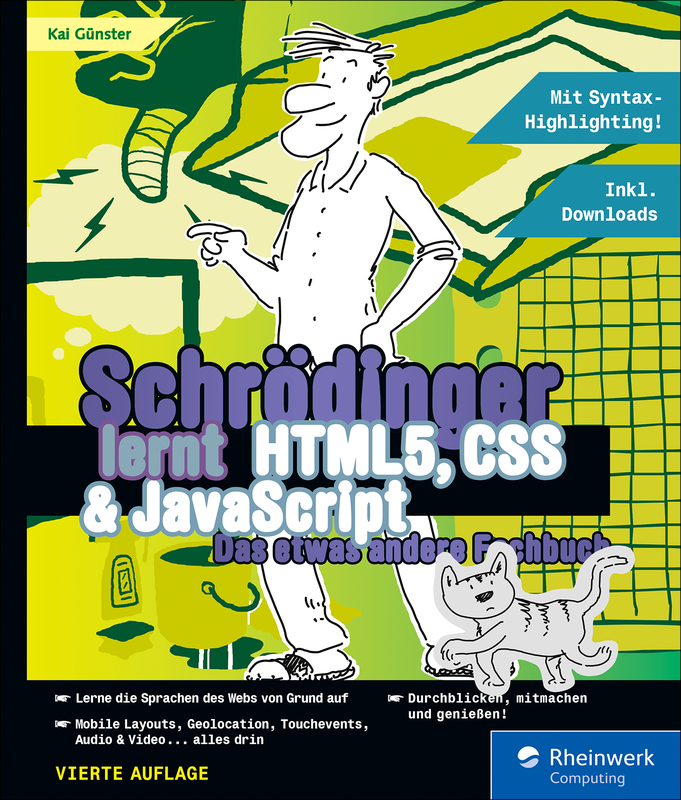
Schrödinger lernt HTML5, CSS und JavaScript (4. Auflg.)
Drei Sprachen in einem Schrödinger-Band! Das etwas andere Fachbuch - 4. aktualisierte Auflage 2023.Eine runde Sache: Schrödinger wird Webentwickler! Zum Glück hat er einen Kumpel, der auf jede Frage eine Antwort weiß, wenn er nur genug Kaffee bekommt. Zusammen lernt ihr HTML, CSS und JavaScript und erstellt die Webauftritte für seine Firma und einen Verein. Mit viel Witz, allen nötigen Erklärungen, Unmengen an Code, Tipps, Übungen und der verdienten Erholung. Von "Hallo Webwelt" über AJAX bis zu Geolocation und TouchScreens: alles auf dem neuesten Stand und, wenn du willst, mit deinem eigenen Webserver. Umwerfende Beispiele, fantastisch illustriert.1. Gründlicher EinstiegSchrödinger ist zwar pfiffig, fängt aber ganz von vorn an zu lernen – und du bist dabei. HTML-Seiten aufbauen, ersten JavaScript-Code schreiben, grafische Gestaltung umsetzen: Alles wird Schritt für Schritt erklärt und ausprobiert.2. Voller Durchblick durch moderne WebstandardsFür Einsteiger und Umsteiger perfekt. Unmengen an Beispielen und Übungen. HTML, CSS und JavaScript von Anfang an – alles in einem Buch und mit farbigem Syntax-Highlighting. Aktuelle Profi-Praxis mit Sinn für guten Code.3. Lernen – Anwenden – WiederholenMit Schrödinger wird immer Hand angelegt. Neue Konzepte und Sprachelemente werden in Ruhe vorgestellt (grün). Dann geht es ab in die Werkstatt (violett), wo ihr Code schreibt oder verbessert. In Schrödingers Wohnzimmer (orange) könnt ihr üben, wiederholen und euch auch etwas Erholung gönnen.Aus dem Inhalt:Ausführlicher Einstieg in HTML, CSS und JavaScriptDesigns umsetzen und gute GUIs erstellenEreignisse behandeln und Funktionen einsetzenServerkommunikation, AJAX und Websockets nutzenMit oder ohne HTML5 und CSS3Karten einbinden und GPS-Daten auswertenZeichnen mit CanvasResponsive Webdesign und ToucheventsWebseiten für einfach alles, was einen Bildschirm hatVideo- und Audiomaterial einbindenÜber den Autor: Kai Günster ist Web- und Softwareentwickler und hat Spaß an immer neuen Details. Er hält HTML5 für die beste Erfindung seit der Laugenbrezel und JavaScript für die Zukunft der GUI-Entwicklung.Leseprobe (PDF-Link)

Pro Spring 6
Master the Spring Framework, its fundamentals and core topics, and share the authors’ insights and real-world experiences. This book goes well beyond the basics: you'll learn how to leverage the latest Spring Framework 6 to build the various tiers and parts of today's modern, complex enterprise Java applications systems, top to bottom, including data access, SQL generation with jOOQ, persistence with Hibernate, transactions, set up security, classic web and presentation tiers and adding in some reactivity. Spring 6 will be based on the latest available Long Term Support (LTS) release, Java 17. So, you will be able to do the following in your Spring applications: use records, use new utility methods in String class; utilize Local-Variable Syntax for Lambda Parameters; Nested Based Access Control, and more. Integrating Spring with the most used frameworks and libraries is covered in this book, such as Testcontainers, Hibernate, jOOQ, Kafka and many others.A full sample application allows you to apply many of the technologies and techniques covered in Pro Spring 6 and see how they work together. This book updates the perennial bestseller with the latest that Spring Framework 6 has to offer. Now in its sixth edition, this popular title is by far the most comprehensive and definitive treatment of Spring available. After reading this book, you'll be armed with the power of Spring to build complex applications, top to bottom. The agile, lightweight, open-source Spring Framework continues to be the de facto leading enterprise Java application development framework for today's Java programmers and developers.WHAT YOU WILL LEARN* What’s new in Spring Framework 6 and how to use it with the latest LTS version of Java, Java 17* How to integrate Spring with the most renowned and practical frameworks and dependencies* How to build complex enterprise cloud-native applications using Spring 6* How to master data access, persistence and transactions* How to use with Spring Batch, Integration and other key Spring projectsTHIS BOOK IS FORExperienced Java and enterprise Java developers and programmers. Some experience with Spring highly recommended.IULIANA COSMINA is a Spring Certified Web Developer and is also Spring Certified Core Spring Professional. She is a Spring certified expert, as defined by Pivotal, the makers of Spring Framework, Boot and other tools. She has authored books with Apress on Core Spring certification and Spring Certified web development. She is a Lead Engineer at Cloudsoft, Edinburgh and is an active coder and software contributor on Apache Brooklyn, GitHub, StackOverflow and more.ROB HARROP is a software consultant specializing in delivering high-performance, highly-scalable enterprise applications. He is an experienced architect with a particular flair for understanding and solving complex design issues. With a thorough knowledge of both Java and .NET, Harrop has successfully deployed projects across both platforms. He also has extensive experience across a variety of sectors, retail and government in particular. Harrop is the author of five books, including Pro Spring, a widely-acclaimed, comprehensive resource on the Spring Framework.CHRIS SCHAEFER is a Principle Software Developer for Spring project at Pivotal, the makers of Spring Framework, Boot and other Spring tools.CLARENCE HO is the Senior Java Architect of a HK-based software consultancy firm, SkywideSoft Technology Limited. Having been worked in the IT field for over 20 years, Clarence had been the team leader of many in-house application development projects, as well as providing consultancy services on enterprise solutions to clients.Chapter 1: Introducing SpringChapter 2: Getting StartedChapter 3: Introducing IoC and DI in SpringChapter 4: Advanced Spring Configuration and Spring BootChapter 5: Spring AOPChapter 6: Spring JDBCChapter 7: Spring with HibernateChapter 8: Spring with JPAChapter 9: Spring Transaction ManagementChapter 10: Spring Data with SQL and NoSQL databasesChapter 11: Validation, Formatting and Type ConversionChapter 12: Task Scheduling - some new things might be needed here.Chapter 13: Spring RemotingChapter 14: Spring Native and Other GoodiesChapter 15: Spring MVCChapter 16: Spring REST SupportChapter 17: Securing Spring Web ApplicationsChapter 18: Monitoring Spring ApplicationsChapter 19: Spring WebSocket SupportChapter 20: Reactive Spring

The Cloud Leader's Handbook
This book is a comprehensive guide covering modern cloud strategies and leadership approaches for building and scaling organizations to maturity on their cloud adoption journey.The book starts by examining technical topics from the perspective of the cloud leader, who is responsible for cloud teams and accountable for cloud products and platforms within their organization. Through a series of practical insights and real-world examples, you will gain a deep understanding of the key considerations for leading a cloud-driven organization.These considerations include understanding the benefits of digital transformation, managing global tech teams, and delivering excellence through platform ownership. Towards the end of the book, you will explore the latest trends and best practices for strategically innovating and scaling your organization in the cloud.With the knowledge gained from this book, you will be able to harness the power of the cloud to drive business success and gain valuable insights and practical strategies to support and empower the adoption of modern cloud platforms and technologies for your clients and organization.The Cloud Leader's Handbook is a must-read for any Cloud Leader who wants to stay ahead of the curve and achieve success in the rapidly evolving world of cloud computing.WHAT WILL YOU LEARN* Develop a strong foundation in the technical aspects of cloud leadership* Understand the benefits of digital transformation and how to lead a cloud-driven organization, including managing global tech teams.* Discover the bleeding-edge cloud trends that are influencing organizational roadmaps* Transition into the role of the modern Cloud Leader by gaining a deeper perspective around what it means to own, manage, administer, govern, and optimize the modern cloud platform* Learn how to effectively envision, manage, and deploy modern cloud transformation projects through successful approaches around innovation, strategy, and excellenceWHO THIS BOOK IS FORExperienced IT professionals and business leaders looking to understand the power of the cloud.RON C. L'ESTEVE is an accomplished author, technology leader, and digital innovation strategist based in Illinois, USA. He is renowned for his impactful books and award-winning articles on Data & AI Architecture and Engineering. With deep technical skills and extensive experience leading modern Cloud Data & AI initiatives for a multitude of global clients, Ron possesses a wealth of knowledge and expertise in his field.As a trusted advisor with several Cloud certifications, Ron has played a pivotal role in some of the most significant and impactful Cloud implementations globally. He has held senior leadership positions at multiple global organizations and has been instrumental in scaling key cloud architectures, defining technology and business intelligence roadmap and strategy, and challenging customers to grow by deeply understanding the fluid business opportunities.Ron has enabled change by translating complex challenges into high-quality and sustainable technical solutions that promote digital innovation and transformation. His insights and strategic thinking have helped clients achieve their goals and realize their potential. Ron's commitment to excellence and innovation is reflected in his track record of delivering high-impact solutions that drive real-world outcomes and impact.Part I: Leadership Essentials.- 1. The Art of Cloud Leadership.- 2. Influencing Change and Driving Cloud Adoption.- 3. Managing Teams in the Digital Age.- 4. Supporting Employee Health & Turnover.- Part II: Innovation Strategies.- 5. Adopting a Cloud Platform.- 6. Democratizing Data & Democratizing Analytics.- 7. Applying DevOps.- 8. New Horizons in Distributed Cloud Computing.- 9. Impacts of Modern AI and ML Trends.- Part III: Platform Ownership.- 10. Owning a Portfolio of Agile Cloud Products.- 11.Designing a Secure Data Lake.- 12. Administering and Auditing the Cloud.- 13. Collaborating with Cloud Vendors and Providers.- Part IV: Delivery Excellence.- 14. Creating a Technology Delivery Roadmap.- 15. Cloud Transformation Roles and Responsibilities.- 16. Delivering Strategic Cloud Innovation and Excellence.- 17. Managing Agile Cloud Projects.- 18. Achieving Digital Transformation Success.

Handbook of Computational Sciences
THE HANDBOOK OF COMPUTATIONAL SCIENCES IS A COMPREHENSIVE COLLECTION OF RESEARCH CHAPTERS THAT BRINGS TOGETHER THE LATEST ADVANCES AND TRENDS IN COMPUTATIONAL SCIENCES AND ADDRESSES THE INTERDISCIPLINARY NATURE OF COMPUTATIONAL SCIENCES, WHICHREQUIRE EXPERTISE FROM MULTIPLE DISCIPLINES TO SOLVE COMPLEX PROBLEMS.This edited volume covers a broad range of topics, including computational physics, chemistry, biology, engineering, finance, and social sciences. Each chapter provides an in-depth discussion of the state-of-the-art techniques and methodologies used in the respective field. The book also highlights the challenges and opportunities for future research in these areas. The volume pertains to applications in the areas of imaging, medical imaging, wireless and WS networks, IoT with applied areas, big data for various applicable solutions, etc. This text delves deeply into the core subject and then broadens to encompass the interlinking, interdisciplinary, and cross-disciplinary sections of other relevant areas. Those areas include applied, simulation, modeling, real-time, research applications, and more. AUDIENCEBecause of the book’s multidisciplinary approach, it will be of value to many researchers and engineers in different fields including computational biologists, computational chemists, and physicists, as well as those in life sciences, neuroscience, mathematics, and software engineering. AHMED A. ELNGAR, PHD, is the founder and head of Scientific Innovation Research Group (SIRG) and assistant professor of Computer Science at the Faculty of Computers and Information, Beni-Suef University, Egypt. VIGNESHWAR. M., is head of R & D and Academic Initiatives, Cybase Technologies, Coimbatore, Tamil Nadu, India. He has around 9 years in industry & research and 8 years in academia. He has an M.E., degree in computer science and engineering, and has published more than 110 international/national conference and journal publications as well as numerous awards. KRISHNA KANT SINGH, PHD, is an associate professor in the Faculty of Engineering & Technology, Jain (Deemed-to-be University), Bengaluru, India. Dr. Singh has acquired BTech, MTech, and PhD (IIT Roorkee) in the area of machine learning and remote sensing. He has authored more than 50 technical books and research papers in international conferences and SCIE journals. ZDZISLAW POLKOWSKI, PHD, is a professor in the Faculty of Technical Sciences, Jan Wyzykowski University, Polkowice, Poland. He has published more than 75 research articles in peer-reviewed journals.
Innovative Engineering with AI Applications
INNOVATIVE ENGINEERING WITH AI APPLICATIONSINNOVATIVE ENGINEERING WITH AI APPLICATIONS DEMONSTRATES HOW WE CAN INNOVATE IN DIFFERENT ENGINEERING DOMAINS AS WELL AS HOW TO MAKE MOST BUSINESS PROBLEMS SIMPLER BY APPLYING AI TO THEM.Engineering advancements combined with artificial intelligence (AI), have resulted in a hyper-connected society in which smart devices are not only used to exchange data but also have increased capabilities. These devices are becoming more context-aware and smarter by the day. This timely book shows how organizations, who want to innovate and adapt, can enter new markets using expertise in various emerging technologies (e.g. data, AI, system architecture, blockchain), and can build technology-based business models, a culture of innovation, and high-performing networks. The book specifies an approach that anyone can use to better architect, design, and more effectively build things that are technically novel, useful, and valuable, and to do so efficiently, on-time, and repeatable. AUDIENCEThe book is essential to AI product developers, business leaders in all industries and organizational domains. Researchers, academicians, and students in the AI field will also benefit from reading this book. ANAMIKA AHIRWAR, PHD, is an associate professor at the Compucom Institute of Information Technology & Management, Jaipur, India. She has about 20 years of experience in teaching and research and has published more than 45 research papers in reputed national/international journals and conferences, authored several books as well as five patents. PIYUSH KUMAR SHUKLA, PHD, is an associate professor in the Department of Computer Science & Engineering, University Institute of Technology, Bhopal, India. He has about 15 years of experience in teaching and research, is the author of 3 books, more than 50 articles and book chapters in international publications, as well as 15 Indian patents. MANISH SHRIVASTAVA, PHD, is the Principal of the Chameli Devi Institute of Technology & Management, Indore, India. He has published more than 100 articles in international journals and spent 7 years as a software engineer. PRITI MAHESHWARY, PHD, is a professor in the Department of CSE and Head of the Centre for Excellence in Internet of Things and Advance Computing Lab, Rabindranath Tagore University, Bhopal, India. BHUPESH GOUR, PHD, is a professor in the Department of Computer Science and Engineering at Lakshmi Narain College of Technology in Bhopal, India. He has 22 years of experience in academia as well as the software industry. He has published more than 50 articles in national and international journals, as well as four patents.

Sensors and Protocols for Industry 4.0
This book Identifies the right sensors and single board computers for any application to achieve the best performance in Industry 4.0 settings and applications. You’ll see what technologies apply the IIoT with elegant efficiency to drastically improve remote monitoring and controlling, decision making, and preventative maintenance.Start by learning exactly what Industry 4.0 is and advance your knowledge from simple Internet of Things projects to full-on Industrial IoT deployment. You'll automate advanced processes, incorporate professional procedures, and take your IoT skills to a professional level. Then move into the protocols and standards expected for industrial applications of sensors at an industrial level. Match the right SBCs to the right use cases and sensor technologies to optimize efficiency and ensure peak performance. Then move into setting up a smart factory and monitoring your supply chain with tech. Finally, you'll dive into programming with the Node-Red platform and Python packages for CPS.By the end of this book, you’ll have jumped from simple, home-based IoT systems up to industrial and professional applications. Conquer your supply chain and both forward and backward processes with accessible Maker tech!WHAT YOU'LL LEARN* Support industrial applications of SBCs and Maker tech* Achieve peak performance by combining the right sensors with the right processing boards* Improve remote monitoring and controlling drastically for better decision making and preventative maintenance WHO THIS BOOK IS FORStudents and aspiring professionals working with Internet of things technologies moving towards industrial applications. Prerequisite knowledge in basic Internet of Things, simple python concepts, automation, and industry procedures is required for this book. Engineers and scientists who are pursuing research and contributing to industrial internet of things might also benefit.DR. G. R. KANAGACHIDAMBARESAN completed his Ph.D. at Anna University Chennai in 2017. He is currently an Associate Professor in the Department of CSE at Vel Tech Rangarajan Dr. Sagunthala R&D Institute of Science and Technology. His main research interests include Body Sensor Networks and Fault Tolerant Wireless Sensor Networks. He has published several articles and undertaken consultancy activities for leading MNC companies. He has also guest-edited special issue volumes and books and served as an editorial review board member for peer-reviewed journals. He is presently working on several government sponsored research projects like ISRO, DBT, and DST. Presently, he is the Editor in chief for the Next Generation Computer and Communication Engineering series.DR. N. BHARATHI works as an Associate Professor in the Department of Computer Science Engineering at SRM Institute of Science and technology, Chennai, India. She has good working knowledge of the Internet of Things and embedded systems in addition to computer science engineering concepts. She was awarded with a Ph.D. degree in computer science in 2014 from SASTRA University, after nearly two decades as as an academician. She also has industrial experience as an R&D head involved in ARM platform boards with software development in Ubuntu OS. She has published many research papers in reputed journals and conferences along with book chapters; guided many tech students in various domains of computer science, engineering, and embedded systems; and currently advises 4 research scholars.SENSORS AND PROTOCOLS FOR INDUSTRY 4.0Chapter 1: Overview of Industry 4.0* Introduction * Industry 4. 0 revolution * Industry 4.0 Enabling Technologies* General Framework* Benefits of Industry 4.0 Chapter 2: Sensors for Industry 4.0* General Features of sensors to support IIoT* List of various sensors and their capabilities* Seamless integration with application Chapter 3: Protocols and Standards* Open Platform Communications* MTConnect* Message Queue Telemetry Transport * Distributed network protocol (DNP3)* Constrained Application Protocol* Reference Architectural Model for Industry 4.0* Industrial Internet Reference Architecture Chapter 4: Single Board Computers* Raspberry Pi* BeagleBone Black* Banana Pi* Odroid-boards* Nvidia Boards Chapter 5: Industry 4.0 dashboard* Data Insights and Decision Making* Digital twin design* Digitalization* Business Intelligence Chapter 6: Smart Factories* Custom Manufacturing * Mass Customization* Fault tolerant Systems* Autonomic Machine Control and Monitoring Chapter 7: Supply Chain Monitoring* Supply Chain Strategies * Industry Operations with Supply Chain* Supply Chain performance measures* Supply Chain Technologies Chapter 8: CPS Programming* Python packages for CPS* Node-Red Platform and its features* Programming with sensors* Programming with Communication Mechanisms

Pro T-SQL 2022
Learn how to write and design simple and efficient T-SQL code. This is a hands-on book that teaches you how to write better T-SQL with examples and straightforward explanations. New in this edition is coverage of Parameter Sensitive Plan (PSP) optimization, Azure Synapse Link for real-time analytics, integration with S3-compatible object storage, and SQL Ledger tables based on blockchain. You’ll learn to improve your T-SQL design in ways that provide faster performance, stronger security, and easier comprehension. The book identifies common anti-patterns in writing T-SQL and instructs you on how to change your code so you can be more confident in writing T-SQL code that is reliable and performs well.Pro T-SQL 2022 is focused on the problems that developers are faced with and must solve in delivering successful applications. The content begins from a foundation of writing T-SQL that is clear and understandable. The book then takes you through writing SQL that performs well, is easy to manage through coding standards and version control, can be maintained and modified as business requirements change over time, scales as your business grows, and takes advantage of the full range of security features built into the SQL Server and Azure SQL database engines.WHAT YOU WILL LEARN* Choose the correct data types and database objects when designing your T-SQL* Write T-SQL that accesses your data efficiently and uses hardware effectively* Implement source control and testing methods to streamline your deployment process.* Design T-SQL that is flexible and can be enhanced or modified with little effort* Plan for long-term data management, including growth and purging of older data* Enhance database security through features such as encryption, data masking, row-level security, and the SQL Ledger blockchain table typeWHO THIS BOOK IS FORDatabase developers who want to improve the efficiency of their applications with better T-SQL; developers who want to know more about T-SQL so they can be prepared to solve complex problems more easily; data professionals who want to write high-quality T-SQL that performs well, is flexible to changing needs, and is easy for others to understandELIZABETH NOBLE is a Microsoft Data Platform MVP and Director of Database Development in the metro Atlanta area. When ze was introduced to hir first database over 10 years ago, ze found the career ze wanted to pursue. Hir passion is to help others improve the quality and speed of deploying database changes through automation. When ze is not trying to automate database development, ze can be found spending time with zir dogs, painting, paddle boarding, or throwing axes. IntroductionPART I. BUILDING UNDERSTANDABLE T-SQL1. Data Types2. Database Objects3. Standardizing T-SQL4. Designing T-SQLPART II. BUILDING PERFORMANT T-SQL5. Set-Based Design6. Hardware Usage7. Execution Plans8. Optimize T-SQLPART III. BUILDING MANAGEABLE T-SQL9. Coding Standards10. Source Control11. Testing12. DeploymentPART IV. BUILDING MAINTAINABLE T-SQL13. Functional Design14. Logging15. EnhancementPART V. BUILDING SCALABLE T-SQL16. Managing Data Growth17. Managing Data Long TermPART VI. BUILDING SECURE T-SQL18. Implementing Security Features19. Implementing Encryption

ESP32 Formats and Communication
Although Wi-Fi communication is incorporated in many internet-based applications, knowledge of alternative communication protocols is vital for optimal project development with a microcontroller, such as the ESP32. This book focuses on communication protocols for the ESP32 microcontroller with illustrative projects ranging from a Bluetooth Low Energy beacon communicating with your smart wristwatch to Long Range (LoRa) communication between microsatellites circling 550km above the Earth and an ESP32 microcontroller in your home.Just as there are different communication protocols, there are different ESP32 microcontroller formats. You’ll examine the features of several ESP32 microcontroller formats, which enable the optimal combination of communication protocol and ESP32 format to achieve the requirements of a project. Several of the communication protocols and ESP32 formats have only been available in the last few months or years, making the book very relevant.Each chapter focuses on a communication protocol and is stand-alone, so they can be read without having to start from the beginning of the book. The chapters are loosely grouped into short- and long-range communication, image management for transmission to a webpage or a remote LCD screen, and the required apps and IoT techniques for remote control of an ESP32-CAM robot vehicle. The advantages of each communication protocol correspond to different project types.WHAT YOU'LL LEARN* Study the MESH communication protocol and the ESP-NOW protocol with communication between ESP32 microcontrollers without a Wi-Fi connection* Review email communication projects with an ESP32 and generation of quick response codes to instruct an ESP32 to control a connected device.* Look at the ESP32-CAM module built around a 2M-pixel camera for streaming images with the WebSocket protocol to a remote ESP32* Control an ESP32-CAM robot car through remote communication over the internet with image streaming to an Android tablet or mobile phone.WHO THIS BOOK IS FORNeil Cameron is an experienced analyst and programmer with a deep interest in understanding the application of electronics. Neil wrote the books Arduino Applied: Comprehensive Projects for Everyday Electronics and Electronics Projects with the ESP8266 and ESP32: Building Web Pages, Applications, and WiFi Enabled Devices, which are published by Apress. He has previously taught at University of Edinburgh and Cornell University.PREFACECHAPTER 1: ESP32 MICROCONTROLLERUSB to UART driver installationArduino IDE Boards Manager esp32 version 2.0.NESP32 DEVKIT DOITTTGO T-Display V1.1Pulse width modulationAnalog to digital conversionTTGO LoRa32 V2.1 1.6TTGO T-Watch V2TTGO T-Watch installationM5Stack Core2M5Stack Core2 installationM5Stack Core2 and soundM5Stack Core2 M5G0 battery baseESP32-CAMESP32-CAM-MB moduleESP32-CAM-CH340 moduleImage resolutionMemoryOver The Air (OTA)Software versionsCHAPTER: 2 I2S AUDIOAnalog to digitalDirect Memory AccessPDM microphoneFast Fourier TransformDigital to analogPCM5102 decoder moduleMAX98357 decoder moduleInternet radioInternet radio with ESP32 moduleInternet radio with M5Stack Core2Audio data and BluetoothESP32 to Bluetooth speakerMP3 playerPlay MP3 files from micro-SD cardPlay MP3 files with M5Stack Core2CHAPTER 3 : MESH COMMUNICATIONESP-MESHESP-MESH and one Bluetooth deviceESP-MESH and several Bluetooth devicesCHAPTER 4: TTGO T-WATCH V2TTGO T-watch functionalityConfiguration fileMain sketchDefault display screenApplication menuScreen brightnessGPS informationGPS satellite mapBluetooth communicationInfrared signallingSynchronisation with Network Time ProtocolSource OpenWeatherMap API dataStep counter and distance measureTimerBattery voltage and microcontroller temperatureData storage on micro-SD cardTemperature, current and screen brightnessGPS tracking dataCHAPTER 5: BLE BEACONSEddystone beaconsEddystone URL beaconEddystone TLM beaconEddystone UID beaconiBeaconBeacon raw dataBLE communicationGATT profileTwo-way communicationNotificationsnRF24L01 module as BLE transceiverCHAPTER 6: LORA AND MICROSATELLITESESP32 as LoRa transmitter or receiverESP32 and LoRa satellitesInstallation and configurationTest station configuration and test messageMicrosatellite trackingCHAPTER 7: EMAIL AND QR CODESemailQR codesXML HTTP requestQR codes and XML HTTP requestQR codes and WebSocketCHAPTER 8: WEBSOCKET, WEBSERIAL AND WEBDASHBOARDWebSocketWebSerialWeb DashboardCHAPTER 9: MQTTSmart meterMQTT and smart meterWi-Fi connection to routerESP-NOW, MQTT and smart meterUpdating timeWi-Fi or Wi-Fi and ESP-NOWCO2 and TVOCCO2 and TVOC with MQTTCHAPTER 10: MANAGING IMAGESImage bitmapDisplay black and white imageDisplay colour imageBitmap and X bitmapSend image in emailStore image file in SPIFFSImage URL in sketchDisplay image as SpriteLCD screenM5Stack Core2 and accelerometerMemory requirementsDisplay time with SpritesExtension to M5Stack Core2Compress HTML codeCHAPTER 11: ESP32-CAM CAMERAStream images direct to LCD screenStream images to remote LCD screenStream images over Wi-FiWebpage with control functionsWebSocketesp_http_serverWebpage with image streaming and control functionsESP32-CAM image resolutionCHAPTER 12: CONTROL APPSapp to display a webpageapp to display streamed imagesapp to transmit and receive dataapp with image streaming and control functionsapp slidersCircular sliderVertical sliderHorizontal slider touchdown and touchupapp to control WS2812 RGB LEDBluetooth communicationWi-Fi communicationCHAPTER 13: REMOTE CONTROL MOTORSServo motorledc functionESP32Servo libraryapp to control servo motorDC motorsTB6612FNG motor driver boardL298N motor driver boardMotor driver controlapp to control DC motors with heading angleCHAPTER 14: REMOTE CONTROL ESP32-CAM ROBOT CARapp with direction buttonsapp with heading angle controlCHAPTER 15 LIBRARIESTFT-eSPI libraryLibraries usedCreate a librarySource fileHeader fileKeyword fileInformation file

Technology Assessment of Dual-Use ICTs
Information and Communication Technologies (ICTs) are important to human, national, and even international security. IT research, artifacts, and knowledge that can be applied in military and civilian contexts, used as part of weapon systems, or cause significant harm are referred to as dual-use. Advances in artificial intelligence (AI), robotics, cybersecurity, and open source intelligence (OSINT) raise questions about their dual-use risks. But how can dual-use of such disparate technologies be assessed? Case studies are still lacking on how to assess dual-use ICT and how to enable sensitive and responsible dual-use design. To address the research gap, this cumulative dissertation uses Technology Assessment (TA) as an epistemological framework to bring together approaches of Critical Security Studies (CSS) as well as Value Sensitive Design (VSD) from the field of Human-Computer Interaction (HCI). As a result, the dissertation systematizes the dual-use risks and scenarios of the selected ICTs and derives organizational and design implications.ABOUT THE AUTHOR:THEA RIEBE is a post-doctoral researcher at the Chair of Science and Technology for Peace and Security (PEASEC) in the Department of Computer Science at the TU Darmstadt. She did her interdisciplinary PhD on technology assessment of dual-use technologies in computer science, combining approaches from critical security research, and human-computer interaction. Introduction.- Theoretical Background and Related Work.- Research Design.- Results.- Discussion.- Conclusion.- Measuring Spillover Effects from Defense to Civilian Sectors: A Quantitative Approach Using LinkedIn.- Dual-Use and Trustworthy? A Mixed Methods Analysis of AI Diffusion between Civilian and Defense R&D.- Meaningful Human Control of LAWS: The CCW-Debate and its Implications for Value-Sensitive Design.- U.S. Security Policy: The Dual-Use Regulation of Cryptography and its Effects on Surveillance.- Values and Value Conflicts in the Context of OSINT Technologies for Cybersecurity Incident Response.- Computer Emergency Response Teams and the German Cyber Defense: An Analysis of CERTs on Federal and State Level.- Privacy Concerns and Acceptance Factors of OSINT for Cybersecurity: A Representative Survey.- CySecAlert: An Alert Generation System for Cyber Security Events Using Open Source Intelligence Data.- Bibliography.
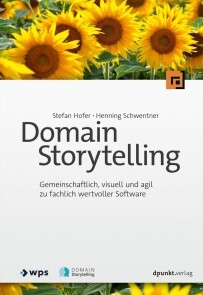
Domain Storytelling
Fachliche Anforderungen in der Softwareentwicklung: Verstehen und verstanden werden- fachliche motivierte Grenzen in Domänen finden, um Software und Teams danach zu organisieren- Anforderungen aus Domain Stories ableiten- Domain Storytelling mit Event Storming, User Story Mapping und anderen Methoden der agilen Softwareentwicklung kombinierenGeschichtenerzählen ist tief in der menschlichen Kommunikation verankert – das gilt auch im Zeitalter der Software. "Fachliche Geschichten" zu erzählen und zu visualisieren macht Geschäftsprozesse und Fachwissen greifbar.Dieses Buch zeigt, wie Sie mit einfachen Mitteln fachlich stimmige Anwendungssoftware entwickeln können. Domain Storytelling hilft, das Fachwissen aus den Köpfen der Anwender*innen in die Köpfe von Entwickler*innen, Product Owners, Produktmanagement und Business Analysts zu transportieren. Es bringt die Beteiligten in Workshops zusammen, um sich über Aufgaben und Prozesse im Unternehmen abzustimmen. Das Ergebnis wird in einer einfachen Bildsprache dokumentiert.Die Autoren erläutern an verständlichen Beispielen, wie Domain Storys entstehen und wie man Domain Storytelling für Domain-Driven Design, die Anforderungsermittlung und weitere Zwecke einsetzen kann.Stefan Hofer hat in Österreich Software Engineering studiert und einen Doktortitel in Informatik an der Universität Hamburg erworben. Seit 2005 arbeitet er für die WPS – Workplace Solutions GmbH. Requirements Enginee-ring und Domain-Driven Design bilden seine Themenschwerpunkte. Stefan ist auf Mastodon (@hofstef@social.wps.de), Twitter (@hofstef) und per E-Mail (stefan@domainstorytelling.org) erreichbar. Henning Schwentner beschäftigt sich mit Computern, seit er Anfang der 90er-Jahre einen Amiga 500 zum Geburtstag bekam. Er hatte das Glück, diese Leidenschaft zum Beruf zu machen, und arbeitet als Coder, Coach und Consultant bei WPS – Workplace Solutions. Er hilft Teams dabei, Struk-tur in ihre bestehende Software zu bringen oder neue Systeme mit einer nachhaltigen Architektur von Grund auf aufzubauen. Henning ist der Au-tor von Domain-Driven Transformation und LeasingNinja.io, der Übersetzer von Domain-Driven Design kompakt und Mitorganisator des ComoCamps. Er schreibt im Fediverse als @hschwentner@social.wps.de, twittert als @hschwentner und liest E-Mails, die an henning@domainstorytelling.org ge-richtet sind. Henning ist stolzer Vater von sechs Kindern in einer ganz be-sonderen Patchwork-Situation.
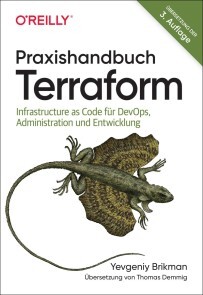
Praxishandbuch Terraform
Erprobtes Praxiswissen für die Infrastruktur-Provisionierung mit Terraform- International bekanntes Standardwerk in der 3. Auflage - von Mitchell Hashimoto, dem Entwickler von Terraform und Mitbegründer von HashiCorp empfohlen- Vermittelt über grundlegende Funktionen hinaus Patterns und Best Practices; inklusive Hilfestellungen zum Testen, zur Wiederverwendbarkeit von Code oder zu Team-Workflows.- Niedrigschwelliges Ausprobieren der Codebeispiele durch Open-Source-Beispiele auf GitHub und AWS umfangreiches Trial-Angebot.Terraform hat sich in der DevOps-Welt zu einem Schlüsselwerkzeug entwickelt. Es ermöglicht Mitarbeiter:innen in DevOps, Administration und Entwicklung, IT-Infrastruktur mithilfe von Code und Skripten für eine Vielzahl von Cloud- und Virtualisierungsplattformen wie AWS, Google Cloud Plattform, Azure u.v.a. zu definieren, bereitzustellen und zu managen.Die Übersetzung der dritten Auflage zeigt Ihnen den schnellstmöglichen Einstieg, um mit Terraform loszulegen. Yevgeniy (Jim) Brikman, Mitbegründer von Gruntwork, demonstriert anhand von aussagekräftigen Codebeispielen, wie Sie mit der einfachen, deklarativen Programmiersprache von Terraform das Bereitstellen und das Managen von IT-Infrastruktur mit nur wenigen Befehlen umsetzen. Mit diesem Praxishandbuch eignen sich erfahrene Sysadmins, DevOps Engineers, aber auch Entwickler:innen belastbare Terraform-Grundlagen an. Sie werden in kurzer Zeit den Betrieb eines vollständigen IT-Stacks – auch bei massivem Datenaufkommen oder für ein großes Entwicklerteam – erfolgreich bewältigen.Yevgeniy (Jim) Brikman ist Mitbegründer der Firma Gruntwork, das sich das Ziel gesetzt hat, die Erstellung von Software zehnmal einfacher zu machen. Er ist mehrfacher Autor und war als Software-Engineer bei LinkedIn, TripAdvisor, Cisco und Thomson Financial tätig. Weitere Informationen finden Sie unter ybrikman.com.

Heartbeat Sensor Projects with PulseSensor
Bring live heartbeats and heart rate data into your electronics projects as an impressive feature that builds user engagement. If you’re a Maker, developer, or artist, you’ve probably run into common, frustrating stumbling blocks for incorporating bio-sensors. Get the upper hand on smoothly integrating heartbeats into your projects on any platform with PulseSensor.First, you'll explore working with PulseSensor with a simple battery, LED, and speaker. Then deepen your knowledge by going through achievable projects using Arduino, nRF52, mico:bit, and other prototyping platforms. This book will guide you through hooking up the PulseSensor to circuits with motors, a GUI, and even the cloud.You’ll get practical tips and tricks that work in the lab, field, and even at public events, and look at the advantages of using PulseSensor on one electronics platform vs. another. You'll also look at the best ways to get a reliable heartbeat and BPM readings from different users in different applications. Finally, this book will show you the easiest path to put heartbeats into your prototypes, whether creating a new generation of hardware or making a memorable cosplay costume.WHAT YOU'LL LEARN* Work with PulseSensor directly on a breadboard with AA batteries and LEDs* Get up and running with PulseSensor on Arduino, micro:bit, and nRF52* Anticipate and address common bio-sensing issues that slow down prototyping* Explore future applications like BPM tracking on the Arduino IoT CloudWHO THIS BOOK IS FORMakers from hobbyists to engineers to students who would like to incorporate cardiac biofeedback into their projects. JOEL MURPHY (BFA MassArt, Boston; MFA UC San Diego) is a creative technologist living in Brooklyn. He owns Flywheel Lab, a business designing and fabricating electro-mechanical projects for artists and designers. He taught Physical Computing at Parsons from 2006 to 2014. He’s also the co-founder of OpenBCI.YURY GITMAN (BS GaTech, Atlanta; MPS ITP NYU, NYC) has taught physical computing, toy design, and mobile app development in the Design and Technology program at the Parsons School of Design since 2003. Yury is also the co-founder of PulseSensor.com, which makes and distributes a popular and easy-to-use heartbeat sensor. With a background in toy design, he often plays with his kids' toys more than they do.Chapter 1: PulseSensor Introduced● Introduction● Quick PulseSensor Development Story● PPG● Capillary Tissue● Green LED, Color-Coded Wires,● Putting a Multimeter on the Header Pins to Measure Voltage Changes.● What's included in the PulseSensor Kit, and whyChapter 2: Battery and a Breadboard● Breadboard Configuration with 3 Volts, 2x AA batteries● Blinking an LED with a live pulse.● Buzz and Piezo and Blink and LED● Includes illustrations of circuit● Includes project parts listChapter 3: Voltage Requirements and Outputting a Fluctuating Voltage Signal● Demonstrate the correct multimeter setting and reading for a 3 Volt configuration.● Demonstrate the correct multimeter setting and reading for a 5 Volt configuration.● See how to troubleshoot connection and power issues with any PulseSensor project quickly.● Includes Illustrations so readers do not need an actual multimeter● Table showing the best setting for analog and digital multimetersChapter 4: BBC's micro:bit● Blinking an LED Heart with the PulseSensor.● Reading and displaying BPM on the matrix LED Screen.● Showing different Emoji faces with different BPM readings.● Send BPM readings over Bluetooth to the micro:bit Android or iOS app.Chapter 5: Arduino UNO● PulseSensor Library● PulseSensor Examples (Image and Paragraph Description)● Using the most up-to-date libraryChapter 6: Arduino, LEDs, and Speakers● "Blink to the Beat": LED circuit and example code breakdown● "Beep and Blink to the Beat": speaker circuit and example code breakdown● "BPM to the Serial Monitor": serial example code breakdown● Different BPM example code for different Arduino boards explainedChapter 7: Arduino & Servo Motors● Considerations for using a servo and PulseSensor together● Servo motor circuit● Servo example code● Includes review of the functions and objects used in the codeChapter 8: Visualizing the Beat with Processing● Introduction to using the PulseSensor with Processing● Walk-through our example code and GUI● Visualizing the BPM in a GUI.● Includes review of the functions and objects used in the codeChapter 9: Two PulseSensors● Project Introduction● Example Code● Circuit IllustrationsChapter 10: PulseSensor and RaspberryPi● The PulseSensor and RasPi wiring setup● Python code for the RasPiChapter 11: Making It Small and Portable.● Power, Size, and Portability Considerations● WiFi and Battery Set-Up● HelloWorld Example Code● Options for sending live beats and BPM wirelessChapter 12: PulseSensor on the Arduino IoT Cloud● Introduction to the Arduino IoT Cloud● Creating a live HeartBeat Arduino Cloud Dashboard● Creating a real-time BPM Arduino Cloud DashboardChapter 13: Future Possibilities● J and Y list where they get inspiration for new projects● Invite other makers and build upon existing examples● Best Practices for publishing and sharing open source PulseSensor projects

Optimierungsmethoden
Das Buch gibt eine breite Übersicht über die wichtigsten Optimierungsmethoden, wobei die Verfahren beispielhaft erläutert und mit über 400 Abbildungen illustriert werden. Im ersten Teil des Buches werden verschiedene Klassen von Optimierungsproblemen vorgestellt. Gegenstand des zweiten Teils sind klassische Methoden zur Lösung von Optimierungsproblemen. Im dritten Teil werden naturanaloge Optimierungsmethoden behandelt, darunter physikbasierende Algorithmen, evolutionäre Algorithmen, schwarmintelligente Methoden sowie Optimierungsverfahren, die durch das Immunsystem inspiriert sind. Der letzte Teil des Buches befasst sich mit der Optimierung neuronaler Netze und gibt eine Einführung in ein neues vielversprechendes Forschungsgebiet der KI-basierten, selbstlernenden Optimierungsalgorithmen. PROF. DR. RALF HOLLSTEIN lehrte an der Universität Paderborn und bis zu seiner Emeritierung an der TH Bingen im Bereich Mathematik und Computational Intelligence. Klassen von Optimierungsproblemen - Klassische Optimierungsmethoden - Naturanaloge Optimierungen - Optimierung von neuronalen Netzen - Neuronale kombinatorische Optimierung

Machine Learning Techniques for VLSI Chip Design
MACHINE LEARNING TECHNIQUES FOR VLSI CHIP DESIGNTHIS CUTTING-EDGE NEW VOLUME COVERS THE HARDWARE ARCHITECTURE IMPLEMENTATION, THE SOFTWARE IMPLEMENTATION APPROACH, THE EFFICIENT HARDWARE OF MACHINE LEARNING APPLICATIONS WITH FPGA OR CMOS CIRCUITS, AND MANY OTHER ASPECTS AND APPLICATIONS OF MACHINE LEARNING TECHNIQUES FOR VLSI CHIP DESIGN.Artificial intelligence (AI) and machine learning (ML) have, or will have, an impact on almost every aspect of our lives and every device that we own. AI has benefitted every industry in terms of computational speeds, accurate decision prediction, efficient machine learning (ML), and deep learning (DL) algorithms. The VLSI industry uses the electronic design automation tool (EDA), and the integration with ML helps in reducing design time and cost of production. Finding defects, bugs, and hardware Trojans in the design with ML or DL can save losses during production. Constraints to ML-DL arise when having to deal with a large set of training datasets. This book covers the learning algorithm for floor planning, routing, mask fabrication, and implementation of the computational architecture for ML-DL. The future aspect of the ML-DL algorithm is to be available in the format of an integrated circuit (IC). A user can upgrade to the new algorithm by replacing an IC. This new book mainly deals with the adaption of computation blocks like hardware accelerators and novel nano-material for them based upon their application and to create a smart solution. This exciting new volume is an invaluable reference for beginners as well as engineers, scientists, researchers, and other professionals working in the area of VLSI architecture development. ABHISHEK KUMAR, PHD, is an associate professor at and obtained his PhD in the area of VLSI design for low power and secured architecture from Lovely Professional University, India. With over 11 years of academic experience, he has published more than 30 research papers and proceedings in scholarly journals. He has also published nine book chapters and one authored book. He has worked as a reviewer and program committee member and editorial board member for academic and scholarly conferences and journals, and he has 11 patents to his credit. SUMAN LATA TRIPATHI, PHD, is a professor at Lovely Professional University with more than 21 years of experience in academics. She has published more than 103 research papers in refereed journals and conferences. She has organized several workshops, summer internships, and expert lectures for students, and she has worked as a session chair, conference steering committee member, editorial board member, and reviewer for IEEE journals and conferences. She has published three books and currently has multiple volumes scheduled for publication from Wiley-Scrivener. K. SRINIVASA RAO, PHD, is a professor and Head of Microelectronics Research Group, Department of Electronics and Communication Engineering at the Koneru Lakshmaiah Education Foundation, India. He has earned multiple awards for his scholarship and has published more than 150 papers in scientific journals and presented more than 55 papers at scientific conferences around the world.

Digital Transformation and Public Policies
The extent of digitalization and the use of digital tools no longer need to be demonstrated. While companies have been integrating the challenges of such a transformation for more than 20 years, the public sector is lagging behind.Digital Transformation and Public Policies studies the mechanisms of the digital transformation of public organizations. It explores how this new deal, driven mainly by platforms, resonates with new public policies and how digital technology is redrawing the relationship between the governors and the governed.This book, the result of transdisciplinary collaboration between researchers, aims to answer these questions by focusing on several cases: public innovation policies, health data and social policies with fiscal microsimulation devices. Valérie Revest is Professor of Economics at the Université Jean Moulin Lyon 3, iaelyon School of Management – Magellan, France. Her research focuses on the financing of innovation, digital platforms and the transformation of public innovation policies.Isabelle Liotard is a lecturer in economics at the Université Sorbonne Paris Nord – CEPN, France. Her research focuses on the digital economy, innovation and the effects of digital transformation on companies and the public sector.

Cybercrime During the SARS-CoV-2 Pandemic
The SARS-CoV-2 pandemic has had an undeniable impact on cybercrime. The initial crisis quickly became a global catastrophe with multiple consequences in economics, health, and political and social fields. This book explores how this global emergency has influenced cybercrime. Indeed, since feeding off new vulnerabilities, thanks to the effects of the pandemic crisis in various states around the world, cybercrime has increased and evolved.In 2020, the world was already dealing with numerous tensions and the effects of the global crisis have therefore only tended to exacerbate the issues that relate to cybercrime. For example, radicalization and identity theft has found an environment in which they thrive: the Internet. Criminals have been able to adapt their modus operandi, their targets and their attack vectors. However, on the plus side, the response of law enforcement and public authorities, in terms of the legal, policing and policy side of cybercrime, has also been adapted in order to better combat the increase in this phenomenon. Daniel Ventre has a PhD in Political Science and conducts his research at the CESDIP laboratory, CNRS, Université Paris Saclay, France. His work focuses on cybersecurity and cyberdefense policies.Hugo Loiseau has a PhD in Political Science and is a professor at l’École de politique appliquée at the Université de Sherbrooke, Canada. His research focuses on the political and international issues involving cybersecurity.
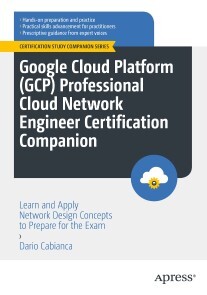
Google Cloud Platform (GCP) Professional Cloud Network Engineer Certification Companion
While many guides exist to help software engineers learn cloud networking design and architecture concepts, and even prepare for cloud network certifications on AWS and Azure, far fewer resources are available covering the Google Cloud Platform (GCP) Professional Cloud Network Engineer certification exam. Well, look no further! This self-paced guide book is designed to help engineers learn cloud networking best practices on GCP, and prepare for the GCP Professional Cloud Network Engineer certification exam.You will waste no time when you use this study companion. It lets you dive in and learn how GCP differs from other public cloud providers (AWS and Microsoft Azure). You will understand GCP's unique ability to allow virtual private clouds (VPCs) that span across multiple regions. You will know how to leverage GCP as a competitive advantage in the IT engineering community. Key concepts covered on the exam are called out and applied in each chapter of this book, giving you both practice and reinforcement, a far more effective learning tool than rote learning or similar approaches typically enlisted in exam preparation.Enterprises are looking for developers with Google networking skills. Now is the time to skill up! This book shows you how to leverage GCP’s developer-focused, user-friendly approach to understand how the networking components enabling the popular 1B-user Google products (e.g., Gmail, Google Search, YouTube, Google Workspace (formerly G-Suite), Google Maps, Google Photos, and many others) work behind the scenes.WHAT YOU WILL LEARNIn addition to preparing for the GCP Professional Cloud Network Engineer certification exam, you will learn how to:* Architect and design a virtual private cloud* Implement a virtual private cloud* Configure network services* Implement hybrid connectivity* Implement network security* Manage network operations* Optimize network resourcesWHO THIS BOOK IS FORSoftware engineers (network, DevOps, SecOps, DataOps, engineers skilled with SDLC), software architects (solution, security, data, infrastructure, cloud, those skilled with TOGAF), and IT professionals. Prerequisites: While this study companion is intended to be self-contained, a basic knowledge of cloud computing along with hands-on experience with a minimum of two modern programming languages (Java, C#) is beneficial in order for readers to fully achieve the objectives of the book.DARIO CABIANCA is a computer scientist (PhD, University of Milan), author, and Cloud Architect. He has worked with a variety of global enterprises for more than two decades and possesses more than 11 cloud certifications. He used his own fail-proof techniques to prepare and pass GCP, Azure, and AWS exams. He is excited to share his knowledge to help readers of his study companion book prepare for the GCP Professional Cloud Network Engineer certification exam, and also come away equipped with the necessary tools and knowledge to be confident and successful on the job.1. Exam Overview1.1. Exam Subject Areas1.2. Exam Format1.3. Supplemental Study Materials1.4. Sign up for a Free Tier1.5. Register for the Exam1.5.1. Schedule the Exam1.5.2. Rescheduling and Cancellation Policy1.5.3. Exam Results1.5.4. Retake Policy1.6. Summary2. Designing, planning, and prototyping a Google Cloud network2.1. Designing an overall network architecture2.1.1. High availability, failover, and disaster recovery strategies2.1.2. DNS strategy (e.g., on-premises, Cloud DNS)2.1.3. Security and data exfiltration requirements2.1.4. Load balancing2.1.5. Applying quotas per project and per VPC2.1.6. Hybrid connectivity (e.g., Google private access for hybrid connectivity)2.1.7. Container networking2.1.8. SaaS, PaaS, and IaaS services2.2. Designing Virtual Private Cloud (VPC) instances2.2.1. VPC Specifications2.2.2. Subnets2.2.3. IP address management and brin your own IP (BYOIP)2.2.4. Standalone vs. Shared VPC2.2.5. Multiple vs. single2.2.6. Regional vs. multi-regional2.2.7. VPC Network Peering2.2.8. Firewalls (e.g., service account-based, tag-based)2.2.9. Custom routes2.3. Designing a hybrid and multi-cloud network2.3.1. Drivers for Hybrid and Multi-cloud strategy2.3.2. Overall goals2.3.3. Designing a Hybrid and Multi-cloud strategy2.3.4. Dedicated Interconnect vs. Partner Interconnect2.3.5. Direct vs. Carrier Peering2.3.6. IPsec VPN2.3.7. Bandwidth and constraints provided by hybrid connectivity solutions2.3.8. Cloud Router2.3.9. Multi-cloud and Hybrid topologies2.3.10. Regional vs. global VPC routing mode2.3.11. Failover and Disaster Recovery strategy2.3.12. Accessing Google Services/APIs privately from on-premises locations2.3.13. IP address management across on-premises locations and cloud2.4. Designing an IP addressing plan for Google Kubernetes Engine2.4.1. GKE VPC-native clusters2.4.2. Optimizing GKE IP ranges2.4.3. Expanding GKE IP ranges2.4.4. Public and private cluster nodes2.4.5. Control plane public vs. private endpoints2.5. Summary2.6. Exam questions3. Implementing Virtual Private Cloud (VPC) instances3.1. Configuring VPC resources3.1.1. Creating VPCs3.1.2. Creating subnets3.1.3. Listing subnets3.1.4. Listing VPCs3.1.5. Deleting VPCs3.2. Configuring VPC Network Peering3.3. Creating a Shared VPC network and sharing subnets with other projects3.3.1. Host and service project concepts3.3.2. Shared VPC deep dive3.3.3. Assigning roles to principals3.3.4. Creating the shared VPC3.3.5. Creating the service projects3.3.6. Enabling Compute API for service and host projects3.3.7. Enabling host project3.3.8. Attaching service projects3.3.9. Assigning individual subnet-level roles to service projects3.4. Using a Shared VPC3.4.1. Listing usable subnets3.4.2. Creating VMs3.4.3. Verifying VMs connectivity3.4.4. Deleting VMs3.5. Sharing subnets using folders3.6. Configuring API access to Google services (e.g., Private Google Access, public interfaces)3.6.1. Configuring Private Google Access (PGA)3.6.2. Configuring Private Service Connect (PSC)3.7. Expanding VPC subnet ranges after creation3.8. Configuring routing3.8.1. Static vs. dynamic routing3.8.2. Global vs. regional dynamic routing3.8.3. Routing policies using tags and priority3.8.4. Internal load balancer as a next hop3.8.5. Custom route import/export over VPC Network Peering3.9. Configuring and maintaining Google Kubernetes Engine clusters. Considerations include:3.9.1. VPC-native clusters using alias IPs3.9.2. Clusters with Shared VPC3.9.3. Creating Cluster Network Policies3.9.4. Private clusters and private control plane endpoints3.9.5. Adding authorized networks for cluster control plane endpoints3.10. Configuring and managing firewall rules. Considerations include:3.10.1. Target network tags and service accounts3.10.2. Rule priority3.10.3. Protocols and Ports3.10.4. Direction3.10.5. Firewall rule logs3.10.6. Summary4. Implementing VPC Service Controls4.1. Creating and configuring access levels and service perimeters4.2. Service perimeter deep dive4.3. VPC accessible services4.4. Perimeter bridges4.5. Audit logging4.6. Dry run mode4.7. Dry-run perimeter deep dive4.8. Exam questions5. Configuring load balancing5.1. Google Cloud load balancers family5.2. Backend services and network endpoint groups (NEGs)5.3. Firewall rules to allow traffic and health checks to backend services5.4. Health checks for backend services and target instance groups5.5. Configuring backends and backend services with balancing method (e.g., RPS, CPU, Custom), session affinity, and capacity scaling/scaler5.6. TCP and SSL proxy load balancers5.7. Load balancers (e.g., External TCP/UDP Network Load Balancing, Internal TCP/UDP Load Balancing, External HTTP(S) Load Balancing, Internal HTTP(S) Load Balancing)5.8. Protocol forwarding5.9. Accommodating workload increases using autoscaling vs. manual scaling5.10. Configuring Google Cloud Armor policies. Considerations include:5.11. Security policies5.12. Web application firewall (WAF) rules (e.g., SQL injection, cross-site scripting, remote file inclusion)5.13. Attaching security policies to load balancer backends5.14. Configuring Cloud CDN. Considerations include:5.15. Enabling and disabling5.16. Cloud CDN5.17. Cache keys5.18. Invalidating cached objects5.19. Signed URLs5.20. Custom origins6. Configuring advanced networking services6.1. Configuring and maintaining Cloud DNS6.1.1. Managing zones and records6.1.2. Migrating to Cloud DNS6.1.3. DNS Security Extensions (DNSSEC)6.1.4. Forwarding and DNS server policies6.1.5. Integrating on-premises DNS with Google Cloud6.1.6. Split-horizon DNS6.1.7. DNS peering6.1.8. Private DNS logging6.2. Configuring Cloud NAT6.2.1. Addressing6.2.2. Port allocations6.2.3. Customizing timeouts6.2.4. Logging and monitoring6.2.5. Restrictions per organization policy constraints6.3. Configuring network packet inspection6.3.1. Packet Mirroring in single and multi-VPC topologies6.3.2. Capturing relevant traffic using Packet Mirroring source and traffic filters6.3.3. Routing and inspecting inter-VPC traffic using multi-NIC VMs (e.g., next-generation firewall appliances)6.3.4. Configuring an internal load balancer as a next hop for highly available multi-NIC VM routing7. Implementing hybrid interconnectivity7.1. Configuring Cloud Interconnect7.1.1. Dedicated Interconnect connections and VLAN attachments7.1.2. Partner Interconnect connections and VLAN attachments7.2. Configuring a site-to-site IPsec VPN7.2.1. High availability VPN (dynamic routing)7.2.2. Classic VPN (e.g., route-based routing, policy-based routing)7.3. Configuring Cloud Router7.3.1. Border Gateway Protocol (BGP) attributes (e.g., ASN, route priority/MED, link-local addresses)7.3.2. Custom route advertisements via BGP7.3.3. Deploying reliable and redundant Cloud Routers8. Managing network operations8.1. Logging and monitoring with Google Cloud’s operations suite8.1.1. Reviewing logs for networking components (e.g., VPN, Cloud Router, VPC Service Controls)8.2. Monitoring networking components (e.g., VPN, Cloud Interconnect connections and interconnect attachments, Cloud Router, load balancers, Google Cloud Armor, Cloud NAT)8.3. Managing and maintaining security8.4. Firewalls (e.g., cloud-based, private)8.5. Diagnosing and resolving IAM issues (e.g., Shared VPC, security/network admin)8.6. Maintaining and troubleshooting connectivity issues8.6.1. Draining and redirecting traffic flows with HTTP(S) Load Balancing8.6.2. Monitoring ingress and egress traffic using VPC Flow Logs8.6.3. Monitoring firewall logs and Firewall Insights8.6.4. Managing and troubleshooting VPNs8.6.5. Troubleshooting Cloud Router BGP peering issues8.7. Monitoring, maintaining, and troubleshooting latency and traffic flow8.8. Testing network throughput and latency8.9. Diagnosing routing issues8.10. Using Network Intelligence Center to visualize topology, test connectivity, and monitor performance

Enhancing Adobe Acrobat Forms with JavaScript
Take your PDF forms to the next level! In this book, you’ll learn various ways to further improve your PDF forms using simple JavaScript coding. You’ll also discover how a few lines of code can speed up your workflow when working with multiple PDFs in Action Wizard.Enhancing Adobe Acrobat Forms with JavaScript covers up-to-date, real working examples that you can easily download and practice with and edit to suit your own projects. This book also shows workarounds and solutions to various form issues you might encounter. Feel empowered by it and improve your PDF documents!JavaScript has been a part of Adobe Acrobat for many versions. However, few people use its features and focus mainly on using basic form properties, never delving deeper into Acrobat’s full capabilities. While information on the web can be helpful, if you don’t know enough about how to use JavaScript in Acrobat you will be left with poor results. JavaScript can be difficult to learn, but it does not need to be scary. This book explains in simple steps for beginner to intermediate level so that you can take full advantage of Acrobat’s capabilities for your own projects.WHAT YOU WILL LEARN• Learn simplified field notation and basic JavaScript for Acrobat• Work with buttons that can be used for navigation• Improve form navigation and printing of forms• Add various types of alerts and custom validations to improve client-entered-data• Learn the basics of how to prepare a form for e-signingWHO IS THIS BOOK FORThis book is for anyone who needs to create forms for clients or websites. Students, lawyers, accountants, and human resources will be able to take their work to the next level by streamlining their workflow and utilizing advanced JavaScript features in Adobe Acrobat.Jennifer Harder has worked in the graphic design industry for over fifteen years. She has a degree in graphic communications and is currently teaching Acrobat, and Adobe Creative Cloud courses at Langara College. She is also author of several Apress books and related videos.Part 1: Basic Form ImprovementsChapter 1: A Fundamental Forms PrimerSub -Topics:• Forms Review• Fields Refresher• Properties Refreshero Text Box Field Properties and New Date Field Propertieso Dropdown Propertieso List Box Propertieso Check Box Propertieso Radio Button Propertieso Button Properties and Image Propertieso Digital Signature Propertieso Barcode Properties• Tab Properties Refresher• Setting Field Tab Order using the menu options• Clearing a Form while workingChapter 2: Introduction to ActionsSub – Topics:• Getting Started• Rating Forms Value Averaging and Sum: Working with Text Fieldso The Validate Tab• Page 2 of Project: The Calculate Tab for the Grand Total Using Sum• Sum and Averaging Using Check Boxes or Radio Buttons with Text Fieldso Using Radio Buttons on Page 3 of the Projecto Using Check Boxes on Page 3 of the Projecto Learning how check boxes can become radio buttons• Basic Action Button Triggers for Reset Buttons and Printing Buttonso Reset Buttono Print Form ButtonChapter 3: Creating a QR Code Custom StampSub - Topics:• Customizing Your QR Code Stamp• QR Code Creation• Using the Stamp Tool• Final Thoughts: QR Code for Professional PrintingChapter 4: Buttons, Navigation, Form and Non-Form ActionsSub - Topics:• Creating a Button Icono Example of a Button as a Label Only• Non-Form Properties Actionso Pageso Bookmarkso Web Hyperlinkso Rich Media Non-Form Navigation Buttonso Layers Basic Actionso Other Non-Form Actions• Triggers for Actions• Choose an Action That Requires No Code• Newsletter Navigation with Buttons• Form Navigation with a Button as Helpful Hint• Adding a Comb of Characters• Before Comb and After Comb• More Action Triggers to Show and Hideo Hide and Clear Fields Button• Set Layer Visibilityo Using Bookmarkso Using ButtonsPart 2: Simplified Field Notation and Basic JavaScriptChapter 5: Introduction to Simplified Field Notation and JavaScriptSub - Topics:• Getting Started• Text Field, Date, and Dropdown Menu Propertieso Action Tabo Format Tabo Validate Tabo Calculate Tabo Check Box, Radio Button, Image Field, and Button Propertieso List Box Propertieso Digital Signature Propertieso Barcode Propertieso Global Document JavaScripto Web Links and Referenceso Regular Forms vs. E-Sign Forms• JavaScript and Acrobat on the Document LevelChapter 6: Basic and Complex CalculationsSub - Topics:• Getting Started• Sum Value• Simplified Field Notation• JavaScript Custom Calculation Script• Resetting Your Field of Focus• Final Thoughtso The Final Line of Code (Setting the 0 value to blank)o Dropdown AlternativesChapter 7: Format CalculationsSub - Topics:• Number Formatting• Formatting with a Percentageo A Workaround for the Percentage• Date Formatting• Time Formatting• Final Thoughtso Dropdown AlternativesChapter 8: Various JavaScript Alerts, Notes and Time StampsSub - Topics:• Alert Types• Create a Document JavaScript• Viewer Version and Validation Alert• Document Actionso Document Will Closeo Document Will Print• Alerts Working with Buttons• Adding a Comment Note, Signature, and Time StampChapter 9: Create Help for Clients with Rollover Text and AlertsSub - Topics:• The Rollover Methodo Mouse Entero Mouse Exito Extra Non-Custom JavaScript Check Box Exampleo How to Show, Hide Fields with JavaScript• The Default Text Method• The Alert Methodo Customer’s Full Nameo Dateo Customer Order Codeo Customer’s Company Name• How to Duplicate Text for multiple fields and make fields read only with JavaScript• Final ThoughtsChapter 10: Various Types of Formatting with JavaScriptSub - Topics:• Adding Global Formatting to Text Fields• Color Properties• Multi-Line Buttons• Multi-Line Text• Complex Formatting Using Check Boxes and Text Fields• Rich Text Formatting for Text Fields and Comments• Silent Printing• Options for Submit Button using email• Final ThoughtsPart 3: Working with More Complex FormsChapter 11: Validation with Text Boxes, Alerts and Radio ButtonsSub - Topics:• Money Transfer Example• Changing the Shipping Price Using Radio Buttons• Additional Checkbox and Radio Button examples with JavaScript and Text Fields and how to change data.• Text Field Validation with Regular Expressionso Telephone Validationo Name Validationo Account Number Validationo Email and URL Validationo Another Phone and Date Example with Two Variables• Final ThoughtsChapter 12: Working with Dropdown MenusSub - Topics:• Current Skills Request Form• Parts Order Form• Final Thoughtso Load a Lengthy Single Dropdown or List MenuChapter 13: Working with List BoxesSub - Topics:• List Box Priority List with Control Buttonso The Add Buttono The Delete Buttono The Clear or Reset Buttono The Up Buttono The Down Button• Check Box, Dropdown, and List Box Example 1• Check Box, List Box, and Multi-Dropdown Example 2• Button Slide Show Variationo Extra Example Priority List Improved• Final Thoughtso Hidden Fieldso Using List Boxes for Number RatingChapter 14: Advanced Navigation: The Popup MenuSub – Topics:• The Popup Menu Example• Final ThoughtsPart 4: Beyond the BasicsChapter 15: Action Wizard and JavaScriptSub – Topics:• Working with Action Wizardo Reuse JavaScript from Chapter 8• Is It a Custom Action or a Custom Command?o Create and Manage Custom CommandsChapter 16: Multi-State Check BoxesSub - Topics:• The Problem of Multi-State Check Boxes• Bonus Star Rating Idea• Select All or Deselect All Check Boxes at OnceChapter 17: Importing an Image into a ButtonSub - Topics:• Creating the ButtonChapter 18: Multiple FormattingSub - Topics:• The Problem of Multiple Formatting• Option 1: Do It Yourselfo Price Scripto No Price Scripto Adding a Degree Symbol and Formatting range• Option 2: Call a ProfessionalChapter 19: Digital Signatures and BarcodesSub - Topics:• Digital Signatures and Security• BarcodesChapter 20: What are E-Signature Forms and Web Forms?Sub - Topics:• A brief Look at E- Signatures and Resources• What are Web Forms, do they have JavaScript? and related ResourcesPart 5: Putting It into PracticeChapter 21: Homework AssignmentsSub - Topics:• Homework Assignment 1: Show and Hide• Homework Assignment 2: Working with JavaScript to Create Formulaso Area of a Circle (A = π r 2 )o Field: CircumferenceRow1 Circumference of a Circle (C = 2 π r )o Field: VolumeRow1 Volume of a Sphere (V = 4/3 π r3 )o Field: FahrenheitRow1 Celsius to Fahrenheit to Formula. (°C x 9/5) + 32 = °F.o Field: CelsiusRow1_2 Fahrenheit to Celsius Formula. (°F - 32) x 5/9 = °C• Homework Assignment 3: Custom Validation and Regular Expressions• Homework Assignment 4: Personal Dropdown Menu and Definitions Text Box
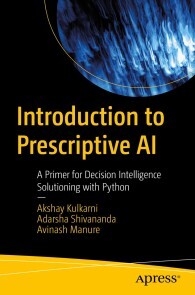
Introduction to Prescriptive AI
Gain a working knowledge of prescriptive AI, its history, and its current and future trends. This book will help you evaluate different AI-driven predictive analytics techniques and help you incorporate decision intelligence into your business workflow through real-world examples.The book kicks off with an introduction to decision intelligence and provides insight into prescriptive AI and how it can be woven into various business strategies and frameworks. You'll then be introduced to different decision intelligence methodologies and how to implement them, along with advantages and limitations of each. Digging deeper, the authors then walk you through how to perform simulations and interpret the results. A full chapter is devoted to embedding decision intelligence processes and outcomes into your business workflow using various applications. The book concludes by exploring different cognitive biases humans are prone to, and how those biases can be eliminated by combining machine and human intelligence.Upon completing this book, you will understand prescriptive AI, tools, and techniques and will be ready to incorporate them into your business workflow.WHAT YOU WILL LEARN* Implement full-fledged decision intelligence applications using Python* Leverage the tools, techniques, and methodologies for prescriptive AI* Understand how prescriptive AI can be used in different domains through practical examples* Interpret results and integrate them into your decision makingWHO THIS BOOK IS FORData Scientists and Machine Learning Engineers, as well as business professionals who want to understand how AI-driven decision intelligence can help grow their business.AKSHAY R. KULKARNI is an artificial intelligence (AI) and machine learning (ML) evangelist and a thought leader. He has consulted several Fortune 500 and global enterprises to drive AI and data science–led strategic transformations. He is a Google developer, an author, and a regular speaker at major AI and data science conferences (including the O’Reilly Strata Data & AI Conference and Great International Developer Summit (GIDS)) . He is a visiting faculty member at some of the top graduate institutes in India. In 2019, he was featured as one of India’s “top 40 under 40” data scientists. In his spare time, Akshay enjoys reading, writing, coding, and helping aspiring data scientists. He lives in Bangalore with his family.ADARSHA SHIVANANDA is a data science and MLOps leader. He is working on creating world-class MLOps capabilities to ensure continuous value delivery from AI. He aims to build a pool of exceptional data scientists within and outside organizations to solve problems through training programs. He always wants to stay ahead of the curve. Adarsha has worked extensively in the pharma, healthcare, CPG, retail, and marketing domains. He lives in Bangalore and loves to read and teach data science.AVINASH MANURE is a seasoned Machine Learning Professional with 10+ years of experience building, deploying, and maintaining state-of-the-art machine learning solutions across different industries. He has 6+ years of experience leading and mentoring high-performance teams in developing ML systems catering to different business requirements. He is proficient in deploying complex machine learning and statistical modeling algorithms/techniques for identifying patterns and extracting valuable insights for key stakeholders and organizational leadership.Chapter 1: Decision Intelligence Overview.- Chapter 2: Decision Intelligence Requirements.- Chapter 3: Decision Intelligence Methodologies.- Chapter 4: Interpreting Results from Different Methodologies.- Chapter 5: Augmenting Decision Intelligence Results into the Business Workflow.- Chapter 6: Actions, Biases and Human-in-the-Loop.- Chapter 7: Case Studies.

Angewandte Data Science
Die Anwendungen der Disziplin Data Science erweitern und wandeln sich stetig. In diesem Buch geben Insider aus Praxis, Wissenschaft und Lehre detailliert die Ergebnisse ihrer Data-Science-Projekte, Methodenwissen sowie Knowhow zu Vorgehensweisen und Prozessmodellen an den Leser weiter. Dabei wird ein weit gespannter Querschnitt an konkreten Anwendungen beschrieben, erklärt und illustriert: von der Nutzung generativer KI-Systeme über quantitative Textanalyse, Predictive Policing, Erklärbarkeit von Machine-Learning-Modellen, experimentelle Datenanalyse in der Spektroskopie bis hin zu Datenvisualisierung, Strukturgleichungsmodellen und Varianzanalyse.Das Buch richtet sich an jeden, der sowohl am konkreten Einsatz von Datenwissenschaft, Statistik, Maschinellem Lernen und Künstlicher Intelligenz als auch am zugehörigen theoretischen Hintergrund interessiert ist. Praktikern, Studierenden und Lehrenden dürfte es von besonderem Nutzen sein: eine Vielzahl an Abbildungen, Diagrammen und Illustrationen ergänzen die reichhaltigen Textinformationen; Links zu Webseiten und Webapplikationen verweisen auf online verfügbare weitere Informationsquellen und Data-Science-Werkzeuge.LOTHAR B. BLUM lehrt als Hochschuldozent interaktives Informationsdesign, Datenvisualisierung und Advanced Analytics. Er ist Principal UX Designer beim Cloudsoftwareunternehmen Infor sowie Co-Founder und Organisator der Data Science Darmstadt Meetups.Einflüsse der Corona-Pandemie auf die deutsche Presse-Sprache.- Predictive Policing.- Am Anfang war der Prompt.- Erklärbarkeit als Schlüssel für den verantwortungsvollen Umgang mit KI. - Strukturgleichungsmodelle versus Varianzanalyse.- Was ist schon normal in diesen Zeiten? - Sankey-Diagramm reloaded.- Jenseits der Algorithmen.- A Scalable Architecture for Smart Genomic Data Analysis in Medical Laboratories.- Die Sieben V der Daten.– Scope Creep, GUI, Skalierung.

Pro Cryptography and Cryptanalysis with C++23
Develop strong skills for writing cryptographic algorithms and security schemes/modules using C++23 and its new features. This book will teach you the right methods for writing advanced cryptographic algorithms, such as elliptic curve cryptography algorithms, lattice-based cryptography, searchable encryption, and homomorphic encryption. You'll also examine internal cryptographic mechanisms and discover common ways in which the algorithms can be implemented and used correctly in practice.The authors explain the mathematical basis of cryptographic algorithms in terms that a programmer can easily understand. They also show how “bad” cryptography can creep in during implementation and what “good” cryptography should look like by comparing advantages and disadvantages based on processing time, execution time, and reliability.WHAT YOU WILL LEARN* Discover what modern cryptographic algorithms and methods are used for * Design and implement advanced cryptographic mechanisms * See how C++23 and its new features are impact the implementation of cryptographic algorithms* Practice the basics of public key cryptography, including ECDSA signatures and more* See how most of the algorithms can be brokenWHO THIS BOOK IS FORProfessional programmers, developers, and software engineers who are developing cryptography algorithms and security schemes/modules in C++. Prior C++ programming and IDE experience and some basic experience of cryptography concepts (symmetric and asymmetric) highly recommended.MARIUS IULIAN MIHAILESCU, PHD is CEO at Dapyx Solution Ltd., a company based in Bucharest, Romania and involved in information security- and cryptography-related research projects. He is a lead guest editor for applied cryptography journals and a reviewer for multiple publications with information security and cryptography profiles. He authored and co-authored more than 30 articles in conference proceedings, 25 articles in journals, and three books. For more than six years he has served as a lecturer at well-known national and international universities (University of Bucharest, “Titu Maiorescu” University, Kadir Has University in, Istanbul, Turkey). He has taught courses on programming languages (C#, Java, C++, Haskell), and object-oriented system analysis and design with UML, graphs, databases, cryptography and information security. He served for three years as IT officer at Royal Caribbean Cruises Ltd. where he dealt with IT infrastructure, data security, and satellite communications systems. He received his PhD in 2014 and his thesis was on applied cryptography over biometrics data. He holds two MSc in information security and software engineering.STEFANIA LOREDANA NITA, PHD is a software developer at the Institute of Computer Science of the Romanian Academy and a PhD with her thesis on advanced cryptographic schemes using searchable encryption and homomorphic encryption. She has served more than two years as an assistant lecturer at the University of Bucharest where she taught courses on subjects such as advanced programming techniques, simulation methods, and operating systems. She has authored and co-authored more than 15 workpapers at conferences and journals, and has authored two books on he Haskell programming language. She is a lead guest editor for special issues on information security and cryptography such as Advanced Cryptography and Its Future: Searchable and Homomorphic Encryption. She holds an MSc in software engineering and two BSc in computer science and mathematics.Part I: Foundations1: Introduction2: Cryptography Fundamentals3: Mathematical Background and Its Applicability4: Large Integer Arithmetic5: Floating Point Arithmetic6: New Features in C++237: Secure Coding Guidelines8: Cryptography Libraries in C/C++23Part II: Pro Cryptography9: Elliptic Curve Cryptography10: Lattice-based Cryptography11: earchable Encryption12: Homomorphic Encryption13: (Ring) Learning with Errors Cryptography14: Chaos-based Cryptography15: Big Data Cryptography16:Cloud Computing CryptographyPart III: Pro Cryptanalysis17: Getting Started with Cryptanalysis18: Cryptanalysis Attacks and Techniques19: Linear and Differential Cryptanalysis20: Integral Cryptanalysis21: Brute Force and Buffer Overflow Attacks22: Text Characterization23: Implementation and Practical Approach of Cryptanalysis Methods