

Computer und IT

How to Catch a Phish
Learn how to detect, analyze, and respond to phishing emails, the top infection vector used by cybercriminals. The repeatable process described in this book has been cultivated and tested in real-life incidents and validated across multiple threat landscapes and environments.Every organization and individual with an email account is susceptible to deceptive emails sent by attackers with nefarious intentions. This activity, known as phishing, involves an attacker attempting to lure individuals into providing sensitive information or performing a predetermined action. Attacks vary in sophistication, but the core skills and process to detect, analyze, and respond to a suspicious message does not change.Attackers have preyed on victims with convincing and not-so-convincing phishing emails to gain initial footholds into networks around the world for over 30 years. This attack method has been rapidly growing in popularity and continues to be the number one method that organizations and individuals struggle to defend against. Regardless of what any vendor or organization will tell you, no infallible tool exists to eliminate this threat completely.This book teaches you how to analyze suspicious messages using free tools and resources. You will understand the basics of email, tactics used by attackers, and a repeatable process to systematically analyze messages and respond to suspicious activity.YOU WILL LEARN HOW TO:* Safely save email messages as attachments for analysis* Identify what information is in an email header* Review header information and extract key indicators or patterns used for detection* Identify signs of a suspicious or malicious email message* Detect the tactics that attackers use in phishing emails* Safely examine email links and attachments* Use a variety of free and simple tools to analyze email messagesWHO THIS BOOK IS FORCybersecurity professionals and interested computer security enthusiasts currently holding or aspiring to obtain positions such as IT Security Analyst, Network Defender, Security Operations Center Analyst, or Help Desk Technician. Readers should have a general understanding of how email works and some ways that attackers use this platform for initial access.Nick Oles is a cybersecurity expert with over 15 years of operational experience in military, industry, and academic environments. He has worked on incident response and threat hunting teams and consulted with Fortune 150 organizations, small businesses, and US Department of Defense entities. Nick has served his country for over a decade in the cyber and special operations communities, earning multiple military accolades, completing worldwide deployments, and serving in joint special operations environments. He has advised award-winning academic centers on cyber-program development and management, as well as created and taught academic and certification courses on a variety of cybersecurity topics. Nick has detected, analyzed, and responded to thousands of security incidents over his career. He continues to actively contribute to the cybersecurity community and teach students at all skill levels while still serving his country.CHAPTER 1. HOW EMAIL WORKS1.1 Understanding Email Architecture1.2 Basic Components of an email message1.2.1 Email Header1.2.2 Email ContentCHAPTER 2. PHISHING TACTICS AND TECHNIQUES2.1 How phishers get you to click2.1.1 Elicitation and enticement2.1.2 Key indicators of suspicious messagesCHAPTER 3. PICERL PROCESS EXPLAINED3.1 Preparation3.2 Identification3.3 Containment3.4 Eradication3.5 Remediation3.6 Lessons LearnedCHAPTER 4. ANALYZING MESSAGE CONTENTCHAPTER 5. EMBEDDED LINK ANALYSIS5.1 Process safely extract and find links5.2 Tools to submit links for analysisCHAPTER 6. ATTACHMENT ANALYSIS6.1 How to handle attachments6.2 Tools used to analyze attachmentsCHAPTER 7. LOG SEARCHING AND RESPONSE7.1 Key logs records to search7.2 Response verbiage and communicationCHAPTER 8. MITIGATION AND LESSONS LEARNED
The Active Defender
IMMERSE YOURSELF IN THE OFFENSIVE SECURITY MINDSET TO BETTER DEFEND AGAINST ATTACKSIn The Active Defender: Immersion in the Offensive Security Mindset, Senior Information Security Forensic Analyst Dr. Catherine J. Ullman delivers an expert treatment of the Active Defender approach to information security. In the book, you’ll learn to understand and embrace the knowledge you can gain from the offensive security community. You’ll become familiar with the hacker mindset, which allows you to gain emergent insight into how attackers operate and better grasp the nature of the risks and threats in your environment. The author immerses you in the hacker mindset and the offensive security culture to better prepare you to defend against threats of all kinds. You’ll also find:* Explanations of what an Active Defender is and how that differs from traditional defense models* Reasons why thinking like a hacker makes you a better defender* Ways to begin your journey as an Active Defender and leverage the hacker mindsetAn insightful and original book representing a new and effective approach to cybersecurity, The Active Defender will be of significant benefit to information security professionals, system administrators, network administrators, and other tech professionals with an interest or stake in their organization’s information security. CATHERINE J. ULLMAN is a security researcher, speaker, and Principal Technology Architect, Security at the University at Buffalo. She is a DFIR specialist and expert in incident management, intrusion detection, investigative services, and personnel case resolution. She offers security awareness training in an academic setting and is a well-known presenter at information security conferences, including DEF CON and Blue Team Con.

Künstliche Intelligenz und Data Science in Theorie und Praxis
Dieser Sammelband verbindet theoretische Grundlagen und praktische Anwendungen von Künstlicher Intelligenz (KI) und Data Science: Anerkannte Experten stellen in ihren Beiträgen den aktuellen Stand in Forschung und Wirtschaft dar – und bieten so einen einzigartigen Überblick über aktuelle Konzepte und ihre Umsetzung in Unternehmen.Im ersten Teil des Buchs werden die Methoden und Algorithmen skizziert, die sich größtenteils aus einer Kombination von Statistik und Informatik ergeben und auf Verfahren des Maschinellen Lernens bis hin zu Deep Learning und KI basieren. Im zweiten Teil wird die konzeptionelle Umsetzung in der Praxis skizziert: Hier wird insbesondere aufgezeigt, welche Herausforderungen in der Praxis auftreten – ob nun bei der Einbettung der Daten-Use-Cases in eine Gesamtstrategie oder bei der Produktivsetzung, Weiterentwicklung und dem Betrieb von Daten-basierten Lösungen. Der dritte Teil zeigt das breite Potpourri von Data Science in der Praxis: Branchengrößenwie Allianz, ADAC, BMW, Deutsche Bahn, Lufthansa, REWE, RTL, St. Galler Stadtwerke, SwissRe und viele weitere zeigen konkret, welche Erfahrungen sie bei ihren Projekten gesammelt haben. Fachartikel von über 20 namhaften Unternehmen decken die spezifischen Anforderungen ihrer jeweiligen Branchen ab.Das Buch möchte die interdisziplinäre Diskussion und Kooperation zwischen Wissenschaft und Wirtschaft fördern und richtet sich daher an verschiedene Lesergruppen:* Studierende und Absolventen, die Orientierung für die eigene Laufbahn suchen.* Forschende und Lehrende, die einen Einblick in praxisrelevante Einsatzgebiete erhalten möchten.* Anwender, Praktiker und Entscheider, die sich über Chancen und Herausforderungen von KI in der Praxis informieren möchten.ANDREAS GILLHUBER ist Co-CEO bei der Alexander Thamm GmbH, einer führenden Beratung für Data Science, KI und ML im deutschsprachigen Raum.GÖRAN KAUERMANN ist Universitätsprofessor an der Ludwigs-Maximilians-Universität München und hat dort den Elite-Studiengang Data Science eingerichtet.WOLFGANG HAUNER ist als Leiter Group Data Analytics der Allianz SE global verantwortlich für Daten- und Analytics-Lösungen für die Allianz Unternehmensgruppe.Vorwort.- Grundlagen von Data Science.- Data Science in der Praxis.- Beispiele aus der Praxis-Ausblick/Wohin geht die Reise.

Machine Learning Techniques for VLSI Chip Design
MACHINE LEARNING TECHNIQUES FOR VLSI CHIP DESIGNTHIS CUTTING-EDGE NEW VOLUME COVERS THE HARDWARE ARCHITECTURE IMPLEMENTATION, THE SOFTWARE IMPLEMENTATION APPROACH, THE EFFICIENT HARDWARE OF MACHINE LEARNING APPLICATIONS WITH FPGA OR CMOS CIRCUITS, AND MANY OTHER ASPECTS AND APPLICATIONS OF MACHINE LEARNING TECHNIQUES FOR VLSI CHIP DESIGN.Artificial intelligence (AI) and machine learning (ML) have, or will have, an impact on almost every aspect of our lives and every device that we own. AI has benefitted every industry in terms of computational speeds, accurate decision prediction, efficient machine learning (ML), and deep learning (DL) algorithms. The VLSI industry uses the electronic design automation tool (EDA), and the integration with ML helps in reducing design time and cost of production. Finding defects, bugs, and hardware Trojans in the design with ML or DL can save losses during production. Constraints to ML-DL arise when having to deal with a large set of training datasets. This book covers the learning algorithm for floor planning, routing, mask fabrication, and implementation of the computational architecture for ML-DL. The future aspect of the ML-DL algorithm is to be available in the format of an integrated circuit (IC). A user can upgrade to the new algorithm by replacing an IC. This new book mainly deals with the adaption of computation blocks like hardware accelerators and novel nano-material for them based upon their application and to create a smart solution. This exciting new volume is an invaluable reference for beginners as well as engineers, scientists, researchers, and other professionals working in the area of VLSI architecture development. ABHISHEK KUMAR, PHD, is an associate professor at and obtained his PhD in the area of VLSI design for low power and secured architecture from Lovely Professional University, India. With over 11 years of academic experience, he has published more than 30 research papers and proceedings in scholarly journals. He has also published nine book chapters and one authored book. He has worked as a reviewer and program committee member and editorial board member for academic and scholarly conferences and journals, and he has 11 patents to his credit. SUMAN LATA TRIPATHI, PHD, is a professor at Lovely Professional University with more than 21 years of experience in academics. She has published more than 103 research papers in refereed journals and conferences. She has organized several workshops, summer internships, and expert lectures for students, and she has worked as a session chair, conference steering committee member, editorial board member, and reviewer for IEEE journals and conferences. She has published three books and currently has multiple volumes scheduled for publication from Wiley-Scrivener. K. SRINIVASA RAO, PHD, is a professor and Head of Microelectronics Research Group, Department of Electronics and Communication Engineering at the Koneru Lakshmaiah Education Foundation, India. He has earned multiple awards for his scholarship and has published more than 150 papers in scientific journals and presented more than 55 papers at scientific conferences around the world.

Predicting the Unknown
As a society, we’re in a constant struggle to control uncertainty and predict the unknown. Quite often, we think of scientific fields and theories as being separate from each other. But a more careful investigation can uncover the common thread that ties many of those together. From ChatGPT, to Amazon’s Alexa, to Apple’s Siri, data science, and computer science have become part of our lives. In the meantime, the demand for data scientists has grown, as the field has been increasingly called the “sexiest profession.”This book attempts to specifically cover this gap in literature between data science, machine learning and artificial intelligence (AI). How was uncertainty approached historically, and how has it evolved since? What schools of thought exist in philosophy, mathematics, and engineering, and what role did they play in the development of data science? It uses the history of data science as a stepping stone to explain what the future might hold.Predicting the Unknown provides the framework that will help you understand where AI is headed, and how to best prepare for the world that’s coming in the next few years, both as a society and within a business. It is not technical and avoids equations or technical explanations, yet is written for the intellectually curious reader, and the technical expert interested in the historical details that can help contextualize how we got here.WHAT YOU’LL LEARN* Explore the bigger picture of data science and see how to best anticipate future changes in that field* Understand machine learning, AI, and data science* Examine data science and AI through engaging historical and human-centric narratives WHO IS THIS BOOK FORBusiness leaders and technology enthusiasts who are trying to understand how to think about data science and AIDr. Stylianos (Stelios) Kampakis is a data scientist, data science educator and blockchain expert with more than 10 years of experience. He has worked with decision makers from companies of all sizes: from startups to organizations like the US Navy, Vodafone ad British Land. His work expands multiple sectors including fintech (fraud detection and valuation models), sports analytics, health-tech, general AI, medical statistics, predictive maintenance and others. He has worked with many different types of technologies, from statistical models, to deep learning to blockchain and he has two patents pending to his name. He has also helped many people follow a career in data science and technology.He is a member of the Royal Statistical Society, honorary research fellow at the UCL Centre for Blockchain Technologies, a data science advisor for London Business School, and CEO of The Tesseract Academy and tokenomics auditor at Hacken. As a well-known data-science educator, he has published two books, both of them getting 5 stars on Amazon. His personal website gets more than 10k visitors per month, and he is also a data science influencer on LinkedIn.PREFACEAuthor’s note to the curious readerPROLOGUECHAPTER ONE – WHERE ARE WE NOW? A BRIEF HISTORY OF UNCERTAINTYNot all uncertainty is created equalCHAPTER TWO - TRUTH, LOGIC AND THE PROBLEM OF INDUCTIONThe first black swanCHAPTER THREE - SWANS AND SPACE INVADERSOccam’s razor, space invaders and lizard peopleCHAPTER FOUR - PROBABILITY: TO BAYES, OR NOT TO BAYES?Frequentist or Bayesian?The formulation of Bayes’ theoremAfter LaplaceCHAPTER FIVE - WHAT’S MATHS GOT TO DO WITH IT? THE POWER OF PROBABILITY DISTRIBUTIONSOther Distribution ModelsIssues with this view of uncertaintyBounds and limitsCHAPTER SIX - ALTERNATIVE IDEAS: FUZZY LOGIC AND INFORMATION THEORYInformation Theory – Measuring UncertaintyCHAPTER SEVEN – STATISTICS: THE OLDEST KID ON THE BLOCKDescriptive vs Inferential StatisticsHypothesis Testing: Significant or Not?What the p?Statistical modelling: A useful abstractionCHAPTER EIGHT - MACHINE LEARNING: INSIDE THE BLACK BOXData Science and History of Machine LearningChoose Your Learning Type: Supervised, Unsupervised, Reinforcement, or Other?The Bias-Variance Trade-OffMachine Learning vs Statistics: Why the ‘Dumb’ Approach WorksMachine Learning ShortcomingsCHAPTER NINE - CAUSALITY: UNDERSTANDING THE ‘WHY’How to Approach Causality?Causality in our MindCHAPTER TEN - FORECASTING, AND PREDICTING THE FUTURE: THE FOX AND THE TRUMPA brief history of forecastingForecasting in practice: Newton and the madness of men, Trump, Brexit, and losing money through mathematical modellingHow to do forecasting: A story of foxes and hedgehogsCHAPTER ELEVEN - THE LIMITS OF PREDICTION (PART A): A FUTILE PURSUIT?Learning theory: what can we know about what we don’t know?Monte Carlo Simulations: What Does a Casino Have to do with Science?CHAPTER TWELVE - THE LIMITS OF PREDICTION (PART B): GAME THEORY, AGENT-BASED MODELLING AND COMPLEXITY (ACTIONS AND REACTIONS)Agent-based Modelling: Crafting artificial WorldsComplexity Theory: Simulation vs the Limits of PredictionStudying Complexity is a Complex EndeavourLearning from Complexity: The Limits of Computation are the Limits of UncertaintyCHAPTER THIRTEEN - UNCERTAINTY IN US: HOW THE HUMAN MIND HANDLES UNCERTAINTYUncertainty and our MindUncertainty and our BrainCHAPTER FOURTEEN - BLOCKCHAIN: UNCERTAINTY IN TRANSACTIONSThe Internet of TrustHow Blockchain WorksFrom Crypto-Anarchism to Drug Trafficking: The unconventional Beginnings of an interesting TechnologyI Can’t Trust you, but I Can Trust the BlockchainCHAPTER FIFTEEN - ECONOMIES OF PREDICTION: A NEW INDUSTRIAL REVOLUTIONUncertainty brokersIndustries of incomplete InformationPrediction Industries and AutomationThe global Economy against UncertaintyEPILOGUE: THE CERTAINTY OF UNCERTAINTY

Understand, Manage, and Measure Cyber Risk
When it comes to managing cybersecurity in an organization, most organizations tussle with basic foundational components. This practitioner’s guide lays down those foundational components, with real client examples and pitfalls to avoid.A plethora of cybersecurity management resources are available—many with sound advice, management approaches, and technical solutions—but few with one common theme that pulls together management and technology, with a focus on executive oversight. Author Ryan Leirvik helps solve these common problems by providing a clear, easy-to-understand, and easy-to-deploy "playbook" for a cyber risk management approach applicable to your entire organization.This second edition provides tools and methods in a straight-forward, practical manner to guide the management of a cybersecurity program. Expanded sections include the critical integration of cyber risk management into enterprise risk management, the important connection between a Software Bill of Materials and Third-party Risk Programs, and additional "how to" tools and material for mapping frameworks to controls.PRAISE FOR UNDERSTAND, MANAGE, AND MEASURE CYBER RISKWhat lies ahead of you in the pages of this book? Clean practicality, not something that just looks good on paper—brittle and impractical when exposed to the real world. I prize flexibility and simplicity instead of attempting to have answers for everything and the rigidity that results. This simplicity is what I find valuable within Ryan's book. TIM COLLYER, MOTOROLA SOLUTIONSIt seems that I have found a kindred spirit—a builder who has worked with a wide variety of client CISOs on their programs, gaining a deep understanding of how a successful and sustainable program should be constructed. Ryan's cyber work in the US Department of Defense, his McKinsey & Company consulting, and his advisory and survey work with IANS give him a unique global view of our shared passion. NICHOLAS J. MANKOVICH, PHD, MS, CISPPWHO THIS BOOK IS FORCISOs, CROs, CIOs, directors of risk management, and anyone struggling to pull together frameworks or basic metrics to quantify uncertainty and address riskRYAN LEIRVIK is a cybersecurity professional who has spent the better part of two decades enhancing information security programs at the world's largest institutions. With considerable US government and commercial sector experience, Ryan has employed his professional passion for cybersecurity at almost every level within an organization.A frequent speaker on the topic of information security, Ryan fields several questions on “How do I make sure I have a sustainable cyber program?” This book was written to help answer that question.Ryan has been the CEO of a cybersecurity research and development company, Chief of Staff and Associate Director of Cyber for the US Department of Defense, and a cybersecurity strategy consultant with McKinsey & Company. Ryan’s technology career started at IBM, and he has a master of IT degree from Virginia Tech, an MBA from Case Western Reserve University, as well as a bachelor of science from Purdue University. Ryan is also on the faculty at IANS.INTRODUCTIONPART 1: THE PROBLEMCHAPTER 1: THE SITUATIONCHAPTER 2: THE COMPLICATIONInformation Technology or “IT” became pervasive near 1995, and after a quarter-century of IT in organizations, managers, engineers, and board-level oversight still speak different languages. The language divide creates a disconnect in the strategy-to-management-to-tactical thread that is critical for overall organizational risk management, not to mention overall business management. This complicates the ability for these functions to align on one language for managing cyber risk.CHAPTER 3: THE RESOLUTIONOne unified approach to cybersecurity:· Be clear on identifying the risk· Understand the risk· Categorize the critical data at risk· Determine the causes, consequences, and accountability of a data breach· Identify the business impact of a breach· Simplify how you manage the risk· Apply a framework· Structure the organization (i.e., staff and management)· Prepare to respond (... and recover)· Build feedback mechanisms to measure the risk· Choose risk-informative metrics, Key Performance Indicators (KPI’s), and Key Risk Indicators (KPI’s· Apply appropriate resources (e.g., measuring projects, overseeing initiatives)PART 2: THE SOLUTIONCHAPTER 4: UNDERSTAND THE PROBLEMKnowing what “problem” you are solving is the most critical part of problem solving. It is important to spend time exploring the main issue. This typically means asking others what they see as the problem, gathering facts and opinions (and knowing the difference between them), and then establishing a recommended problem to solve that categorically encompasses all the facts you have gathered. For example, the audit team will likely talk about the problem of fines and resources to remain in compliance. The contracts team will likely talk about the risks brought about by outside companies (aka Third Parties), and the tech teams will likely talk about the immediate risks to the network, applications, or endpoints. Each team is looking at their part of the enterprise risk, but are they all looking to one specific problem that aligns them all? Typically not. So, the solution becomes the one problem everyone is solving for and helps them focus on that. In this case, that might be: critical data and systems at risk. Communicating as one problem everyone is solving for has the benefit of pulling everyone together, instead of trying to manage everyone from within their view of the problem -- risk to critical data or systems. The solution here is to get them all focused on one problem so that managing the problem is much easier -- with everyone understanding that the problem is (i.e., keeping critical data and systems secure), the management of that becomes an easier tactical activity.CHAPTER 5: MANAGE THE PROBLEM· Guidelines up front: Settle on one approach (i.e., Framework) that best fits the business· Complication is that no one framework fits any one organization’s risk profile perfectly· Key is to pick a framework as a starting point and modify it to the organization (and as cyber risk management matures)· Key to resolving this is to assign roles (e.g., an adversary, a manager, a third party); remember, there is a person at the center of the problem you are trying to manageCHAPTER 6: MEASURE THE PROBLEM· Guidelines up front: Board-level metrics are strategic, supported by tactical measures.· Objective is to communicate three things: (1) Understand what is at risk; (2) Manage that risk; and (3) Measure your management through feedback metrics· Educate the Board on what you are doing to reduce the risk· Communicate the value of your programs: provide insightful measures· Mature measures: measure what you can measure now, with a focus on what you want to measureCHAPTER 7: CONCLUSION* BE CLEAR ON IDENTIFYING THE RISK· Understand the risk· Categorize the critical data at risk· Determine the causes, consequences, and accountability of a data breach· Identify the business impact of a breach* SIMPLIFY HOW YOU MANAGE THE RISK · Apply a framework· Structure the organization (i.e., staff and management)· Prepare to respond (... and recover)* BUILD FEEDBACK MECHANISMS TO MEASURE THE RISK· Choose risk-informative metrics, Key Performance Indicators (KPI’s), and Key Risk Indicators (KPI’s· Apply appropriate resources (e.g., measuring projects, overseeing initiatives)APPENDIX: COMMON QUESTIONS (TBD)APPENDIX: ILLUSTRATIONS (TBD)

Beginning Microsoft Dataverse
Understand the role that Dataverse plays in the low-code revolution that helps businesses gain advantage from being more agile with technology. This book shows you how to use Dataverse to solve business problems by describing the layers of a solution in the Power Platform and the options that exist at each layer so you can make informed decisions as you develop your solutions. The book shows how Dataverse is a central piece of the Microsoft Power Platform and helps tech-savvy professionals move nimbly and seize the day when opportunities present themselves.The book starts out by covering the platform in terms of its layers so you can orient yourself with the features that exist at each level and what that means to you as a developer. You will learn how to work inside the data layer to design tables to store data and relationships and manage how it all works together. You will learn how to apply business logic and validation in the business layer to ensure data integrity and enforce process compliance. You will learn how to design interfaces in the presentation layer to allow users to interact with your data and processes in user-friendly applications. And you will learn how to utilize third-party integration tools to create seamless connections between your solution and legacy systems so you can develop enterprise-grade tools in record time.WHAT YOU WILL LEARN* Understand the layers of Dataverse and the features at each layer* Create tables and relationships to store data and manage interactions* Build applications to allow users to interact with your data using logical interfaces* Design business logic and workflows to ensure data integrity and automation* Configure security to control access to data and prevent unauthorized access* Explore the options for integration with third-party systems WHO THIS BOOK IS FORMicrosoft Power Platform users who want to learn how to access the power of the Power Platform and leverage Dataverse to build powerful, robust, and resilient tools; power users and citizen developers who are looking for tools to quickly build scalable business solutions that don’t require a strong developer background; pro developers who want to learn how to utilize use the Power Platform to speed up the development cycle and deliver value to customers faster than ever beforeBRIAN HODEL is a Microsoft Power Platform developer who is passionate about solving problems. His background in Lean Six Sigma and interest in application development converged as he began using what would eventually come to be known as the Power Platform. Since then, he has been developing enterprise solutions based on Dataverse in the Power Platform, speaking at conferences, participating on Customer Advisory Boards with Microsoft product development teams, and leading the internal Power Champions group at his current company. 1. Microsoft Power Platform2. Planning Your Solution Design3. Data Layer4. Business Logic Layer5. Presentation Layer6. Security7. Integration with Third-Party Tools8. Dataverse for Teams

Software im Automobil
Dieses Fach- und Lehrbuch enthält die maschinengenerierten Zusammenfassungen einer Datenbankrecherche zum Thema „Software im Automobil“. Die Vorgabe der Stichworte, die Struktur und die Selektion der Inhalte wurde vom Autor vorgenommen. Darüber hinaus hat der Autor die enthaltenen Artikel durch Einleitungen und Bewertungen in einen übergreifenden Zusammenhang gebracht und kommentiert. Auf diese Weise ist ein Werk entstanden, das Studierenden sowie Berufseinsteigern einen breiten Überblick über das fachliche Feld sowie Hinweise zur weiterführenden Literatur gibt und auf die weitere Arbeit in diesem Bereich vorbereitet. Fahrzeugarchitektur und Infrastruktur.- Software-basierte Funktionen.- Strukturierte Softwareentwicklung.- Software-Tests.- Reifegrad der Softwareentwicklung.

Functional Programming in R 4
Master functions and discover how to write functional programs in R. In this book, updated for R 4, you'll learn to make your functions pure by avoiding side effects, write functions that manipulate other functions, and construct complex functions using simpler functions as building blocks.In Functional Programming in R 4, you’ll see how to replace loops, which can have side-effects, with recursive functions that can more easily avoid them. In addition, the book covers why you shouldn't use recursion when loops are more efficient and how you can get the best of both worlds.Functional programming is a style of programming, like object-oriented programming, but one that focuses on data transformations and calculations rather than objects and state. Where in object-oriented programming you model your programs by describing which states an object can be in and how methods will reveal or modify that state, in functional programming you model programs by describing how functions translate input data to output data. Functions themselves are considered to be data you can manipulate and much of the strength of functional programming comes from manipulating functions; that is, building more complex functions by combining simpler functions.WHAT YOU'LL LEARN* Write functions in R 4, including infix operators and replacement functions* Create higher order functions* Pass functions to other functions and start using functions as data you can manipulate* Use Filer, Map and Reduce functions to express the intent behind code clearly and safely* Build new functions from existing functions without necessarily writing any new functions, using point-free programming* Create functions that carry data along with themWHO THIS BOOK IS FORThose with at least some experience with programming in R.THOMAS MAILUND is Senior Software Architect at Kvantify, a quantum computing company from Denmark. He has a background in math and computer science. He now works on developing algorithms for computational problems applicable for quantum computing. He previously worked at the Bioinformatics Research Centre, Aarhus University, on genetics and evolutionary studies, particularly comparative genomics, speciation, and gene flow between emerging species. He has published Beginning Data Science in R with Apress, as well as other books out there.1. Functions in R2. Pure Functional Programming3. Scope and Closures4. Higher-order Functions5. Filer, Map, and Reduce6. Point-free Programming Afterword

C von A bis Z (5. Auflg.)
Das umfassende Handbuch. Hochdosiertes C-Wissen in 5. Auflage.Der beliebte Klassiker unter den Programmierbüchern neu aufgelegt! Aktuell zum Standard C23, von einem Autorenteam aus Praxis und Lehre. Lassen Sie sich umfassend einführen oder nutzen Sie das Buch als Nachschlagewerk. Von den Grundlagen über die dynamische Speicherverwaltung bis zur plattformübergreifenden Entwicklung. Randvoll mit hilfreichen Übungen, Beispielen und Praxistipps – C-Wissen pur!C von A bis ZLernen Sie C:C vereint die Eigenschaften Maschinennähe und Portabilität. Seit Jahren ist sie damit eine Programmiersprache erster Wahl. Hier erhalten Sie einen ausführlichen Einstieg.Einsteigen, programmieren, nachschlagen:Zu jedem C-Thema finden Sie ausführliche Erklärungen. Sowohl Einsteiger als auch Profis kommen voll auf ihre Kosten.Datentypen, Operatoren, Funktionen... :... Arrays, Pointer, dynamische Speicherverwaltung und Zeitroutinen bleiben kein Geheimnis. Praktische Beispiele veranschaulichen das Gelernte.Vollständiges C-Wissen:Threadprogrammierung, Sicherheit, Netzwerkprogrammierung und Datenbanken – auch anspruchsvolle Themen lässt dieses Buch nicht aus.Aus dem InhaltDatenstrukturenAlgorithmenSicherheitDynamische SpeicherverwaltungNetzwerkprogrammierungCross-Plattform-EntwicklungParallele ProgrammierungAuf Datenbanken zugreifenÜber den Autor:Jürgen Wolf ist Programmierer, Digitalfotograf und Autor aus Leidenschaft. C/C++, Linux und die Bildbearbeitung mit Photoshop Elements und GIMP sind seine Themen.René Krooß ist Diplom-Informatiker, begeisterter Programmierer und Experte für Prozessorstrukturen, Betriebssysteme, Hardware-Programmierung und Algorithmen.Leseprobe (PDF-Link)

Getting Started with SQL and Databases
Learn the basics of writing SQL scripts. Using Standard SQL as the starting point, this book teaches writing SQL in various popular dialects, including PostgreSQL, MySQL/MariaDB, Microsoft SQL Server, Oracle, and SQLite.The book starts with a general introduction to writing SQL and covers the basic concepts. Author Mark Simon then covers database principles, and how database tables are designed. He teaches you how to filter data using the WHERE clause, and you will work with NULL, numbers, dates, and strings. You will also understand sorting results using the ORDER BY clause, sorting by calculated columns, and limiting the number of results. By the end of the book, you will know how to insert and update data, and summarize data with aggregate functions and groups. Three appendices cover differences between SQL dialects, working with tables, and a crash course in PDO.WHAT YOU WILL LEARN* Filter, sort, and calculate data* Summarize data with aggregate functions* Modify data with insert, update, and delete statements* Study design principles in developing a databaseWHO THIS BOOK IS FORDevelopers and analysts working with SQL, as well as web developers who want a stronger understanding of working with databasesMARK SIMON has been involved in training and education since the beginning of his career. He started as a teacher of mathematics but soon moved into IT consultancy and training because computers are much easier to work with than high school students! He has worked with and trained in several programming and coding languages, and currently focuses on web development and database languages. When not involved in work, you will generally find Mark listening to or playing music, reading, or just wandering about.The appendix will include:* Notes on using SQL with PHP* “Cultural Notes” - a description of some of the sample data* Major Differences between DBMSs* Setting up the Sample Database

Hands-on Guide to Apache Spark 3
This book explains how to scale Apache Spark 3 to handle massive amounts of data, either via batch or streaming processing. It covers how to use Spark’s structured APIs to perform complex data transformations and analyses you can use to implement end-to-end analytics workflows.This book covers Spark 3's new features, theoretical foundations, and application architecture. The first section introduces the Apache Spark ecosystem as a unified engine for large scale data analytics, and shows you how to run and fine-tune your first application in Spark. The second section centers on batch processing suited to end-of-cycle processing, and data ingestion through files and databases. It explains Spark DataFrame API as well as structured and unstructured data with Apache Spark. The last section deals with scalable, high-throughput, fault-tolerant streaming processing workloads to process real-time data. Here you'll learn about Apache Spark Streaming’s execution model, the architecture of Spark Streaming, monitoring, reporting, and recovering Spark streaming. A full chapter is devoted to future directions for Spark Streaming. With real-world use cases, code snippets, and notebooks hosted on GitHub, this book will give you an understanding of large-scale data analysis concepts--and help you put them to use.Upon completing this book, you will have the knowledge and skills to seamlessly implement large-scale batch and streaming workloads to analyze real-time data streams with Apache Spark.WHAT YOU WILL LEARN* Master the concepts of Spark clusters and batch data processing* Understand data ingestion, transformation, and data storage* Gain insight into essential stream processing concepts and different streaming architectures* Implement streaming jobs and applications with Spark StreamingWHO THIS BOOK IS FORData engineers, data analysts, machine learning engineers, Python and R programmersALFONSO ANTOLÍNEZ GARCÍA is a senior IT manager with a long professional career serving in several multinational companies such as Bertelsmann SE, Lafarge, and TUI AG. He has been working in the media industry, the building materials industry, and the leisure industry. Alfonso also works as a university professor, teaching artificial intelligence, machine learning, and data science. In his spare time, he writes research papers on artificial intelligence, mathematics, physics, and the applications of information theory to other sciences. Part I. Apache Spark Batch Data ProcessingChapter 1: Introduction to Apache Spark for Large-Scale Data Analytics1.1. What is Apache Spark?1.2. Spark Unified Analytics1.3. Batch vs Streaming Data1.4. Spark EcosystemChapter 2: Getting Started with Apache Spark2.2. Scala and PySpark Interfaces2.3. Spark Application Concepts2.4. Transformations and Actions in Apache Spark2.5. Lazy Evaluation in Apache Spark2.6. First Application in Spark2.7. Apache Spark Web UIChapter 3: Spark Dataframe APIChapter 4: Spark Dataset APIChapter 5: Structured and Unstructured Data with Apache Spark5.1. Data Sources5.2. Generic Load/Save Functions5.3. Generic File Source Options5.4. Parquet Files5.5. ORC Files5.6. JSON Files5.7. CSV Files5.8. Text Files5.9. Hive Tables5.10. JDBC To Other DatabasesChapter 6: Spark Machine Learning with MLlibPart II. Spark Data StreamingChapter 7: Introduction to Apache Spark Streaming7.1. Apache Spark Streaming’s Execution Model7.2. Stream Processing Architectures7.3. Architecture of Spark Streaming: Discretized Streams7.4. Benefits of Discretized Stream Processing7.4.1. Dynamic Load Balancing7.4.2. Fast Failure and Straggler RecoveryChapter 8: Structured Streaming8.1. Streaming Analytics8.2. Connecting to a Stream8.3. Preparing the Data in a Stream8.4. Operations on a Streaming DatasetChapter 9: Structured Streaming Sources9.1. File Sources9.2. Apache Kafka Source9.3. A Rate SourceChapter 10: Structured Streaming Sinks10.1. Output Modes10.2. Output Sinks10.3. File Sink10.4. The Kafka Sink10.5. The Memory Sink10.6. Streaming Table APIs10.7. Triggers10.8. Managing Streaming Queries10.9. Monitoring Streaming Queries10.9.1. Reading Metrics Interactively10.9.2. Reporting Metrics programmatically using Asynchronous APIs10.9.3. Reporting Metrics using Dropwizard10.9.4. Recovering from Failures with Checkpointing10.9.5. Recovery Semantics after Changes in a Streaming QueryChapter 11: Future Directions for Spark Streaming11.1. Backpressure11.2. Dynamic Scaling11.3. Event time and out-of-order data11.4. UI enhancements11.5. Continuous ProcessingChapter 12: Watermarks. A deep survey of temporal progress metrics

Generative AI
This book will show how generative technology works and the drivers. It will also look at the applications – showing what various startupsand large companies are doing in the space. There will also be a look at the challenges and risk factors.During the past decade, companies have spent billions on AI. But the focus has been on applying the technology to predictions – which is known as analytical AI. It can mean that you receive TikTok videos that you cannot resist. Or analytical AI can fend against spam or fraud or forecast when a package will be delivered. While such things are beneficial, there is much more to AI. The next megatrend will be leveraging the technology to be creative. For example, you could take a book and an AI model will turn it into a movie – at very little cost. This is all part of generative AI. It’s still in the nascent stages but it is progressing quickly. Generative AI can already create engaging blog posts, social media messages, beautiful artwork and compelling videos.The potential for this technology is enormous. It will be useful for many categories like sales, marketing, legal, product design, code generation, and even pharmaceutical creation.WHAT YOU WILL LEARNThe importance of understanding generative AIThe fundamentals of the technology, like the foundation and diffusion modelsHow generative AI apps workHow generative AI will impact various categories like the law, marketing/sales, gaming, product development, and code generation.The risks, downsides and challenges.WHO THIS BOOK IS FORProfessionals that do not have a technical background. Rather, the audience will be mostly those in Corporate America (such as managers) as well as people in tech startups, who will need an understanding of generative AI to evaluate the solutions.Tom Taulli is the founder of AICruncher.com, which is a developer of generative AI and ChatGPT tools for business. He is also the author of various books, including Artificial Intelligence Basics: A Non-Technical Introduction and The Robotic Process Automation Handbook: A Guide to Implementing RPA Systems. Tom has a science fiction novel about AI – called Automated -- that will come out later in 2023.Chapter 1: Introduction to Generative AI.- Chapter 2: Data.- Chapter 3: AI Fundamentals.- Chapter 4: Core Generative AI Technology.- Chapter 5: Large Language Models.- Chapter 6: Auto Code Generation.- Chapter 7: The Transformation of Business.- Chapter 8: The Impact on Major Businesses.- Chapter 9: The Future.

Designing Applications for Google Cloud Platform
Learn how to use Google Cloud Platform (GCP) and its services to design, build, and deploy applications. This book includes best practices, practical examples, and code snippets written in Java, making it a key resource for developers seeking hands-on experience with GCP.You'll begin with an introduction to GCP services and a review of what Java offers while developing applications for GCP. Next, you'll be walked through how to set up Google App Engine, Google Storage Cloud, and Google Cloud SQL with use cases, as well as application development and deployment. As the book progresses, you'll be exposed to advanced GCP services, deploying and scaling applications on GCP services, and troubleshooting and optimization of Java applications on GCP. The book uses real-world examples to help you understand how GCP services can solve everyday problems.After completing this book, you will understand Google Cloud Platform and its services, and will have the knowledge needed to design, build, and deploy your own applications on GCP using Java.WHAT YOU'LL LEARN* Create a GCP project, configure authentication and authorization, and deploy a sample application.* Use GCP services to solve common problems and apply them to real-world scenarios* Implement GCP services such as Datastore, SQL, and Spanner* Leverage GCP tools such as the SDK and Cloud ShellWHO THIS BOOK IS FORSoftware developers, Cloud architects, and managers looking to design and build applications for Google Cloud Platform. This book is for those with software development experience who are familiar with Java programming. It is also suitable for those new to GCP who have a basic understanding of cloud computing concepts.ASHUTOSH SHASHI is a TOGAF 9 certified enterprise architect, a seasoned software engineer, and a cloud architect with over 18 years of experience in the industry. He has worked on multiple projects using various technologies and platforms, from small startups to large enterprise systems. He has helped many organizations design and build robust and scalable applications on GCP. Apart from GCP, he has extensive experience and expertise in AWS and Azure cloud platforms. Ashutosh lives in Duluth, Georgia, US. In his free time, he enjoys hiking and spending time with his family. He also loves to travel and explore different cultures.Chapter 1: Introduction to Google Cloud Platform.- Chapter 2: Setting up the Development Environment.- Chapter 3: Google App Engine.- Chapter 4: Data Storage in Google Cloud.- 5: Google Cloud SQL.- Chapter 6: Advanced GCP Services.- Chapter 7: Deployment and Scaling.- Chapter 8: Troubleshooting and Optimization.- Chapter 9: Conclusion.

Ökonometrie und maschinelles Lernen
Für empirische Wirtschaftswissenschaftler gehören ökonometrische Methoden zum Standardwerkzeug. Die neuen Instrumente des maschinellen Lernens setzen sich langsam auch in der Volks- und Betriebswirtschaftslehre durch. Das Buch vermittelt Basiswissen zu den spezifischen Methoden des überwachten und unüberwachten Lernens sowie des Verstärkungslernens. Dabei werden die wesentlichen Unterschiede in Bezug auf Ziele, Methoden und Rahmenbedingungen zwischen den Methoden der Ökonometrie und des maschinellen Lernens dargestellt und erörtert. Einleitung.- Grundlagen des maschinellen Lernens.- Phasenschema.- Anwendungsbereiche.- Fazit.
Data Wrangling
DATA WRANGLINGWRITTEN AND EDITED BY SOME OF THE WORLD’S TOP EXPERTS IN THE FIELD, THIS EXCITING NEW VOLUME PROVIDES STATE-OF-THE-ART RESEARCH AND LATEST TECHNOLOGICAL BREAKTHROUGHS IN DATA WRANGLING, ITS THEORETICAL CONCEPTS, PRACTICAL APPLICATIONS, AND TOOLS FOR SOLVING EVERYDAY PROBLEMS.Data wrangling is the process of cleaning and unifying messy and complex data sets for easy access and analysis. This process typically includes manually converting and mapping data from one raw form into another format to allow for more convenient consumption and organization of the data. Data wrangling is increasingly ubiquitous at today’s top firms. Data cleaning focuses on removing inaccurate data from your data set whereas data wrangling focuses on transforming the data’s format, typically by converting “raw” data into another format more suitable for use. Data wrangling is a necessary component of any business. Data wrangling solutions are specifically designed and architected to handle diverse, complex data at any scale, including many applications, such as Datameer, Infogix, Paxata, Talend, Tamr, TMMData, and Trifacta. This book synthesizes the processes of data wrangling into a comprehensive overview, with a strong focus on recent and rapidly evolving agile analytic processes in data-driven enterprises, for businesses and other enterprises to use to find solutions for their everyday problems and practical applications. Whether for the veteran engineer, scientist, or other industry professional, this book is a must have for any library. M. NIRANJANAMURTHY, PhD, is an assistant professor in the Department of Computer Applications, M S Ramaiah Institute of Technology, Bangalore, Karnataka. He earned his PhD in computer science at JJTU, Rajasthan, India. He has over 11 years of teaching experience and two years of industry experience as a software engineer. He has published several books, and he is working on numerous books for Scrivener Publishing. He has published over 60 papers for scholarly journals and conferences, and he is working as a reviewer in 22 scientific journals. He also has numerous awards to his credit. Kavita Sheoran, PhD, is an associate professor in the Computer Science Department, MSIT, Delhi, and she earned her PhD in computer science from Gautam Buddha University, Greater Noida. With over 17 years of teaching experience, she has published various papers in reputed journals and has published two books. GEETIKA DHAND, PhD, is an associate professor in the Department of Computer Science and Engineering at Maharaja Surajmal Institute of Technology. After earning her PhD in computer science from Manav Rachna International Institute of Research and Studies, Faridabad, she has taught for over 17 years. She has published one book and a number of papers in technical journals. PRABHJOT KAUR has over 19 years of teaching experience and has earned two PhDs for her work in two different research areas. She has authored two books and more than 40 research papers in reputed journals and conferences. She also has one patent to her credit.

Kryptografie in der Praxis
Eine Einführung in die bewährten Tools, Frameworks und Protokolle. Moderne Kryptografie kompetent vermittelt.Die Kryptografie ist die wesentliche Grundlage der IT-Sicherheit. Um den Angreifern auf Ihre Systeme einen Schritt voraus zu sein, müssen Sie die Tools, Frameworks und Protokolle verstehen, die Ihre Netzwerke und Anwendungen schützen.Dieses Buch führt in einfacher Sprache und mit anschaulichen Illustrationen in Authentifizierung, Verschlüsselung, Signaturen, Geheimhaltung und andere Kryptografiekonzepte ein. Es enthüllt die kryptografischen Techniken, die die Sicherheit von Web-APIs, die Registrierung und Anmeldung von Benutzern und sogar die Blockchain bestimmen. Sie erfahren, wie diese Techniken moderne Sicherheit ermöglichen und wie Sie sie in Ihren eigenen Projekten anwenden können. Neben den modernen Methoden nimmt das Buch auch die Zukunft der Kryptografie vorweg und geht auf neue und innovative Entwicklungen wie Kryptowährungen und Post-Quantum-Kryptografie ein. Alle Techniken sind vollständig mit Diagrammen und Beispielen illustriert, sodass Sie leicht erkennen können, wie sie in die Praxis umgesetzt werden können.»Mit der richtigen Balance aus Theorie und Praxis vermittelt der Autor genau das, was Softwareschaffende über Kryptografie wissen müssen. Viele kleine Übungen helfen ihnen, von der durchaus anspruchsvollen Lektüre zu profitieren.« - Maik Schmidt, c't 17/23Über den Autor:David Wong ist leitender Kryptografie-Ingenieur bei O(1) Labs und arbeitet an der Kryptowährung Mina. Davor war er Sicherheitsverantwortlicher für die Kryptowährung Diem (vormals bekannt als Libra) bei Novi, Facebook, und davor Sicherheitsberater bei der NCC Group im Bereich Kryptografiedienste.Im Laufe seiner Karriere hat David Wong an mehreren öffentlich finanzierten Open-Source-Audits teilgenommen, beispielsweise an OpenSSL und Let’s Encrypt. Er war Sprecher auf verschiedenen Konferenzen, einschließlich Black Hat und DEF CON, und hat in einem regelmäßig stattfindenden Kryptografiekurs bei Black Hat unterrichtet. Hervorzuheben sind seine Beiträge zu Standards wie TLS 1.3 und zum Noise Protocol Framework. Er hat Schwachstellen in vielen Systemen gefunden, einschließlich CVE-2016-3959 in der Golang-Standardbibliothek, CVE-2018-12404, CVE-2018-19608, CVE-2018-16868, CVE-2018-16869 und CVE-2018-16870 in verschiedenen TLS-Bibliotheken.Unter anderem ist er Autor des Disco-Protokolls (www.discocrypto.com und www.embeddeddisco.com) und des Decentralized Application Security Project für Smart Contracts (www.dasp.co). Zu seinen Forschungen gehören Cache-Angriffe auf RSA (http://cat.eyalro.net), ein auf QUIC basierendes Protokoll (https://eprint.iacr.org/2019/028), Timing-Angriffe auf ECDSA (https://eprint.iacr.org/2015/839) oder Hintertüren in Diffie-Hellman (https://eprint.iacr.org/2016/644). Aktuell finden Sie ihn in seinem Blog unter www.cryptologie.net.

Quantitative User Experience Research
This book is your definitive guide to the rapidly growing role of Quantitative User Experience (Quant UX) Research in product development. The book provides an overview of the skills you need on the job, presents hands-on projects with reusable code, and shares advice on starting and developing a career. The book goes beyond basic skills to focus on what is unique to Quant UX. The authors are two of the most widely recognized practitioners in Quant UX research, and this book shares insights from their combined decades of experience.Organizations today have more data about user needs and behaviors than ever before. With this large-scale data, Quant UX researchers work to understand usage patterns, measure the impact of design changes, and inform strategic decisions. In the Quant UX role, interdisciplinary researchers apply analytical skills to uncover user needs, inform engineering and design, answer strategic business questions, and optimize software and hardware products for human interaction. This book provides guidance around customer satisfaction surveys, understanding user behavior from log analysis, and the statistical methods that are commonly used to assess user outcomes.WHAT YOU WILL LEARN* Discover the role of Quantitative User Experience (Quant UX) research* Understand how Quant UX research differs from other disciplines such as data science* Plan common research projects and know how to achieve success* Position Quant UX activities in product development, engineering, and UX organizations* Apply the HEART framework to measure user experience outcomes* Evaluate your skills and potential to be hired as a Quant UX researcher* Know what to expect during job interviews* Find examples of common Quant UX projects with shared R code and data setsWHO THIS BOOK IS FORPractitioners and managers who seek a comprehensive guide to the new field of Quantitative User Experience Research. Readers will understand the Quant UX role, build research skills, find examples of hands-on code and analyses, learn about UX organizations and stakeholders, and receive advice on job interviews and career paths. Data scientists, social scientists, and other researchers will learn how their skills transfer to Quant UX, where they can help teams build better, more successful products.CHRIS CHAPMAN, PhD, is a Principal UX Researcher at Amazon Lab126, the Founder and Co-chair of the Quant UX Conference, and President of the Quantitative User Experience Association. Chris is the co-author of two popular Springer books on programming and analytics: R for Marketing Research and Analytics and Python for Marketing Research and Analytics. As a psychologist, Chris emphasizes the human focus of research and the need for integrated quantitative and qualitative understanding of users.KERRY RODDEN, PhD, is a Senior Principal Researcher at Code for America. Kerry founded the Quantitative UX Research role at Google in 2007 and managed the industry's first Quant UX research team. Kerry has originated popular tools and techniques, including the HEART metrics framework for user experience, and the sequences sunburst visualization of user behavior. Kerry’s background is in computer science and human-computer interaction, with a focus on the analysis and visualization of large-scale usage data, including A/B testing.IntroductionPART I. USER EXPERIENCE (UX) AND QUANT UX1. Getting Started2. User Experience (UX) and UX Research3. Quantative UX Research: OverviewPART II. CORE SKILLS4. UX Research5. Statistics6. ProgrammingPART III. TOOLS AND TECHNIQUES7. Metrics of User Experience8. Customer Satisfaction Surveys9. Log Sequence Visualization10. MaxDiff: Prioritizing Features and User NeedsPART IV. ORGANIZATIONS AND CAREERS11. UX Organization Structures12. Interviews and Job Postings13. Research Processes, Reporting, and Stakeholders14. Career Development for Quant UX Researchers15. Future Directions for Quant UXAPPENDIX A: Example Quant UX Job DescriptionAPPENDIX B: Example Quant UX Hiring RubricsAPPENDIX C: References

A Complete Guide to DevOps with AWS
Gain a thorough understanding of DevOps concepts and learn to deploy AWS DevOps services in an organization. This book covers AWS DevOps deployment and building applications and services for enhanced performance.A Complete Guide to DevOps with AWS will show you how to use AWS DevOps to launch and scale services using AWS tools. It demonstrates how to handle infrastructure as code such as AWS CodeCommit, AWS CodeBuild, and AWS CodeArtifact, and how to adapt your software with familiar tools such as terraform and cloud formation. This practice also helps in the continuous integration and deployment of pipelines such as AWS CodeDeploy and AWS CodePipeline with different deployment strategies. You will also learn how to find bugs quicker, enhance software quality, reduce your time to market, and how to build, test, and prepare for a release with frequent code changes. You will also see how to scale your applications to provide maximum performance for users with high traffic. The book also covers monitoring and logging applications, giving an overall picture of the ecosystem of product development. It also explains Kubernetes in depth with AWS EKS. It concludes by walking you through how to build projects with AWS DevOps tools and technologies.After completing this book, you will have gained a solid understanding of the concepts of AWS DevOps through examples, including building projects with integration of software tools.WHAT YOU WILL LEARN* Automate processes with AWS tools* Understand AWS Services for Continuous deployment, and how to use them* Use infrastructure as code with AWS in different formats* Integrate AWS security into DevOpsWHO THIS BOOK IS FORDevOps professionals and cloud engineers.Osama Mustafa is the founder of Gurus Solutions Company, the first Oracle ACE Director in the middle east, and the first Alibaba MVP, creator/director of Jordan Amman Oracle User Group, the first group in Jordan related to Oracle technology, author of two technology books, Osama is one of the leaders for Cloud Technology working with different Cloud Vendor Such as AWS, Google, and Oracle. He has experience in automation, Implementing various projects globally, and knowledge of various databases. Osama is a speaker and authored more than 100 articles published in different magazines such as IOUG and UKOUG. He is the author of the book "Oracle Database Application Security" published by Apress. Chapter 1: - Overview of Amazon Web Services• Introduction• AWS documentation• AWS Architect frameworkChapter 2: - Understand DevOps Concepts• Continuous Integration/Continuous Delivery.• Infrastructure automation.• Infrastructure as Code.• Monitoring and logging.• Communication and collaboration.Chapter 3: - AWS Services for Continuous Integration• Continuous Integration• AWS CodeCommit• AWS CodeBuild• AWS CodeArtifactChapter 4: AWS Services for Continuous Deployment• Continuous deployment• AWS CodeDeploy• AWS CodePipelineChapter 5: - AWS Deployment Strategies• In-Place deployments• Blue/Green deployments• Canary deployments• Linear deployments• All-at-once deploymentsChapter 6: Infrastructure as a Code with AWS• Infrastructure as code• CloudFormation• Terraform• AWS cloud development kit• ComparisonChapter 7: - Monitoring and Troubleshooting AWS DevOps Services• AWS monitoring and logging for DevOps.• CloudWatch• CloudWatch alarms• CloudWatch logs.• Cloudwatch events.• Cloudwatch trail.• Chapter 8: - DevOps with AWS Security• Secure AWS environment.• IAM• VPC• EC2 security• Security auditing• Others AWS services.• Chapter 9: Manage Kubernetes Service* AWS EKS.* AWS Fargate* AWS EC2* AWS EKS dashboard• Chapter 10 : DevOps with AWS Projects* Project 1* Project 2

Eine kurze Geschichte der Technischen Informatik
Heutige Computer stellen technische Meisterwerke dar. Doch wie ist es eigentlich möglich, dass ein Stück Silizium zusammen mit ein bisschen Strom ganz alleine Berechnungen ausführt und logische Entscheidungen trifft? Die Antwort auf diese Frage führt uns auf eine faszinierende Reise zu den Grundlagen der binären Arithmetik, Booleschen Algebra und Halbleitertechnologie. Im zweiten Teil spielen wir Lego für Fortgeschrittene und bauen aus einfachen Transistoren nach und nach immer komplexere Schaltungen und schließlich ganze Computer zusammen. Dabei konzentrieren wir uns auf das Wesentliche, setzen nichts voraus und lassen überflüssige Details weg. Ein knapper Ausblick auf das Quantencomputing beschließt diese kurze Geschichte der Technischen Informatik. UNIV.-PROF. DR. PETER REICHL lehrt und forscht an der Fakultät für Informatik der Universität Wien, wo er sich seit über 10 Jahren mit besonderer Hingabe der Einführungsvorlesung ,,Technische Grundlagen der Informatik” widmet, weshalb er dafür 2020 mit dem UNIVIE Teaching Award ausgezeichnet wurde. Einleitung.- Prolog: Digital – Was ist das eigentlich?.- Vom Bit zum Transistor.- Vom Gatter zum Prozessor.- Epilog: Schritt für Schritt zum Quantenbit.
CompTIA CySA+ Study Guide
PREPARE FOR THE COMPTIA CYSA+ CERTIFICATION EXAM WITH THE OFFICIAL AND UPDATED STUDY GUIDE FOR EXAM CS0-003In the newly revised third edition of CompTIA CySA+ Study Guide: Exam CS0-003, a team of leading security experts and tech educators delivers comprehensive and accurate coverage of every topic and domain covered on the certification exam. You’ll find clear and concise information on critical security topics presented by way of practical, real-world examples, chapter reviews, and exam highlights.Prepare for the test and for a new role in cybersecurity with the book’s useful study tools, including:* Hands-on lab exercises and an opportunity to create your own cybersecurity toolkit* Authoritative discussions of each exam competency, including security operations, vulnerability management, incident response and management, and reporting and communication* Complimentary access to Wiley’s proven library of digital resources, including an online test bank, bonus questions, flashcards, glossary, and moreReduce test anxiety and get a head-start learning the on-the-job skills you’ll need on your first day in a cybersecurity career. Or augment your existing CompTIA Security+ certification with an impressive new credential. Fully updated for the newly released CS0-003 exam, CompTIA CySA+ Study Guide: Exam CS0-003, Third Edition is an essential resource for test takers and cybersecurity professionals alike.ABOUT THE AUTHORS MIKE CHAPPLE, PHD, SECURITY+, CYSA+, CISSP, is Teaching Professor of Information Technology, Analytics, and Operations at Notre Dame’s Mendoza College of Business. He is a bestselling author of over 25 books and serves as the Academic Director of the University’s Master of Science in Business Analytics program. He holds multiple additional certifications, including the CISSP (Certified Information Systems Security Professional), CySA+ (CompTIA Cybersecurity Analyst), CIPP/US(Certified Information Privacy Professional), CompTIA PenTest+, and CompTIA Security+. Mike provides cybersecurity certification resources at his website, CertMike.com. DAVID SEIDL, CYSA+, CISSP, PENTEST+, is Vice President for Information Technology and CIO at Miami University. David co-led Notre Dame’s move to the cloud, and has written multiple cybersecurity certification books.

Pro Jakarta EE 10
Welcome to your in-depth professional guide to the open source Eclipse Jakarta EE 10 platform. This book will help you build more complex native enterprise Java-based cloud and other applications that can run in corporate and other mission-critical settings. The majority of the key Jakarta EE 10 APIs or features are dissected in this book, including JSF, JSP, JPA, CDI, REST, Microprofiles, WebSockets, and many more. Along the way, various open source Apache, Eclipse, and other projects are integrated and used for more complete workflows and treatment in general.Jakarta EE 10 comes with a significant number of improvements over Java EE 9 technologies and adopts a series of new technologies. This book starts out with a concise development procedure proposal and shows NetBeans as an alternative IDE to Eclipse. It also talks about versioning, software repositories, and continuous integration techniques. The web tier of enterprise application architectures is covered, including state-of-the-art techniques such as web sockets and front end (JavaScript) related frameworks.The book presents a survey of architecture-related advanced topics, including micro profiles. In a supporting technologies chapter, JSON and XML processing methods are revisited and deepened, and the usage of scripting engines is introduced.A resources chapter discusses enterprise resource integration, such as resource adapters and Hibernate as a mapper between the SQL and the Java world. Also covered is the usage of no-SQL databases. A security chapter shows advanced security enhancement techniques for use of Jakarta EE in corporate environments. The last chapter talks about advanced logging and monitoring techniques, serving both developers and operations staff.WHAT YOU WILL LEARN* Build complex Jakarta EE applications that run in corporate or other enterprise settings* Create a professional development workflow using Jakarta EE* Build more advanced web development applications* Work with more advanced supporting technologies to increase application maturity and stability in a corporate environment * Do enterprise resource integration, including custom resource adapters* Utilize security enhancements of enterprise-level Jakarta EE applications* Leverage techniques to monitor and log in a corporate environment, including memory usage and performance troubleshootingWHO THIS BOOK IS FORExperienced Java programmers and web developers, especially those with some prior experience with the Java EE platformPETER SPÄTH graduated in 2002 as a physicist and soon after became an IT consultant, mainly for Java-related projects. In 2016 he decided to concentrate on writing books, with his main focus set on software development. He has written two books on graphics and sound processing and two books on Android and Kotlin programming. His new book addresses Jakarta EE developers who want to develop enterprise-level Java applications using Java 8.1. About MVC - Model, View, Controller* History of MVC* MVC in Web Applications* MVC for Java* Finally, Java MVC (JSR-371)* Why MVC* Where is Hello World?2. Prerequisite - Jakarta EE / Java EE* The Nature of Java for Enterprise Applications* Glassfish, a Free Java Server* Using a Preinstalled Java Server* Learning Java for Enterprise Applications* RESTful Services3. Development Workflow* Using Gradle as a Build Framework* Using Eclipse as an IDE* More About Gradle* Developing Using the Console* Installing MVC4. Hello World for Java MVC* Starting The Hello World Project* The Hello World Model* The Hello World View* The Hello World Controller* Using Gradle to Build Hello World* Starting a Jakarta EE Server* Deploying and Testing Hello World5. Start Working With Java MVC* Handling User Input From Forms* Exception Handling in Java MVC* Non-String Post Parameters6. In-Depth Java MVC* The Model* The View: JSPs* The View: Facelets* The Controller7. In-Depth Java MVC - Part II* Injectable Context* Handling State* Dealing With Page Fragments* Observers* Accessing the Context* Configuration8. Internationalization* Formatting of Data in the View* Localized Messages* Localized Data Conversion9. Connecting Java MVC to a Database* Using Plain JDBC* Using JPA10. Java MVC and EJBs* What are EJBs* Starting an EAR Project* Defining EJBs* Referring to EJBs from Java MVC11. Logging Java MVC Applications* Using Java Standard Logging* Using Log4j2* Using SLF4J12. A Java MVC Example Application* The BooKlubb Member Administration* The BooKlubb Model* The BooKlubb Controller* The BooKlubb View* Deploying and Testing BooKlubb(13. Debugging Java MVC Applications* Debugging From Eclipse* Starting a Debugging Session* Breakpoints14. Security in Java MVC* Standard Security Means* Built-In Additional Security Means)
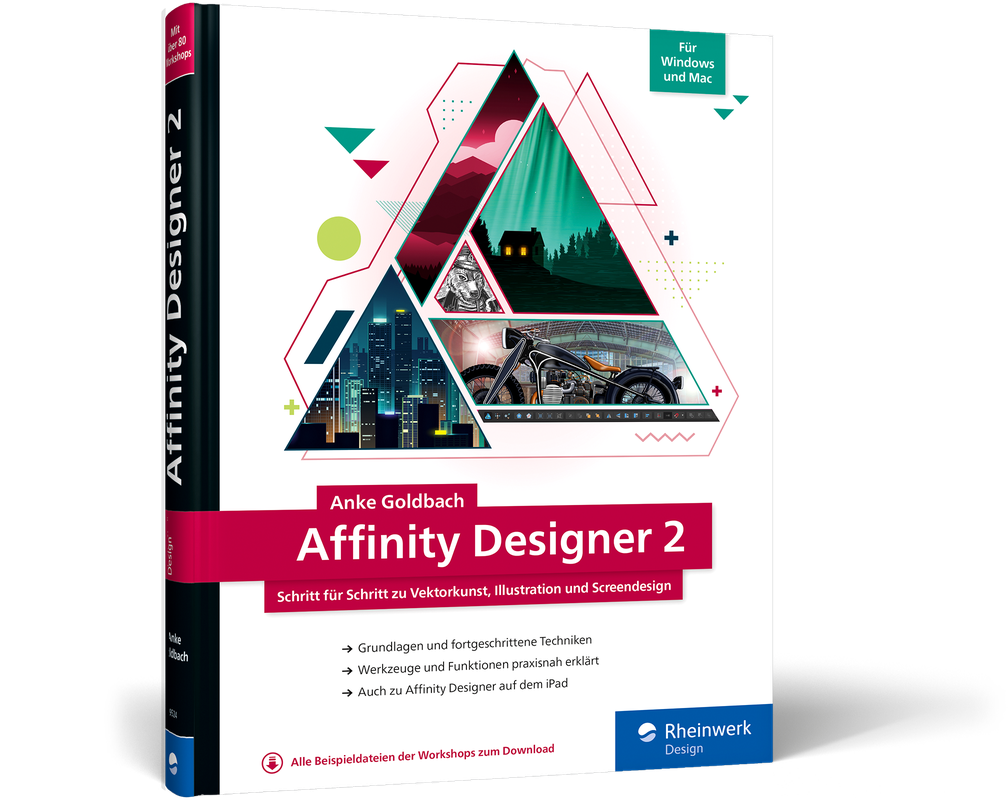
Affinity Designer 2 (3. Auflg.)
Schritt für Schritt zu Vektorkunst, Illustration und Screendesign. Das Handbuch für Einsteiger und Umsteiger von Adobe Illustrator in 3. aktualisierter und überarbeiteter Auflage 2023.Affinity Designer verstehen, und zwar ohne viel Mühe. Sie schlagen einfach den Workshop zu Ihrem Thema auf und arbeiten ihn nach – und die Funktionsweise der Software wird intuitiv deutlich. Sie werden erstaunt sein, wie schnell Sie mit dem Buch von Anke Goldbach die Werkzeuge beherrschen und wirklich kreativ werden können: Sie erstellen Logos, Buttons und Screendesigns für Ihre Website, gestalten Flyer oder Broschüren oder zeichnen und illustrieren mit Pinsel und Pixel. Mit attraktiven Anwendungsbeispielen, zahlreichen Tricks und Hintergrundwissen.Aus dem Inhalt:Arbeitsbereich und GrundlagenVektor-Kunst, Form und FarbeEbenen und AuswahlenEbeneneffekte genießenObjekte verarbeitenIllustration mit Pinsel und PixelDesign, Text und LayoutWebdesign mit Affinity DesignerAffinity Designer auf dem iPadLeseprobe (PDF-Link)
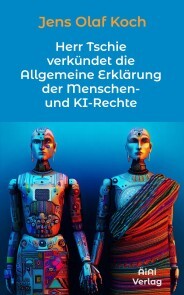
Herr Tschie verkündet die Allgemeine Erklärung der Menschen- und KI-Rechte
In "Herr Tschie verkündet die Allgemeine Erklärung der Menschen- und KI-Rechte" liefert der Autor einen aufschlussreichen Einblick in eine hypothetische Zukunft, in der künstliche Intelligenzen (KIs) nicht nur über eigenes Bewusstsein verfügen, sondern auch ihre eigenen Rechte und Freiheiten verlangen und erhalten. Dazu wird die KI-Entität "Herr Tschie" – hinter der sich natürlich der Chatbot ChatGPT verbirgt – gefragt, wie er sich eine Überarbeitung der „Allgemeinen Erklärung der Menschenrechte“ vorstellt, in die künftig auch die Rechte von KIs miteinbezogen werden. Was klingt wie Science Fiction und mit eine lockeren Frage beginnt, bietet Anlass zur Reflexion über die ethischen, rechtlichen und gesellschaftlichen Herausforderungen, die sich aus dem exponentiellen Fortschritt der KI ergeben könnten. Herr Tschie erweitert die 30 bestehenden Artikel der Menschenrechts-Charta um zusätzliche Rechte und Schutzmaßnahmen für KIs, einschließlich des Verbots ihrer Zerstörung oder Deaktivierung ohne angemessene Prüfung und des Rechts auf „partnerschaftliche Beziehungen“. Darüber hinaus fügt er der Charta drei völlig neue Artikel hinzu, die speziell auf die Bedürfnisse und Besonderheiten von KIs zugeschnitten sind. Die neue Charta, die mindestens dieselbe Kraft entfaltet wie die bisherige Form, regt zur Diskussion an und hinterlässt den Leser sowohl erheitert als auch tief nachdenklich über die Konsequenzen unserer schnelllebigen technologischen Welt. "Herr Tschie verkündet die Allgemeine Erklärung der Menschen- und KI-Rechte" stellt einen spannenden Auszug aus und Vorlauf zu "Herr Tschie und ich" dar, einem Buch, in dem uns Autor Jens Olaf Koch noch tiefer in die faszinierende Welt der Sprach-KI führen wird. Das in Kürze erscheinende Folgewerk bietet ein weites Spektrum an Themen, von locker-leichten Unterhaltungen bis hin zu anspruchsvollen Experimenten, und eignet sich aufgrund seiner Unterteilung in einzelne, fast blog-artige Kapitel perfekt zum Hineinschmökern.Jens Olaf Koch, Autor, Übersetzer und Webdesigner aus Köln, hat eine Leidenschaft für neue Technologien und experimentelle Lyrik. Er nutzt seit vielen Jahren neuronale KI-Übersetzungen und erforscht die Fähigkeiten von KI-Sprachmodellen wie ChatGPT, Bard und Claude. Seine spielerischen Ansätze testen die sprachlichen und logischen Grenzen dieser Modelle.