

Computer und IT
From Data To Profit
TRANSFORM YOUR COMPANY’S AI AND DATA FRAMEWORKS TO UNLOCK THE TRUE POWER OF DISRUPTIVE NEW TECHIn From Data to Profit: How Businesses Leverage Data to Grow Their Top and Bottom Lines, accomplished entrepreneur and AI strategist Vineet Vashishta delivers an engaging and insightful new take on making the most of data, artificial intelligence, and technology at your company. You’ll learn to change the culture, strategy, structure, and operational framework of your company to take full advantage of disruptive advances in tech. The author explores fascinating work being undertaken by firms in the real world, as well as high-value use cases and innovative projects and products made possible by realigning organizational frameworks using the capabilities of new technologies. He explains how to get everyone in your company on the same page, following a single framework, in a way that ensures individual departments get what they want and need. You’ll learn to outline a comprehensive technical vision and purpose that respects departmental autonomy over their core competencies while guaranteeing that they all get the tools they need to make technology their partner. You’ll also discover why firms that have adopted a holistic strategy toward AI and data have enjoyed results far beyond those experienced by those that have taken a piecemeal approach. From Data to Profit demonstrates the proper role of the CEO during an intensive transformation: one of maintaining culture during the change. It offers advice for organizational change, including the 3-Phase Data Organizational Development Framework, the Core Rim 3 Main People Groups Framework, and the way to implement new roles for a Chief Digital Officer and Technical Strategist. Perfect for data professionals, data organizational leaders, and data product and process owners, From Data to Profit will also benefit executives, managers, and other business leaders seeking hands-on advice for digital transformation at their firms. VIN VASHISHTA is the Founder of V Squared and its Chief Revenue Officer and technical strategist. He builds data and AI strategies for SMEs and Fortune 500 clients. He has over 25 years’ experience in technology with a background in science, strategy, leadership, applied machine learning research, and software engineering.

The Definitive Guide to PCI DSS Version 4
This book is your go-to reference on how to achieve PCI compliance. With more than 400 PCI requirements, the updated PCI Data Security Standard (PCI DSS) v4.0 does not detail the specific documentation that a PCI auditor—known as a Qualified Security Assessor (QSA)—needs to know. This book is the first reference to detail the specific documentation needed for every PCI requirement. The authors provide real-world examples of complying with the 12 main PCI requirements and clarify many of the gray areas within the PCI DSS.Any merchant or service provider that stores, processes, or transmits credit card data must comply with the PCI Data Security Standard. PCI DSS 1.0 was first published in 2004, yet many of those tasked with PCI compliance still encounter difficulties when trying to make sense of it. PCI DSS version 4 was published in March 2022, and at 360 pages, it has numerous additional requirements, leaving many people struggling to know what they need to do to comply.PCI DSS v4.0 has a transition period in which PCI DSS version 3.2.1 will remain active for two years from the v4.0 publication date. Although the transition period ends on March 31, 2024, and may seem far away, those tasked with PCI compliance will need every bit of the time to acquaint themselves with the many news updates, templates, forms, and more, that PCI v4.0 brings to their world.WHAT YOU’LL LEARN* Know what it takes to be PCI compliant* Understand and implement what is in the PCI DSS* Get rid of cardholder data* Everything you need to know about segmenting your cardholder data network* Know what documentation is needed for your PCI compliance efforts* Leverage real-world experience to assist PCI compliance workWHO THIS BOOK IS FORCompliance managers and those tasked with PCI compliance, information security managers, internal auditors, chief security officers, chief technology officers, and chief information officers. Readers should have a basic understanding of how credit card payment networks operate, in addition to basic security concepts. ARTHUR B. COOPER JR. ("COOP") is Principal Security Consultant at TrustedSec. He has 44 years of experience in information technology with the last 17 years focused on the security of payment systems and architectures, ecommerce, payment application assessments, forensic investigations, compliance security assessments, development of secure network architectures, risk management programs, security governance initiatives, and regulatory compliance. Coop was a member of the US Air Force for most of his young adult life and had direct experience with the original ARPANET and ARPANET 1822 Protocols. He was directly involved with the original DoD X.25 networks, the Defense Data Network (DDN), and the Automatic Digital Information Network (AUTODIN). He was directly involved with the original BBN Packet Switch Node (PSN) systems and has witnessed every major information technology “leap” or development since that time.Coop was the Standards Trainer for the Payment Card Industry Security Standards Council (PCI SSC) for three years from 2010 to 2013 and has been a consultant to some of the largest retail companies and financial institutions in the world. He has worked with businesses to improve their overall security posture and to meet compliance regulations such as PCI, HIPAA, GLBA, and SOX. Coop is an experienced team leader and IT security expert who can ensure timely and successful completion of projects, as well as an enthusiastic security engineer researching emerging security technologies, trends, and tools. His certifications include: Security +, CEH, CISA, CDPSE, CISSP, PCIP, and PCI QSA.JEFF HALL is Principal Security Consultant at Truvantis, Inc. He has over 30 years of technology and compliance project experience. Jeff has done a significant amount of work with financial institutions, and the health care, manufacturing, and distribution industries, including security assessments, strategic technology planning, and application implementation. He is part of the PCI Dream Team and is the writer of the PCI Guru blog, the definitive source for PCI DSS information.DAVID MUNDHENK is Principal Security Consultant at the eDelta Consulting, as an information security, governance, risk, and compliance consultant with extensive multi-organizational experience providing a myriad of professional security services to business and government entities worldwide. He has worked as a computer and network system security professional for more than 30 years. David’s experience covers a broad spectrum of security disciplines, including security compliance assessments, security product quality assurance, vulnerability scanning, penetration testing, application security assessments, network and host intrusion detection/prevention, disaster and recovery planning, protocol analysis, formal security training instruction, and social engineering. He has successfully completed 200+ PCI DSS assessments and scores of PADSS assessments. Certifications include CISSP, CISA, QSA, PCIP.BEN ROTHKE, CISSP, CISM, CISA is a New York city-based Senior Information Security Manager with Tapad and has over 20 years of industry experience in information systems security and privacy. His areas of expertise are in risk management and mitigation, security and privacy regulatory issues, design and implementation of systems security, encryption, cryptography, and security policy development. Ben is the author of the book Computer Security - 20 Things Every Employee Should Know, and writes security and privacy book reviews for the RSA Conference blog and Security Management. He is a frequent speaker at industry conferences, such as RSA and MISTI, is a member of ASIS, and InfraGard, and holds many security certifications, besides being an ISO 27001 lead auditor.PrefaceChapter 1. IntroductionChapter 2. What it takes to be PCI compliantChapter 3. Getting rid of cardholder dataChapter 4. Brief overview of PCI version 4Chapter 5. Everything you need to know about segmenting your cardholder data networkChapter 6. PCI requirement 1 - Install and Maintain Network Security ControlsChapter 7. PCI requirement 2 - Apply Secure Configurations to All System ComponentsChapter 8. PCI requirement 3 - Protect Stored Account DataChapter 9. PCI requirement 4 - Protect Cardholder Data with Strong Cryptography During Transmission Over Open, Public NetworksChapter 10. PCI requirement 5 - Protect All Systems and Networks from Malicious SoftwareChapter 11. PCI requirement 6 - Develop and Maintain Secure Systems and SoftwareChapter 12. PCI requirement 7 - Restrict Access to System Components and Cardholder Data by Business Need to KnowChapter 13. PCI requirement 8 - Identify Users and Authenticate Access to System ComponentsChapter 14. PCI requirement 9 - Restrict Physical Access to Cardholder DataChapter 15. PCI requirement 10 - Log and Monitor All Access to System Components and Cardholder DataChapter 16. PCI requirement 11 - Test Security of Systems and Networks RegularlyChapter 17. PCI requirement 12 - Support Information Security with Organizational Policies and ProgramsChapter 18. Closing thoughts
LPI Security Essentials Study Guide
PREPARE SMARTER AND FASTER FOR THE LPI SECURITY ESSENTIALS EXAMIn LPI Security Essentials Study Guide: Exam 020-100, veteran Linux server administrator David Clinton delivers an expert tutorial on the major security threats facing computers, networks, connected devices, and IT services, both on-premise and in the cloud. You’ll discover common and effective ways to prevent, mitigate, and respond to security attacks, and validate your ability to use encryption to secure data transferred through a network.This book is designed to prepare you for the LPI Security Essentials certification offered by the global standard and career support organization for open-source professionals. Whether you’re preparing for this foundational exam as a steppingstone to the more advanced Security+ certification or as an end in itself, you’ll advance your knowledge of security concepts, encryption, node, device, and storage security, network and service security, and identity and privacy concepts. You’ll get:* Techniques and tools you can use immediately in a new role as an IT security professional* Key strategies for digital self-defense, including securing your own devices and making use of IT services* Complimentary access to Sybex’s superior online interactive learning environment and test bank, complete with chapter tests, a practice exam, electronic flashcards, and a glossary of key termsPerfect for anyone seeking to take the LPI Security Essentials certification exam, LPI Security Essentials Study Guide, Exam 020-100 is a must-have resource for people looking to hit the ground running in a new career focused on information security.ABOUT THE AUTHORDAVID CLINTON is a Linux server administrator with experience working in IT infrastructure in academic and enterprise environments. He is the co-author of AWS Certified Solutions Architect Study Guide: Associate (SAA-C03) Exam, Fourth Edition and AWS Certified Cloud Practitioner Study Guide: Foundational (CLF-C01) Exam. Introduction xiiiAssessment Test xviiChapter 1 Using Digital Resources Responsibly 1Chapter 2 What Are Vulnerabilities and Threats? 17Chapter 3 Controlling Access to Your Assets 37Chapter 4 Controlling Network Connections 63Chapter 5 Encrypting Your Data at Rest 85Chapter 6 Encrypting Your Moving Data 97Chapter 7 Risk Assessment 113Chapter 8 Configuring System Backups and Monitoring 127Chapter 9 Resource Isolation Design Patterns 143Appendix Answers to Review Questions 155Index 167

Beginning Breadboarding
Using fun, hands-on projects, learn what a circuit is and how it works! This book uses a common tool in electronics, the breadboard, to build your way to an understanding of circuits, circuit components, and the basics of computers.You'll master current, voltage, and resistance. With that you can control outputs like lights and motors as well as inputs like switches and sensors. You'll also discover the difference between analog and digital electrical signals while studying both electricity and computers. Dabble in electrical engineering, whether you are interested in building things with electronics or learning to program simple, physical systems. Build your own electronic projects to learn how electronics work. And also how computers store information and process requests. You'll work with simple, low-cost tools like conductive tape before developing up to working with breadboards and discovering the components to build more complex systems.With Beginning Breadboarding, makers of all ages and backgrounds can learn to build real-life physical computing systems and projects. Have fun building something with tangible results while learning all the theory you need to make new projects of your own!WHAT YOU'LL LEARN* Rapidly prototype circuits with breadboards* Use common components to make simple electronic devices* Share electrical energy and control the flow of electricity through componentsWHO THIS BOOK IS FORMakers, seeking a fun, hands-on introduction to technology, electronics, and computers. Those who have little to no knowledge of the subject, but want to learn electronics or know more about computers.JEN FOX is an engineer, educator, and maker. After dabbling in dark matter (Occidental College, B.A. Physics) , Fox studied engineering (UCLA, M.S. Mechanical Engineering) where she blended electronics, art, and education to tackle problems related to environmental and social justice. Fox founded her company, FoxBot Industries, in 2015 to provide an arts-based approach to STEM education and current leads a team at Microsoft doing maker-related work. Chapter 1: Introduction, Supplies, and Circuit Diagrams● Introductiono Safety considerations (note: all projects run off coin cell batteries which have minimal risk)● Tools and Materialso Master supply list● Reading Circuit DiagramsChapter 2: Paper Circuits● What is electricity?○ An overview of electricity, including AC vs DC○ Current and Voltage● Make a circuit○ Project: coin cell + LED○ Basic parts of a circuit: power source, power sink, conductors○ Electrical Flow and Polarity○ Project: coin cell + LED + conductive tape● Series and Parallel Circuits○ How current and voltage behave in series and in parallel circuits○ Project: coin cell + 2 LEDs + conductive tape in series○ Project: coin cell + 2 LEDs + conductive tape in parallel● Electromagnetic Spectrum○ Project: coin cell + 2 or more LEDs of different colors● Going Further○ Ideas on how to apply these concepts to projects, like light-up greeting cards and adding lights to dollhouses or model trainsBonus Project 1: Using a Multimeter● Overview of multimeters● Measuring Voltage● Measuring Current● Measuring continuityChapter 3: Breadboards and Outputs● Brief history of breadboards -- why we use them and where they came from● Breadboard anatomy● Breadboarding: Lights on!o Project: coin cell + LED on breadboardo Project: coin cell + 2 LEDs on breadboard▪ In series▪ In parallel● Making Sounds○ Overview of how speakers and buzzers work○ Project: coin cell + buzzer on breadboard● Digging into motors○ Overview of how different types of DC motors work○ Project: coin cell + motor on breadboard○ Project: Motor (in reverse) + LED● Going Further○ Project: coin cell +2 different output devices on breadboard○ Ideas for how to apply these concepts to projects, like Brush Bots, a mini alarm system, or a mini lampChapter 4: Passive Components● Resistance: How to limit electricity○ General overview of resistance○ Project: coin cell + LED + resistor 1○ Project: coin cell + LED + resistor 2● Varying resistance with potentiometers○ Project: coin cell + LED + potentiometer (wiring option 1)○ Project: coin cell + LED + potentiometer (wiring option 2)○ How potentiometers work (inner diagram)● Capacitors: quick bursts of current○ General overview of capacitors○ Project: coin cell + LED + capacitor 1○ Project: coin cell + LED + capacitor 2○ Safety considerations for large capacitors (note: educational only, readers will NOT be using large capacitors)● Going Further○ Project: coin cell + 2 LEDs + potentiometer○ Project: coin cell + LED + 2 or more resistors○ How to apply these findings to projects, like long-lasting wearables, motor speed control, and volume controlBonus Project 2: Ohm’s Law● Introduction to Ohm’s Law● Using a multimeter to measure resistance● Example Projects (readers guided through the procedure)● Practice Projects (answers provided in back of the book)Chapter 5: Electromechanical Components● Turning electricity on and off● Temporary switches: 2-Legged Pushbuttons○ Overview of how pushbuttons work○ Project: coin cell + LED + pushbutton● Permanent Switches: Slide switches○ Overview of how slide switches work○ Project: coin cell + LED + pushbutton○ Project: coin cell + 2 LEDs + pushbutton● Going Further○ Digging deeper into switches■ 4-legged pushbuttons■ Electrical contact terminology: contact states (Normally Closed, NC, and Normally Open, NO)○ How to apply these findings to projects, like a mini stop light, a simple Morse code system, or hand-made custom switches with household objectsChapter 6: Logic Gates, Pt. 1● Analog and Digital signals: Records vs CDs● AND Logic Gate○ Project: coin cell + LED + 2 pushbuttons● OR Logic Gate○ Project: coin cell + LED + 2 pushbuttons● Using Binary Numbers to analyze logic gates● NOT Logic Gate○ Project: coin cell + LED + pushbutton● Going Further○ Using logic gates to explore the flow of electricity○ NAND and NOR gates○ How to apply these findings to projects, like using switches to make decisionsChapter 7: Simple Sensors● Overview of sensors○ Common types of inputs● Light Sensors: Photoresistors○ Overview on photoresistors○ Project: coin cell + LED + photoresistor○ Project: coin cell +● Force Sensing Resistors (FSRs)○ Overview on FSRs○ Project: coin cell + LED + FSR● IR “Breakbeam” sensors○ Overview on IR sensors○ Project: coin cell + LED + IR● Tilt Sensors○ Overview on tilt sensors○ Project: coin cell + LED + tilt sensor● Going Further○ Other types of simple sensors○ How to apply these findings to project, like touch-sensitive sounds and light displays, simple security systems, and simple orientation detectorsChapter 8: Transistors● Overview of Transistors○ Intro to semiconductors○ Overview of common transistor types○ Pin Overview● Transistor Switch Circuit○ Project: coin cell + LED + resistor + transistor○ Project: coin cell + motor + resistor + transistor● Transistor Amplifier Circuit○ Project: 2 coin cells + LED + resistor + transistor○ Project: 2 coin cells + motor + resistor + transistor● Going Further○ Connecting a potentiometer○ Connecting a switch○ How to apply these findings to project, like a dark detecting circuitChapter 9: Logic Gates, Pt. 2● Introduction to Physical Computing○ Truth Tables● AND Logic Gate with Transistors○ Project: coin cell, LED, 2 pushbuttons, 3 resistors, 2 transistors○ Truth Table● OR Logic Gate with Transistors○ Project: coin cell, LED, 2 pushbuttons, 3 resistors, 2 transistors○ Truth Table● NOT Logic Gate with Transistors○ Project: coin cell, LED, pushbutton, resistor, transistor● Going Further○ NAND. NOR, XOR, and XNOR Logic Gates■ Truth Tables○ Two or more Logic Gates○ How to apply these findings to project, like a 2-, 3-, or 4-bit adderBonus Project 3: PCB Component Identification● Introduction to Printed Circuit Boards (PCBs)● Electronic and tool safety● Recommended electronics to explore○ Electronic toys, keyboards, old desktop or laptop computers, remote controls, etc.○ What to avoid○ What kinds of parts are reasonable to harvest and repurpose● Look Inside: Electronic Toy● Look Inside: Keyboard● Going Further○ How to apply these findings to projects, like toy mash ups, electronic instruments, and as an affordable source for motorsChapter 10: Electromagnetic Components● Overview of Electromagnets○ Faraday’s Law○ Project: Build a simple electromagnet● Motors○ Overview○ Project: Build a simple motor● Speaker○ Overview○ Project: Build a simple speaker● Going Further○ How to incorporate these findings to projects, like using a motor to generate electricity, using a speaker as a microphone, and creating wireless electrical transmissionChapter 11: Topics for Further Exploration● Integrated Circuits● Other types of electromechanical components○ Relays, Solenoids● Microcontrollers and microprocessorsAppendix I: Circuit Component Technical SpecificationsGoal: This appendix provides technical specifications for all electronic components used for projects outlined in this book.● Example technical specification for coin cell battery:Appendix II: Ohm’s Law and the Power LawAudience: Beginner

Maturing the Snowflake Data Cloud
This project-oriented book gives you a hands-on approach to designing, developing, and templating your Snowflake platform delivery. Written by seasoned Snowflake practitioners, the book is full of practical guidance and advice to accelerate and mature your Snowflake journey. Working through the examples helps you develop the skill, knowledge, and expertise to expand your organization’s core Snowflake capability and prepare for later incorporation of additional Snowflake features as they become available. Your Snowflake platform will be resilient, fit for purpose, extensible, and guarantee rapid, consistent, and repeatable, pattern-based deployments ready for application delivery.When a Snowflake account is delivered there are no controls, guard rails, external monitoring, nor governance mechanisms baked in. From a large organization perspective, this book explains how to deliver your core Snowflake platform in the form of a Landing Zone, a consistent, templated approach that assumes familiarity with Snowflake core concepts and principles. The book also covers Snowflake from a governance perspective and addresses the “who can see what?” question, satisfying requirements to know for certain that your Snowflake accounts properly adhere to your organization’s data usage policies.The book provides a proven pathway to success by equipping you with skill, knowledge, and expertise to accelerate Snowflake adoption within your organization. The patterns delivered within this book are used for production deployment, and are proven in real-world use. Examples in the book help you succeed in an environment in which governance policies, processes, and procedures oversee and control every aspect of your Snowflake platform development and delivery life cycle. Your environment may not be so exacting, but you’ll still benefit from the rigorous and demanding perspective this book’s authors bring to the table. The book shows you how to leverage what you already know and adds what you don’t know, all applied to deliver your Snowflake accounts. You will know how to position your organization to deliver consistent Snowflake accounts that are prepared and ready for immediate application development.WHAT YOU WILL LEARN* Create a common, consistent deployment framework for Snowflake in your organization* Enable rapid up-skill and adoption of Snowflake, leveraging the benefits of cloud platforms* Develop a deep understanding of Snowflake administration and configuration* Implement consistent, approved design patterns that reduce account provisioning times* Manage data consumption by monitoring and controlling access to datasetsWHO THIS BOOK IS FORSystems administrators charged with delivering a common implementation pattern for all Snowflake accounts within an organization; senior managers looking to simplify the delivery of complex technology into their existing infrastructure; developers seeking to understand guard rails, monitoring, and controls to ensure that Snowflake meets their organization's requirements; sales executives needing to understand how their data usage can be monitored and gain insights into how their data is being consumed; governance colleagues wanting to know who can see each data set, and wanting to identify toxic role combinations, and have confidence that their Snowflake accounts are properly provisionedANDREW CARRUTHERS is the Director for the Snowflake Corporate Data Cloud at the London Stock Exchange Group. Comprising two Snowflake accounts supporting both ingestion data lake and consumption analytics hub, the Corporate Data Cloud services a growing customer base of over 7,000 end users. He leads both the Centre for Enablement in developing tooling, best practices, and training, and the Snowflake Landing Zone provisioning Snowflake Accounts conforming to both internal standards and best practices. This book is the distilled best practices for implementing a Snowflake Landing Zone.Andrew has more than 30 years of hands-on relational database design, development, and implementation experience starting out with Oracle in 1993. Until joining the London Stock Exchange Group, he operated as an independent IT consultant. His experience has been gained predominantly through working at major European financial institutions. Andrew is considered a visionary and thought leader within his domain, with a tight focus on delivery. Successfully bridging the gap between Snowflake technological capability and business usage of technology, he often develops proof of concept to showcase benefits leading to successful business outcomes.Since early 2020 Andrew has immersed himself in Snowflake and is considered a subject matter expert. He is SnowPro Core certified, contributes to online forums, and speaks at Snowflake events on behalf of the London Stock Exchange Group. In recognition of his contribution to implementing Snowflake at London Stock Exchange Group, Andrew recently received the Snowflake Data Driver award. This category recognizes a technology trailblazer who has pioneered the Data Cloud into their organization.Andrew has two daughters, 19 and 21, both elite figure skaters. He has a passion for Jaguar cars, having both designed and implemented modifications, and has published articles for both the Jaguar Enthusiast magazine and the Jaguar Driver magazine. Andrew enjoys 3D printing and has a mechanical engineering workshop with lathe, milling machine, and TIG welder, to name but a few tools, and enjoys developing his workshop skills.SAHIR AHMED is a Snowflake CorePro certified developer working alongside Andrew on the Snowflake Corporate Data Cloud at the London Stock Exchange Group. Sahir began investing his time learning Snowflake prior to joining the London Stock Exchange Group. He drew upon his experience with other relational databases such as MySQL and MS Access. Sahir developed a passion for Snowflake by designing a car parts catalog using JavaScript stored procedures and SQL scripts. As Sahir’s skills and knowledge expanded, he dug deeper into Snowflake and within a year he became SnowPro Core certified.In his spare time, Sahir also takes advantage of his self-taught skills in both electrical and manual car repairs, working on many brands of cars such as Jaguar, BMW, and Audi, to name a few. He also competes in amateur boxing competitions. Seen as a role model, Sahir supports and encourages youngsters both within boxing and his wider community. His biggest driving factor, and where his most precious time, is his time spent with his wife and two young daughters. They keep his motivation alive and push him to be the best version of himself.IntroductionPART I. THE LANDING ZONE1. Maturing the Snowflake Data Cloud2. PrivateLink3. Security4. Costs5. Share6. Usage7. Catalog8. SSO9. SCIM10. Templates11. Disaster RecoveryPART II. THE CENTER FOR ENABLEMENT12. What is a Center for Enablement?13. Training14. Tooling15. Outreach and Engagement16. SandpitPART III. END USER CONSUMPTION17. Self-Service Options18. Cloud Data Management Capabilities

Cloud Computing with AWS
Embark on a ground-up journey to cloud computing and the Amazon Web Services (AWS) eco-system, including all the other systems, services, and the security associated with it. This book provides you with the practical know-how to become an AWS Cloud practitioner.Your exploration will take you from key fundamentals of identity and access, storage, networking, architectures, databases, security and compute services all the way through to more advanced topics. The book is organized into easy-to-follow and engaging chapters with simple examples to make complex concepts very easy to understand followed by simple step-by-step demonstrations and case studies to make you proficient in every area of AWS.You'll manage databases in your on-prem data centers and set up, operate, and scale relational database in the cloud. All the services and resources taught in this book come from the AWS Free Tier, so you will not have to pay anything to use and learn from this book.WHAT YOU'LL LEARN* Understand key concepts and benefits of cloud computing* Employ key cloud computing models and services * Review the concept of virtual machines in a cloud computing context* Study compute services that meet your requirementsWHO THIS BOOK IS FORIT professionals looking to change their domain to cloud computing as well as those who are looking to utilize AWS for their systems and projects.PRAVIN MISHRA has more than 12 years of experience in IT and 8 years as a course trainer. He specializes in designing and implementing multi-Cloud based solutions. As an AWS trainer, Pravin help students and IT professionals switch careers in AWS Cloud. With a strong belief in "learning by doing", he helps his students grow their cloud-based skills and realize their their full potential from basic concepts and methodologies to getting ready to pursue AWS certification. 1. Introduction to Cloud Computing2. Getting Started with AWS3. AWS Identity and Access Management4. AWS Storage Services5. Virtual Private Cloud (VPC)6. Elastic Compute Cloud (EC2)7. High-Level Architecture8. Databases9. Advanced AWS Services10. AWS Security and Management Services11. AWS Billing and Pricing

Practical Graph Structures in SQL Server and Azure SQL
Use the graph table features in Azure SQL that were introduced in SQL Server 2017 and further refined in SQL Server 2019. This book shows you how to create data structures to capture complex connections between items in your data. These connections will help you analyze and draw insights from connections in your data that go beyond classic relationships.The graph examples in the book are useful for analyzing social media relationships, complex product-to-customer relationships, and any other type of data analysis in which indirect connections that otherwise might be missed using conventional techniques can be mined for their insight and business value.Tree structures are covered, with emphasis on a structure commonly used by organizations to aggregate data at different levels of an organization. The book provides code examples of SQL Graph objects as well as an alternate tree implementation technique. Included is sample data (and data generators) for you to test for performance and choose the implementation approach that best suits your needs and that of your application.If your job involves analyzing or storage of data elements that are connected in a networked topology, then this is the book that will help you bring the power of SQL Server to bear on that data and take advantage of your existing knowledge.WHAT YOU WILL LEARN* Understand the graph model and the associated terms used in graph analysis* Store highly connected data in SQL Server and Azure SQL alongside existing relational data* Make full use of the graph table feature that is refined and enhanced in SQL Server 2019* Implement high performance tree structures that will make storing and querying tree data possible* Report on data associated with a tree structure to aggregate results at different levelsWHO THIS BOOK IS FORLOUIS DAVIDSON has been working with databases for more than 25 years as a corporate database developer and architect, and is now the editor for the Redgate Simple Talk website. He has been a Microsoft MVP for 18 years. In addition to this book on graphs, he has written six editions of his general-purpose SQL Server database design book (Apress).Louis has been active in speaking about database design and implementation at many conferences over the past 25 years, including SQL PASS, SQL Rally, SQL Saturday events, CA World, Music City Data, and the devLink Technical Conference. He has a bachelor’s degree in computer science from the University of Tennessee at Chattanooga. For more information, please visit his website at drsql.org.1. Introduction to Graphs: What a graph is, and ways graphs can be used2. Data Structures and Algorithms: How graphs are implemented, and the algorithms that are used to process them3. SQL Graph Tables Basics: The syntax that Microsoft has implemented for use with graph data stored in SQL Server tables4. SQL Graph Tables: Extended Topics: Methods that can help you load and protect the integrity of the data in your SQL Graph tables5. Tree Data Structures: A tree structure built using SQL Graph objects, including code to load and manipulate those nodes in ways that you will need when building production systems6. Tree Structures, Algorithms, and Performance: A new method of implementing a tree, objects that can help you report on your trees faster, and how these methods perform with certain sized data sets7. Other Directed Acyclic Graphs: A bill of materials directed acyclic graph to demonstrate the techniques you will need when you are working with these structures that are similar to trees8. A Graph for Testing: A graph structure and data generation tools for you to try on large sets of data to match your expected needs, and a set of performance tips for handling graph objects

Visual Studio Code Distilled
Use Visual Studio Code to write and debug code quickly and efficiently on any platform, for any device, using any programming language, and on the operating system of your choice.Visual Studio Code is an open source and cross-platform development tool that focuses on code editing across a variety of development scenarios, including web, mobile, and cloud development. This third edition has been updated to match the latest releases of the environment. Additional updates relate to .NET 7 and explain how to consume AI services from code you write in Visual Studio Code. This new edition is also refreshed with the latest updates, such as enhanced merge editor, creating extensions, support for the Julia language, and much more.The book teaches you how to be immediately productive with Visual Studio Code, from the basics to some of the more complex topics. You will learn how to work on individual code files, complete projects, and come away with an understanding of advanced code-editing features that will help you focus on productivity, and source code collaboration with Git.WHAT YOU WILL LEARN* Get started with practical guidance on Visual Studio Code, including expansive guidance on writing apps with C# and Python* Understand how to edit individual files and how to work with folders by working on the latest workspace trust and multi-root workspaces* Debug code on multiple platforms through real-world guidance, such as working under corporate networks* Package code into Docker containers and deploy these to Azure* Acquire valuable tips, tricks, and suggestions from hard-earned, real-world experience to be more productiveWHO THIS BOOK IS FORAll developers (including JavaScript, Java, NodeJS), not just those with a Microsoft background, who will benefit from learning and using VS code as a cross-platform and cross-language toolALESSANDRO DEL SOLE is Senior Software Engineer for a healthcare company, building mobile apps for doctors and dialysis patients. He has been in the software industry for more than 20 years, focusing on Microsoft technologies such as .NET, C#, Visual Studio, and Xamarin. He has been a trainer, consultant, and a Microsoft MVP since 2008 and is the author of many technical books. He is a Xamarin Certified Mobile Developer, Microsoft Certified Professional, and a Microsoft Programming Specialist in C#.Chapter 1: Introducing Visual Studio CodeChapter Goal: this chapter will introduce Visual Studio Code as a development tool from Microsoft, discussing its open source and cross-platform nature, its goals and most typical usage scenarios, explaining how it works on Windows, macOS and Linux distributions.Chapter 2: Getting to know the WorkspaceChapter Goal: this chapter will explain the VS Code workspace, its menus, commands, toolbars, shortcuts and areas in the user interface the developer must know to get familiar with the environment.Chapter 3: Language support and code editing featuresChapter Goal: this chapter will explain what languages are supported out of the box and which are instead supported through extensibility and, more important, it will cover all the powerful code editing features that represent the core of this tool. This is definitely the most important chapter. This is updated according to the latest releases (e.g. support for Julia language).Chapter 4: Working with files and foldersChapter Goal: this chapter explains how to edit individual files and how to work with folders that contain multiple files (or projects) in a structured way, making the natural step forward after learning about code editing features. This is updated according to the releases of the latest 15 months (e.g. workspace trust, multi-root workspaces).Chapter 5: Customizing VS CodeChapter Goal: this chapter will talk about customizing preferences in the VS Code environment, such as themes, keyboard shortcuts, the code editor, network preferences and much more. This is updated according to the releases of the latest 15 monthsChapter 6: Managing extensionsChapter Goal: this chapter will explain how to extend Visual Studio Code by installing extensions such as additional languages, debuggers, code snippets and team collaboration tools. It will also provide a list of must-have extensions and it will explain how to customize extension settings. As a new topic, guidance on how to create extensions will be provided (this is also the reason why this chapter has been renamed).Chapter 7: Source control with GitChapter Goal: this chapter will discuss source control with Git, which is about how people in the development team can collaborate over the code. Common features such as committing changes, merging and branching will be discussed. As a bonus, this chapter will also discuss how to leverage the integrated Git support against Microsoft Azure DevOps and GitHub via an extension. This is updated according to the releases of the latest 15 months (e.g. enhanced merge editor)Chapter 8: Automating tasksChapter Goal: this chapter will discuss how to execute external tools and commands from VS Code (such as compilers), explaining how this goes beyond being a simple code editor. This is updated according to the releases of the latest 15 monthsChapter 9: Building and debugging codeChapter Goal: this is another key chapter, as it explains how powerful VS Code is as a development tool and not as a simple code editor, due to its capability of running and debugging code with integrated debuggers for .NET and Node.JS and with debuggers that can be installed as extensions. Examples of running and debugging code will be provided for .NET (C#), Node.JS (Java) and Docker. This has been renamed to appear less specific, but it will be updated to target .NET 7.Chapter 10: Writing applications with PythonChapter Goal: this chapter explains how VS Code can be used to build apps with the popular Python language, leveraging all the enhanced editing features described in Chapter 3 and the task automation features described in Chapter 8. It comes with fully working code examples.Chapter 11: Building applications for the CloudChapter Goal: this chapter explains how to set up VS Code to work with Microsoft Azure, installing the appropriate extensions and with practical examples about writing and deploying Azure functions. As a new topic, this chapter also describes how to package code into Docker containers and deploy these to Azure.Chapter 12: Consuming AI Services with VS CodeChapter Goal: this is a brand new chapter that wants to address a trending topic of these days: consuming AI services. In this chapter, code examples will be provided about consuming some of the AI services offered by MS Azure (e.g. Computer Vision API).

Introduction to Software Testing
Get started and hit the ground running in the world of software testing. This simple and practical guide teaches you the fundamentals of software testing, with no prior experience required.You will start by learning functional and non-functional software testing. Then you will gain an understanding of the primary responsibilities of a tester in the Software Development Life Cycle and how to plan and execute testing activities. You will also learn how testing applies to an agile environment, what challenges you might face in your day-to-day life as a tester, and how to overcome them. You will learn the most commonly used test design techniques, with ample examples and exercises to practice yourself.By the end of this book, you will understand the software testing ecosystem, from its types, techniques, and tools, to test planning, execution, and reporting.WHAT YOU WILL LEARN* Master the fundamentals of Software Testing* Gain an understanding of different software testing types* Plan and execute testing activities* Apply test design techniques to concrete examplesWHO THIS BOOK IS FORSoftware testers, developers, project managers, and other stakeholders involved in software testing.PANAGIOTIS LELOUDAS is a software quality assurance engineer with more than ten years of working experience in the industry. He holds several ISTQB certifications and is an expert in testing principles, methodologies, and techniques.He decided to write a quick guide to software testing because he needed a go-to document to use as a manual for all the decisions he has to make on a day-to-day basis. He tried include everything he would have liked to have known when he started his career.Chapter 1: Introduction.- Chapter 2: Software Testing Types and Techniques.- Chapter 3: Software Development Life Cycle.- Chapter 4: Test Planning.- Chapter 5: Test Design Techniques.- Chapter 6: Test Execution.- Chapter 7: Test Automation.- Chapter 8: Testing in Agile Environments.- Chapter 9. Challenges and Solutions in Software Testing.- Afterword.

MCA Windows Server Hybrid Administrator Complete Study Guide with 400 Practice Test Questions
YOUR 2-EXAMS-IN-1 STUDY GUIDE FOR THE NEXT-GEN WINDOWS SERVER 2022 CERTIFICATIONIn MCA Windows Server Hybrid Administrator Complete Study Guide: Exam AZ-800 and Exam AZ-801, five-time Microsoft MVP and veteran IT trainer William Panek delivers a one-stop resource to help you efficiently prepare for and pass the required exams for Microsoft’s latest Windows Server certification. In the book, you’ll learn to expertly administer Windows Server workloads and services using on-premises, hybrid, and cloud technologies. The book provides hands-on explanations of all relevant Windows Server administration tasks, from security to migration, monitoring, troubleshooting, disaster recovery, and more. You’ll also find:* 100% coverage of the objectives of each of the exams required to access an in-demand and lucrative new certification* The skills and tools you’ll need to succeed as a newly minted Windows Server 2022 administrator* Complimentary access to Sybex’ superior interactive online learning environment and test bank, which offers hundreds of practice questions, flashcards, and a glossaryA practical and indispensable resource for anyone seeking to acquire the brand-new MCA Windows Server Hybrid Administrator certification, MCA Windows Server Hybrid Administrator Complete Study Guide also deserves a place in the libraries of aspiring and practicing network and system administrators looking for an actionable guide to on-premises, hybrid, and cloud Windows Server 2022 environments. ABOUT THE AUTHORWILLIAM PANEK, MCP, MCSE, MCSA, MCTS, MCITP, CCNA, is a five-time Microsoft MVP winner. He has taught at Boston University, Clark University, and the University of Maryland. He conducts live online classes for StormWind Studios and has been a consultant and trainer for the United States Secret Service, Cisco, the United States Air Force, and the United States Army. Introduction xxxiiiAssessment Test liiChapter 1 Introduction to Windows Server 2022 1Chapter 2 Understanding Hyper-V 29Chapter 3 Installing Windows Server 2022 85Chapter 4 Understanding IP 159Chapter 5 Implementing DNS 209Chapter 6 Configuring DHCP and IPAM 265Chapter 7 Understanding Active Directory 337Chapter 8 Understanding Group Policies 425Chapter 9 Introduction to Microsoft Azure 465Chapter 10 Understanding Azure Active Directory 499Chapter 11 Configuring Storage 547Chapter 12 Building an Azure Infrastructure 619Chapter 13 Managing Data in a Hybrid Network 663Chapter 14 Hybrid Data and Servers 743Chapter 15 Implementing Security 785Chapter 16 Understanding Monitoring 845Chapter 17 Understanding Disaster Recovery 901Appendix Answers to Review Questions 981Index 1017

Developing Solutions for Microsoft Azure Certification Companion
Improve your odds of passing one of the most highly sought-after exams for developers working with Microsoft’s cloud platform: Exam AZ-204: Developing Solutions for Microsoft Azure. This book guides you through practical examples of each of the technologies covered by the exam while exposing you to the settings and interactions between platform solutions that you will need to be in command of to prepare for the exam and to use on your job in Azure development.Chapters in this book correspond directly to the exam skills outline and are delivered in a “from-the-ground-up” approach, allowing you to build your knowledge as you go. This approach serves to help even novice developers get up to speed quickly, while allowing more experienced developers to find the exact topics and scenarios they need to hone their skill sets as they both prepare for the exam and reference information for real-world solutions.As you work through each chapter, you will get an introduction to the topic of the chapter followed by a comprehensive discovery of the key elements of the Azure service(s) being covered. You’ll be guided through solutions by studying typical, real-world scenarios. Each chapter concludes with review questions to solidify your learning and includes links to the corresponding Microsoft Learn modules that are relevant to the concepts in the chapter and associated with each section of the AZ-204 exam.WHAT YOU WILL LEARN* Know the essential platform services of Azure* Develop and deploy secure and robust web solutions* Architect and create serverless solutions* Manage containers in the Azure Containers ecosystem* Choose the correct messaging and event-handling tools for your applications* Master real-world examples and challenges that help prepare you for the AZ-204 examWHO THIS BOOK IS FORDevelopers planning to take the AZ-204 exam, and developers who want to learn more about development on the most common Azure platform servicesBRIAN L. GORMAN is a Microsoft Azure MVP, developer, computer science instructor, and trainer. He has been working in .NET technologies as long as they have existed. He was originally MCSD certified in .NET 1 and re-certified with MCSA: Web Apps and MCSD: App Builder certifications in 2019. From 2019 on, Brian has earned 11 Azure certifications, including the Azure, Security, and Data Fundamentals certifications, the Azure Administrator, Database Administrator, Security Engineer, and Developer Associate certifications, the Azure Solutions Architect and DevOps Expert certifications, and the IoT and Cosmos DB Specialty certifications.Additionally, Brian became an MCT as of April 2019, and is focusing on developing and training developers with full-stack web solutions with .NET Core and Azure. Most recently, Brian has found purpose as an instructor for the Microsoft Software and Systems Academy (MSSA) in the cloud application development program.In addition to working with .NET technologies, Brian was also an adjunct faculty member in the computer science department for Franklin University for over 10 years, where his courses included data structures, algorithms, design patterns, and, full-stack solutions in the computer science capstone practicum course. Brian has created many online technical training courses that can be found online on various platforms. Brian is also the author of Apress books Practical Entity Framework, and Practical Entity Framework Core 6.IntroductionPART I. DEVELOP FOR AZURE1. Develop Solutions that Use Blob Storage2. Develop Solutions that Use Cosmos DB StoragePART II. DEVELOP AZURE COMPUTE SOLUTIONS3. Implement IaaS Solutions4. Create Azure App Service Web Apps5. Azure Container Ecosystem6. Implement Azure FunctionsPART III. IMPLEMENT AZURE SECURITY7. Implement User Authentication and Authorization8. Implement Secure Cloud SolutionsPART IV. MONITOR, TROUBLESHOOT, AND OPTIMIZE AZURE SOLUTIONS9. Implement Caching for Solutions10. Troubleshoot Solutions by Using Metrics and Log DataPART V. CONNECT TO AND CONSUME AZURE SERVICES AND THIRD-PARTY SERVICES11. Implement API Management12. Develop Event-Based Solutions13. Develop Message-Based Solutions

Ansible for Kubernetes by Example
Learn how to automate your Kubernetes infrastructure using Ansible. This book will enable you to automate more tasks and save time with this human-readable platform.Containerized microservices deployed via Kubernetes allows you to save time, reduce human interaction and errors, and create applications that are more robust. You’ll learn how to automate the most redundant activities such as reports, services, the launch of a pod, adding permanent storage, configuring load balancing, and adding or modifying any Kubernetes parameter. You'll also gain an understanding of end-to-end use cases and how advanced cluster automation, such as Helm packages and node states, are evolving.Each lesson utilizes a specific use-case for the modern Kubernetes cluster and focuses on a single module from the most crucial parameter, complete with code demonstrations. Each code example is battle-proven in real-life with console interaction and verification.WHAT YOU'LL LEARN* Automate Kubernetes cluster management, cloud services, pods, and storage with Ansible* Configure your Ansible controller node* Write and execute Ansible Playbook code that follows best practices* Augment your productivity by applying Infrastructure as Code (IaC)* Troubleshoot Ansible WHO THIS BOOK IS FORIT professionals who would like a jargon-free understanding of Ansible technology, Windows Systems Administrators, DevOps professionals, thought leaders, and infrastructure-as-code enthusiasts.Luca Berton is an Ansible Automation Expert who has been working with Red Hat Ansible Engineer Team for three years. With more than 15 years of experience as a System Administrator, he has strong expertise in Infrastructure hardening and automation. Enthusiast of the Open Source supports the community by sharing his knowledge in different public access events. Geek by nature, Linux by choice, Fedora, of course.Chapter 1: Modern IT Infrastructure and Hello AppCHAPTER GOAL: The tools to handle a modern enterprise IT Infrastructure that enables Infrastructure as Code following DevOps methodologiesSUB -TOPICSModern IT Infrastructure (DevOps & IaC)The move to containersAnsible by Red HatKubernetes and the CNCFKubernetes distributions - OpenShift by Red Hat, Rancher, EKS, AKS, GCPContainers & PodCreating a ‘Hello’ appBuilding Hello AppRunning Hello in DockerDeploying Hello in KubernetesHello OperatorCHAPTER 2: ANSIBLE LANGUAGE CODECHAPTER GOAL: Description of the Ansible Platform and how to write and execute Ansible Playbook code that follows the best practicesSUB - TOPICSAnsible Architecture and Getting StartedAnsible InstallationAnsible Code LanguageCHAPTER 3: ANSIBLE FOR CONTAINERSCHAPTER GOAL: How to automate container management using Ansible (Docker and podman)SUB - TOPICSAnsible For ContainersInstall Docker in Linux and WindowsInstall and Update flatpak in LinuxInstall a snap in LinuxDeploy Web Server in a Container for Linux (Docker and Podman)CHAPTER 4: ANSIBLE FOR K8S TASKSCHAPTER GOAL: How to configure your Ansible controller node to interact with a k8s clusterSUB - TOPICS:Why Kubernetes & How it works.Set up your laboratory (cluster of VMs, Kubespray, Raspberry Pis, OpenShift local)Minikube to Create a ClusterCreate a cluster with KOPS - ( Cloud )Configure Ansible For KubernetesAnsible troubleshooting - Kubernetes K8s 401 UnauthorizedConfigure a Python Virtual EnvironmentConfigure an Ansible Execution EnvironmentReport a list of namespacesReport all deployments in namespaceCreate Kubernetes K8s namespaceCreate Kubernetes K8s podCreate Kubernetes K8s secretUsing a Service to Expose Your AppScale Your AppUpdate Your AppAssign CPU Resources to Kubernetes K8s Containers and PodsAssign Memory Resources to Kubernetes K8s Containers and PodsConfigure a Pod to Use a Volume for StorageApply Multiple YAML Files at Once on Kubernetes K8sCHAPTER 5: ANSIBLE FOR K8S USE-CASESCHAPTER GOAL: Some end-to-end examples about Ansible for Kubernetes usageSUB - TOPICS:Configuring a Java MicroserviceStateless - Deploying PHP Guestbook application with RedisStateful Deploying WordPress and MySQL with Persistent VolumesApply Pod Security Standards at the Namespace LevelRestrict a Container's Access to Resources with AppArmorRestrict a Container's Syscalls with seccompCHAPTER 6: ANSIBLE FOR K8S MANAGEMENTCHAPTER GOAL: How to automate system administration tasks for your K8s cluster using Ansible automationSUB - TOPICS:Report Helm package deployed inside the clusterReport Helm plugins deployed inside clusterDeploy a monitoring tool inside clusterManage Helm repositoriesRemove Helm package deployed inside clusterInstall Helm pluginRemove Helm pluginFetch logs from Kubernetes resourcesApply JSON patch operations to existing objectsCopy files and directories to and from podManage Services on KubernetesTaint a node in a Kubernetes/OpenShift clusterDrain, Cordon, or Uncordon node in k8s clusterKubernetes (K8s) dynamic inventoryRollback Kubernetes (K8S) Deployments and DaemonSetsSet a new size for a Deployment, ReplicaSet, Replication Controller, or JobCHAPTER 7: ANSIBLE FOR K8S CLOUD PROVIDERSCHAPTER GOAL:Some specific examples that automate Kubernetes with the major cloud providers using Ansible automationSUB - TOPICS:Amazon Elastic Kubernetes Service (EKS)Google Kubernetes Engine (GKE)Azure Kubernetes Service (AKS)

Elektronik für Einsteiger
Beginnen Sie Ihre Reise in die Welt der Elektronik! Wenn Sie mit dem Gedanken spielen, in die Elektronik einzusteigen, aber nicht wissen, wo Sie anfangen sollen, gibt Ihnen dieses Buch die Informationen, die Sie brauchen. Beginnend mit den Grundlagen von Elektrizität und Schaltkreisen werden Sie in die digitale Elektronik und Mikrocontroller, Kondensatoren und Induktivitäten sowie Verstärkerschaltungen eingeführt - und erhalten gleichzeitig die grundlegenden Werkzeuge und Informationen, die Sie für die Arbeit mit Elektronik mit geringem Stromverbrauch benötigen.Electronics for Beginners schafft den Spagat, sich auf projektbasiertes Lernen zu konzentrieren und gleichzeitig die Elektronik in den Mittelpunkt zu stellen. Sie lernen die Mathematik der Schaltkreise auf unkomplizierte Weise kennen und sehen, wie Schaltpläne auf echten Breadboards abgebildet werden. Dieses Buch ist für den absoluten Anfänger geschrieben und vermeidet es, zu mathematisch zu sein. Es gibt den Lesern die Schlüsselinformationen, die sie brauchen, um mit ihrer Reise in die Elektronik zu beginnen.Was Sie lernen werden· Wiederholung der grundlegenden "Muster" für die Verwendung von Widerständen - Pull-up, Pull-down, Spannungsteiler und Strombegrenzer· die Anforderungen an Schaltkreise und deren Aufbau verstehen· Lesen und Unterscheiden, was die verschiedenen Teile des Schaltplans bewirkenwelche Überlegungen Sie bei der Auswahl der Komponenten anstellen müssen· Verwenden Sie ausschließlich batteriebetriebene Schaltkreise, damit die Projekte sicher sind.Für wen dieses Buch bestimmt istPraktiker, Studenten und Anfänger jeden Alters, die sich für den Einstieg in die Elektronik interessieren.Jonathan Bartlett ist Softwareentwickler, Forscher und Autor. Sein erstes Buch, Programming from the Ground Up, ist Pflichtlektüre in Informatikprogrammen von DeVry bis Princeton. Er war alleiniger oder leitender Autor von acht Büchern zu Themen von der Computerprogrammierung bis zur Infinitesimalrechnung. Er ist technischer Leiter bei ITX, wo er sich darauf spezialisiert hat, festgefahrene Projekte wieder in Gang zu bringen. Jonathan schreibt regelmäßig für den Blog MindMatters.ai.Kapitel 1: EinleitungKapitel 2. Bevor wir beginnenTeil I - Grundlegende KonzepteKapitel 3. Der Umgang mit EinheitenKapitel 4. Was ist Elektrizität?Kapitel 5. Spannung und WiderstandKapitel 6. Ihr erster SchaltkreisKapitel 7. Konstruieren und Testen von SchaltungenKapitel 8. Analyse von Reihen- und ParallelschaltungenKapitel 9. Dioden und ihre VerwendungKapitel 10. Grundlegende Muster für WiderstandsschaltungenKapitel 11. Macht verstehenTeil II - Digitale Elektronik und MikrocontrollerKapitel 12. Integrierte Schaltungen und WiderstandssensorenKapitel 13. Verwendung von Logik-ICsKapitel 14. Einführung in MikrocontrollerKapitel 15. Projekte mit Arduino bauenKapitel 16. Analoge Eingabe und Ausgabe auf einem ArduinoTeil III - Kondensatoren und InduktivitätenKapitel 17. Kondensator EinführungKapitel 18. Kondensatoren als ZeitgeberKapitel 19. Einführung in SchwingkreiseKapitel 20. Klangerzeugung mit OszillationKapitel 21. InduktivitätenKapitel 22. Induktivitäten und Kondensatoren in StromkreisenKapitel 23. Reaktanz und ImpedanzTeil IV - VerstärkerschaltungenKapitel 24. GleichstrommotorenKapitel 25. Leistungsverstärkung mit TransistorenKapitel 26. Transistor-SpannungsverstärkerKapitel 27. Prüfung von TeilstromkreisenKapitel 28. Weiter gehenAnhängeA. GlossarB. Elektronik-SymboleC. Namenskonventionen für integrierte SchaltkreiseD. Elektronische Gleichungen und woher sie kommenE. Vereinfachte Datenblätter für gängige Geräte
Deep Dive
LEARN TO GATHER AND ANALYZE PUBLICLY AVAILABLE DATA FOR YOUR INTELLIGENCE NEEDSIn Deep Dive: Exploring the Real-world Value of Open Source Intelligence, veteran open-source intelligence analyst Rae Baker explains how to use publicly available data to advance your investigative OSINT skills and how your adversaries are most likely to use publicly accessible data against you. The author delivers an authoritative introduction to the tradecraft utilized by open-source intelligence gathering specialists while offering real-life cases that highlight and underline the data collection and analysis processes and strategies you can implement immediately while hunting for open-source info. In addition to a wide breadth of essential OSINT subjects, you’ll also find detailed discussions on ethics, traditional OSINT topics like subject intelligence, organizational intelligence, image analysis, and more niche topics like maritime and IOT. The book includes:* Practical tips for new and intermediate analysts looking for concrete intelligence-gathering strategies* Methods for data analysis and collection relevant to today’s dynamic intelligence environment* Tools for protecting your own data and information against bad actors and potential adversariesAn essential resource for new intelligence analysts, Deep Dive: Exploring the Real-world Value of Open Source Intelligence is also a must-read for early-career and intermediate analysts, as well as intelligence teams seeking to improve the skills of their newest team members. RAE BAKER is a Senior OSINT Analyst on the Dynamic Adversary Intelligence team at Deloitte specializing in maritime intelligence, human intelligence, corporate reconnaissance, and U.S. sanctions research. Rae is also a licensed private investigator and owns Kase Scenarios, an immersive training experience geared toward readying individuals for real-life OSINT work.

Ingenieurinformatik
Umfassende Programmierkenntnisse werden für Ingenieur:innen immer wichtiger, vor allem im Bereich der Produktentwicklung. Die Autoren erklären die Grundlagen der Ingenieurinformatik beispielhaft anhand von MATLAB, Simulink und Stateflow.Neben den Grundkenntnissen lernen Leser:innen auch die Vorteile von MATLAB im Vergleich zu anderen Programmiersprachen kennen und anzuwenden. Die dabei vorgestellten Zusammenhänge und Prinzipien sind allgemeingültig und lassen sich daher auch problemlos auf andere Programmiersprachen übertragen. Konkrete Beispiele und Problemstellungen aus der Ingenieurpraxis werden vorgestellt und Lösungsansätze aufgezeigt.Das Lehrbuch richtet sich an Studierende aller ingenieurwissenschaftlichen Studiengänge. Es eignet sich besonders für die Bachelorausbildung in den Studienschwerpunkten Elektro- und Informationstechnik, Mechatronik, Maschinenbau, Automatisierungstechnik sowie Energie- und Gebäudetechnik.Für die zweite Auflage wurde das Lehrbuch umfassend überarbeitet und an die aktuellen Programmversionen angepasst. Weitere Übungen mit Lösungen sowie Hinweise zur Erstellung eigener Apps und Programmbeispiele stehen auf plus.hanser-fachbuch.de zur Verfügung.Der auf dem Cover abgebildete Programmcode und die animierte Rakete wurden im Projekt „water rocket“ an der Technischen Hochschule Rosenheim im Jahr 2021 unter der Leitung von Prof. Zentgraf entwickelt. Die Projekt-Unterlagen und der zugehörige Filmbeitrag können unter www.th-rosenheim.de/rt-WaterRocket eingesehen werden.Aus dem Inhalt: Grundlagen der Programmierung; Grafische Bedienoberflächen; Zahlenformate; Numerische Integration; Zeitgesteuerte Systeme (Simulink); Ereignisdiskrete Systeme (Stateflow); Paralleles Rechnen; Symbolisches Rechnen Prof. Dr.-Ing. Rainer Hagl lehrt an der Hochschule Rosenheim in den ingenieurwissenschaftlichen Studiengängen.Prof. Dr.-Ing. Frank A. King lehrt Ingenieurinformatik und Regelungstechnik an der Technischen Hochschule Rosenheim.Prof. Dr.-Ing. Peter Zentgraf lehrt Ingenieurinformatik, Modellbildung sowie Simulation und Mess-und Regelungstechnik an der Technischen Hochschule Rosenheim.

Vom Ding an sich zum Internet der Dinge
Seit Beginn dessen, was man Philosophie nennt – also dem Zeitalter der Vorsokratiker – haben große Geister sich bemüht, den Dualismus Geist-Materie zu überwinden und Erkenntnis auf eine einzige, eindeutige Quelle zurück zu führen – dem Ding-an-sich. Diese Entwicklung wird in diesem Buch nachverfolgt – bis hin zu den modernen Instrumenten der Datenhaltung und der künstlichen Intelligenz. Im Internet of Things schließlich werden Informationen und Objekte wieder zu einer einzigen Entität verschmolzen. Liegt da vielleicht die Lösung nach der Suche des Ding-an-sich?WOLFGANG OSTERHAGE ist Diplom-Ingenieur mit Promotionen in Physik und Informationstechnologie und war lange Jahre als Berater in internationalen Organisationen, der freien Wirtschaft und als Dozent an verschiedenen Institutionen tätig. Er hat eine Vielzahl von Büchern zu physikalischen und IT-Themen veröffentlicht. Lebt und arbeitet als freier Autor im Rheinland.Suche nach Erkenntnis.- Grenzen der Erkenntnis in der Quantenphysik.- Historische Versuche der Wirklichkeitsbeschreibung.- Poincaré und die Sprache der Wissenschaft.- Organisationsmodelle und Wahrscheinlichkeiten.- Datenhaltungssysteme.- Künstliche Intelligenz.- Internet of Things.- Löst IoT den Dualismus auf?.- Referenzen.- Namensverzeichnis.
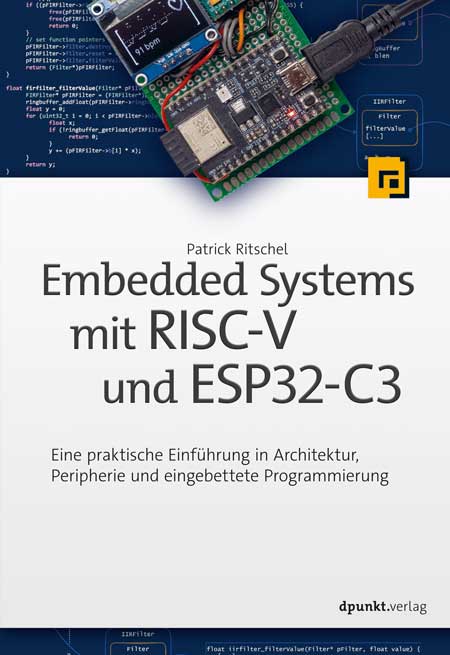
Embedded Systems mit RISC-V und ESP32-C3
Eine praktische Einführung in Architektur, Peripherie und eingebettete Programmierung.Neu und groß im Kommen – RISC-V ist eine auf freier Technologie basierende Befehlssatzarchitektur. In Anwendung im ESP32-C3-DevKitM-1 werden hier grundlegende Konzepte und Funktionsweisen von Mikrocontrollern theoretisch vermittelt.Mehrere Hands-On-Projekte dienen außerdem dazu, Ihnen einen ersten Einblick zu geben, Sie für das selbstständige Programmieren mit Mikrocontrollern vorzubereiten und das Gelernte Schritt für Schritt zu vertiefen.Das Werk ist in drei Teile gegliedert, welche aufeinander aufbauen. Teil eins geht auf den Aufbau eines RISC-V-Mikroprozessors und die hardwarenahe Programmierung ein. Hierbei werden den Leser:innen wichtige Grundlagen mit auf den Weg gegeben. Der zweite Teil setzt den Fokus auf das Erlernen von elektrotechnischen Grundlagen und wie Peripheriemodule angesteuert werden. Im letzten Teil wird ein Pulsoximeter als Beispiel genommen, wie verschiedene Internetprotokolle funktionieren. Eine praktische Betrachtung von Bluetooth LE rundet diesen Teil ab.Über den Autor:Prof.(FH) Dipl-Ing. Patrick Ritschel studierte Informatik an der TU Wien. Anschließend leitete er die Entwicklung von Smart Cards bei der Winter AG. Seit 2003 unterrichtet er embedded Systems, Programmierung und Algorithmik in C, C++ und Java, sowie Mobile Computing an der Fachhochschule Vorarlberg. Er gründete die clownfish IT GmbH, die eingebettete Anwendungen im B2B-Bereich anbietet. In seiner Freizeit zieht es ihn mit seiner Familie auf die Theaterbühne, um zu spielen, zu singen und auch Theaterstücke zu schreiben.Leseprobe (PDF-Link)

Introductory Programs with the 32-bit PIC Microcontroller
Embark on a journey into the world of embedded programming. This book introduces you to the 32bit PIC and will teach you how the main functions of C programming work and can be used with a PIC micro.A one-stop reference for the would-be embedded programmer, you'll explore the electronics needed for a variety of programs as well as how to use different devices with the PIC. The book starts with downloading the environment and creating a simple project, one that uses different oscillators, Phase Lock Loop, and circuitry needed to create the different system clocks—an easy entry point to this exciting environment. You'll also review the MPLABX integrated development environment (IDE) and see how to program the 32Bit PIC, which can be adapted to different PICs.Throughout subsequent chapters, you’ll learn how to use a range of programs that use PIC modules such as the SPI, I2C, UART communication modules, the ADC module, the Capture, Compare, and Pulse Width Modulation module, and the RTCC, Real Time Clock and Calendar Module.WHAT YOU'LL LEARN* Create a project in MPLABX * Configure the different clock frequencies that are used in the 32bit PIC* Build a variable delay subroutine to be used in a simple traffic lights program* Use the MAX 7219 driver IC to control the 8by8 matrix display* Program an I2C expander module to control the display on a LCDWHO THIS BOOK IS FORReaders who want to try their hand at embedded programming, newcomers to programming the PIC 32, programmers who want to look into using MPLAB Harmony 3, and programmers who want to understand how C instructions work with respect to 32bit PIC. Also students who are studying for an engineering qualification.Hubert Ward has nearly 25 years of experience as a college lecturer delivering the BTEC, and now Pearson's, Higher National Certificate and Higher Diploma in Electrical & Electronic Engineering. Hubert has a 2.1 Honours Bachelor's Degree in Electrical & Electronic Engineering. Hubert has also worked as a consultant in embedded programming. His work has established his expertise in the assembler and C programming languages, within the MPLAB X IDE from Microchip, as well as designing electronic circuits, and PCBs, using ECAD software. Hubert was also the UK technical expert in Mechatronics for three years, training the UK team and taking them to enter in the Skills Olympics in Seoul 2001, resulting in one of the best outcomes to date for the UK in Mechatronics.CHAPTER 1 CREATING OUR FIRST PROJECTThis will take the reader through the process of creating a project in MPLABX and how to configure the different clock frequencies that are used in the 32bit PIC. You will start a simple program that allows the user to turn on and off a single LED connected to the PIC.CHAPTER 2 HEADER FILES AND DELAYSThis will take the reader through the important aspect of creating and using local and global header files. We will then look at creating a variable delay subroutine that we will use in a simple traffic lights program.CHAPTER 3 THE SEVEN SEGMENT DISPLAYThis will explain what a seven-segment display is and how they work. Then we will go on to write a program that controls the display.CHAPTER 4 THE LCDThis will introduce the reader to the LCD, Liquid Crystal Display. It will explain how they work and how we can create a program to write to the display. It will then move on to explain how we can create and use special characters to display on the LCD.It will also introduce the reader into the concept of arrays.CHAPTER 5 THE DOT MATRIX DISPLAYThis will introduce the reader into the use of a single 8by8 dot matrix display. It will explain how we can use the MAX 7219 driver IC to control the 8by8 matrix display. It will then go on to explain how to control a series of 4 dot matrix displays cascaded together.CHAPTER 6 COMMUNICATIONThis will look at how we can use the SPI module of the PIC to communicate with some EPROM to store data on. It will also move on to explain how we can use the UART terminal to communicate with a terminal.CHAPTER 7 I2C COMMUNICATIONThis will move on to explain what the I2C communication protocol is and how we can create a program to use I2C. It will then move on to show how we can program an I2C expander module to control the display on a LCD.CHAPTER 8 USING INTERRUPTSThis will introduce the reader into interrupts. It will explain what they are and how we can set up the 32bit PIC to use single vectored and multi-vectored interrupts. It will also explain why and how we can set the interrupts to use different priority levels.CHAPTER 9 THE RTCThis will cover using the external crystal oscillator and interrupts to create an accurate clock signal. This will then display the time of day using the TM1637 IC on four 7 segment displays.CHAPTER 10 THE RTC AND THE DS3231This will look at a real time clock using interrupts and an external crystal. It will then look at the DS3231 RTC Module.CHAPTER 11 THE RTCC MODULE OF THE 32 BIT PIC.In this chapter we will look at using the RTCC module of the 32 bit PIC. It will explain how to create an alarm with the RTCC module. We will also look at using the Parallel Master Port of the PIC to write the data of time etc to the LCD.CHAPTER 12 THE ANALOGUE WORLDThis chapter will explain what analogue and digital signals are. It will then move on to explain how the 32 bit PIC use the ADC module to allow analogue inputs to be used in the PIC. It will look at creating a voltmeter with the PIC and using the TC107A temperature transducer on the 16-explorer development board.CHAPTER 13 THE DHT11This will look at the DHT11 humidity and temperature sensor.This will look at SPI and I2C comms.CHAPTER 14 CREATING A SQUARE WAVEThis will look at creating a square wave with a fixed 50/50 duty cycle using the compare module of the PIC. It will then move onto creating a PWM square wave to creates a variable DC voltage output from the PIC.

Roll away the boring stuff!
Too often, users need to perform the same tasks again and again. It's not only boring, it takes up the time that could be used differently! In this book, you will learn how to do less typing, how Excel can insert formattings and calculations for you, how to establish best relationships between cells, how to adjust table data, that is provided in a less than perfect way and how to arrange the Excel window in a way to find desired features quicker.Ina Koys is an experienced instructor for Microsoft Office. Many questions are frequently asked in trainings, but seldom covered in books. Now she answers some of them in her originally German "short & spicy" series. A little accent will add to the fun :-)

New ways to go!
You’re working with Excel since long, but would like some fresh inspiration? You had an Excel training 15 years ago and wonder what all these new buttons could do for you? Then, this book is for you! We’ll be looking at all new topics from Excel 2007 onwards: Matrix operations, Flash Fill, Conditional Formatting, Sparklines, new formulas and much more. All explained using clear examples, suitable for normal users and insiders.Ina Koys is an experienced instructor for Microsoft Office. Many questions are frequently asked in trainings, but seldom covered in books. Now she answers some of them in her originally German "short & spicy" series. A little accent will add to the fun :-)

Outlook 2021
Nope, it won't make you a coffee right now. But Outlook can write, sort and tag your mail, find lost items, maybe throw away stuff instantly or re-present it at the time you find it suitable. More than that, Outlook can organize appointments, deliver route planning, present pictures of your contacts and much more.Ina Koys is an experienced instructor for Microsoft Office. Many questions are frequently asked in trainings, but seldom covered in books. Now she answers some of them in her originally German "short & spicy" series. A little accent will add to the fun :-)

How to get Instant Overview
Often, Excel is used to evaluate given data. Which values are critical? Can I see at a glance what the development was like? Can I highlight a whole row if one column has important content? Or ask for the content of two cells, simultaneously? How do I get overview in a thick workbook? How do I get a clear and telling chart? Is there anything as clear, but not as large as a diagram? Can I ask Excel in natural language without any formula? All these questions are answered here.Ina Koys is an experienced instructor for Microsoft Office. Many questions are frequently asked in trainings, but seldom covered in books. Now she answers some of them in her originally German "short & spicy" series. A little accent will add to the fun :-)
Deine agile Reise
Was zählt für dich als Agile Coach wirklich? Wie kannst du mehr Wirkung in der Arbeitswelt entfalten? Finde es heraus!- 99 erkenntnisreiche Selbstcoaching-Übungen mit unterschiedlichem Fokus- die Methoden der Übungen kommen aus den Bereichen Journaling, agilen Methoden und Systemisches Coaching- Gestalte dein Lernbacklog, um deine agile Reise aktiv zu gestaltenDas Arbeitsbuch "Deine Agile Reise" ist eine Kombination aus Selbstcoaching und Training. Es bietet dir die perfekten Mischung aus fachlich fundierten Fakten aus der agilen und systemischen Welt sowie eigenen Erfahrungen, die die Autorin Janna Wurdig ehrlich mit dir teilt. Die Übungen und Aufgaben aus dem Buch führen dich aktiv mit Stift, Papier und Post-its zu neuen Erkenntnissen zu deiner Rolle als Agile Coach.Schnapp dir einen Stift und starte deine agile Reise!Janna Wurdig ist Expertin für Agilität, Teamentwicklung und moderne Arbeitsweisen im digitalen Wandel. Als Agile Coach und Senior Consultant für Future Work bei der esentri AG arbeitet sie gemeinsam mit ihren Kund*innen an Haltung, Fähigkeiten, Werkzeugen und Strukturen, die eine agile, nachhaltige und wertstiftende (Zusammen-)Arbeit ermöglichen. Mit viel Leidenschaft unterstützt sie mutige Entscheidungen, Entwicklung und neues Denken. Hierbei setzt sie auf gemeinsames Wachstum und Potenzialentfaltung. Erfahre mehr: www.deine-agile-reise.de/ueber-mich
Software Transparency
DISCOVER THE NEW CYBERSECURITY LANDSCAPE OF THE INTERCONNECTED SOFTWARE SUPPLY CHAINIn Software Transparency: Supply Chain Security in an Era of a Software-Driven Society, a team of veteran information security professionals delivers an expert treatment of software supply chain security. In the book, you’ll explore real-world examples and guidance on how to defend your own organization against internal and external attacks. It includes coverage of topics including the history of the software transparency movement, software bills of materials, and high assurance attestations. The authors examine the background of attack vectors that are becoming increasingly vulnerable, like mobile and social networks, retail and banking systems, and infrastructure and defense systems. You’ll also discover:* Use cases and practical guidance for both software consumers and suppliers* Discussions of firmware and embedded software, as well as cloud and connected APIs* Strategies for understanding federal and defense software supply chain initiatives related to securityAn essential resource for cybersecurity and application security professionals, Software Transparency will also be of extraordinary benefit to industrial control system, cloud, and mobile security professionals. CHRIS HUGHES is the co-founder and Chief Information Security Officer of Aquia. He is an Adjunct Professor for M.S. Cybersecurity programs at Capitol Technology University and the University of Maryland Global Campus, and a co-host of the Resilient Cyber Podcast. TONY TURNER has 25 years’ experience as a cybersecurity engineer, architect, consultant, executive, and community builder. He is the Founder of Opswright, a software company creating solutions for security engineering in critical infrastructure and leads the OWASP Orlando chapter.