

Programmierung

Understanding Generative AI Business Applications
This guide covers the fundamental technical principles and various business applications of Generative AI for planning, developing, and evaluating AI-driven products. It equips you with the knowledge you need to harness the potential of Generative AI for enhancing business creativity and productivity.The book is organized into three sections: text-based, senses-based, and rationale-based. Each section provides an in-depth exploration of the specific methods and applications of Generative AI. In the text-based section, you will find detailed discussions on designing algorithms to automate and enhance written communication, including insights into the technical aspects of transformer-based Natural Language Processing (NLP) and chatbot architecture, such as GPT-4, Claude 2, Google Bard, and others. The senses-based section offers a glimpse into the algorithms and data structures that underpin visual, auditory, and multisensory experiences, including NeRF, 3D Gaussian Splatting,Stable Diffusion, AR and VR technologies, and more. The rationale-based section illuminates the decision-making capabilities of AI, with a focus on machine learning and data analytics techniques that empower applications such as simulation models, agents, and autonomous systems.In summary, this book serves as a guide for those seeking to navigate the dynamic landscape of Generative AI. Whether you’re a seasoned AI professional or a business leader looking to harness the power of creative automation, these pages offer a roadmap to leverage Generative AI for your organization’s success.WHAT YOU WILL LEARN* What are the technical elements that constitute the makeup of Generative AI products?* What are the practical applications of Generative AI?* How can algorithms be designed to automate and improve written communication?* What are the latest Generative AI architectures and algorithms?WHO THIS BOOK IS FORData scientists, data analysts, decision makers, and business executives interested in gaining an understanding of Generative AI productsIRENA CRONIN is SVP of Product for DADOS Technology, which is making an app for the Apple Vision Pro that does data analytics and visualization. She is also the CEO of Infinite Retina, which provides research to help companies develop and implement AI, AR and other new technologies for their businesses. Prior to this, she worked for several years as an equity research analyst and gained extensive experience in evaluating both public and private companies.Irena has a joint MBA/MA from the University of Southern California and an MS with Distinction in Management and Systems from New York University. She graduated with a BA from the University of Pennsylvania with a major in Economics (summa cum laude).Chapter 1: Introduction to the World of Generative AI.- Chapter 2: Core Technical Concepts.- Chapter 3: The Business Case for Generative AI.- Chapter 4: The World of Text-based Generative AI.- Chapter 5: Unpacking Transformer-based NLP.- Chapter 6: Exploring Chatbot Technologies.- Chapter 7: Advanced Applications of Text-based AI.- Chapter 8: Senses-based Generative AI Demystified.- Chapter 9: In-depth Look at Supportive Visual Algorithms and Computer Vision.- Chapter 10: The Auditory and Multisensory Experience.- Chapter 11: Autonomous AI Agents: Decision Making, Data, and Algorithms.- Chapter 12: Text-based Generative Intelligent Agents: Beyond Traditional Chatbots and Virtual Assistants.- Chapter 13: Applications and Real-world Case Studies.- Chapter 14: Summarizing Key Insights.- Chapter 15: The Evolving World of Generative AI.
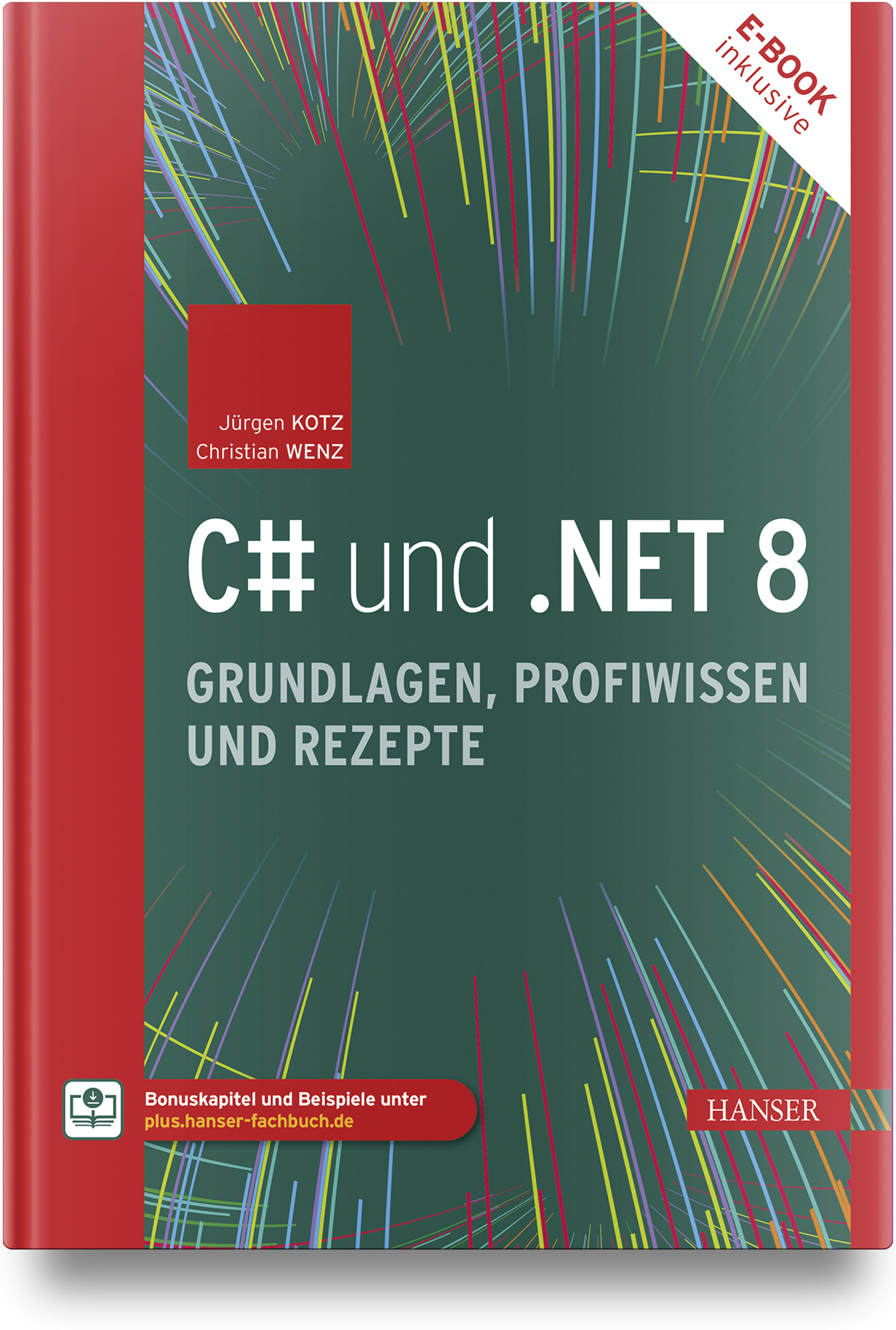
C# und.NET 8
C# und.NET 8 - Grundlagen, Profiwissen und Rezepte (Mai 2024)Dieser komplett überarbeitete Klassiker der C#-/.NET-Programmierung bietet Ihnen Know-how und zahlreiche Rezepte, mit denen Sie häufig auftretende Probleme meistern. Einsteiger erhalten ein umfangreiches Tutorial zu den Grundlagen der C# 12-Programmierung mit Visual Studio, dem Profi liefert es fortgeschrittene Programmiertechniken zu allen wesentlichen Einsatzgebieten der Programmierung mit .NET 8. Zum sofortigen Ausprobieren finden Sie am Ende eines jeden Kapitels hochwertige Lösungen für nahezu jedes Problem.Das Buch gliedert sich in einen Grundlagenteil zur Programmierung, eine Einführung in die Desktop-Programmierung (WPF, MAUI (Multi-platform App UI), einen Technologieteil zu fortgeschrittenen Themen sowie einen Teil zur Web-Programmierung (ASP.NET Core, MVC, Razor, Web-API, Blazor).Es ist der ideale Begleiter für Ihre tägliche Arbeit und zugleich – dank der erfrischenden und unterhaltsamen Darstellung – eine spannende Lektüre, die Lust macht, Projekte auch in der Freizeit umzusetzen.Leseprobe (PDF-Link)Über die Autoren: Jürgen Kotz arbeitet seit über 20 Jahren als freiberuflicher Trainer, Berater, Entwickler und Autor. Mit .NET beschäftigt er sich seit der ersten Beta-Version. Mit seiner Firma PrimeTime Software in München entwickelt er .NET-Projekte und führt Schulungen in diesem Umfeld durch. Seine Hauptthemen sind dabei die Entwicklung von REST- bzw. SOAP-basierten Services und der Datenzugriff mittels Entity Framework. Darüber hinaus hat er zahlreiche Fachbücher und -artikel geschrieben.Christian Wenz arbeitet als Berater, Trainer und Autor mit Schwerpunkt auf Webtechnologien und ist Autor oder Co-Autor von über 100 Computerbüchern. Er schreibt regelmäßig Beiträge für verschiedene IT-Magazine und hält Vorträge auf Konferenzen rund um den Globus. In seiner täglichen Arbeit ist er einer der Gründer der Webagentur Arrabiata Solutions mit Büros in München und London.

C# und .NET 8 - Grundlagen, Profiwissen und Rezepte
- Für Einsteiger, Fortgeschrittene und Profis - Windows(WPF und .NET MAUI)- und Web-Programmierung (ASP.NET Core, Blazor und Co.) - Datenbankprogrammierung mit Entity Framework Core 8 - Online: Bonuskapitel u. a. zur GUI-Entwicklung mit Windows Forms sowie alle Beispiele aus dem Buch unter http://plus.hanser-fachbuch.de - Ihr exklusiver Vorteil: E-Book inside beim Kauf des gedruckten Buches Dieser überarbeitete Klassiker der C#-/.NETProgrammierung bietet Ihnen Know-how und zahlreiche Rezepte, mit denen Sie häufig auftretende Probleme meistern. Einsteiger erhalten ein umfangreiches Tutorial zu den Grundlagen der C# 12-Programmierung mit Visual Studio 2022, dem Profi liefert es fortgeschrittene Programmiertechniken zu allen wesentlichen Einsatzgebieten der Programmierung mit .NET 8. Zum sofortigen Ausprobieren finden Sie am Ende eines jeden Kapitels hochwertige Lösungen für nahezu jedes Problem. Das Buch gliedert sich in einen Grundlagenteil zur Programmierung, eine Einführung in die Desktop-Programmierung mit WPF und .NET MAUI(Multi-Platform App UI), einen Technologieteil zu fortgeschrittenen Themen sowie einen Teil zur Web-Programmierung (ASP.NET Core, Web API, Blazor). Es ist der ideale Begleiter für Ihre tägliche Arbeit und zugleich eine unterhaltsame Lektüre, die Lust macht, Projekte auch in der Freizeit umzusetzen. AUS DEM INHALT // - Grundlagen der Sprache - OOP-Konzepte - Arrays, Strings, Funktionen - Einführung in LINQ - Neuerungen in C# - Einführung in WPF - WPF Controls, WPF-Datenbindung - Einführung in .NET MAUI - Asynchrone Programmierung & Task Parallel Library - Debugging, Fehlersuche und -behandlung - Entity Framework Core 8 und JSON-Serialisierung - Webanwendungen und APIs mit ASP.NET Core - Single-Page Applications (SPAs) mit Blazor

Spieleentwicklung mit Unity
Unity – die geniale Plattform steckt hinter großen Games wie Among Us und Pokémon Go und wird in der Indie-Szene geliebt. Egal, ob du gerade einsteigst oder schon eine Karriere in der Games-Branche im Blick hast: Dieses Handbuch ist der perfekte Begleiter, wenn du die sagenhafte Engine meistern willst. Von den Grundkonzepten über Prefabs und Scripte bis zum komplexen 3D-Spiel mit coolen Mechaniken wirst du nach und nach zum Profi. Dieses Handbuch ist einstiegsfreundlich und umfassend zugleich. Max Schlosser zeigt dir von der Installation an, wie es geht, hält Praxisbeispiele bereit und hört auch bei anspruchsvollen Themen nicht auf, alles genau zu erklären. Du programmierst dabei nicht einfach Fertiges nach, sondern baust dir ein solides Repertoire auf, inklusive der Konzepte, Scripting mit C# und der Logik hinter den Effekten. Trainiere deine Skills und mach aus deinen besten Ideen spielbare Games! Aus dem Inhalt: Installation und erste SchritteAnimationen und SoundLebewesen automatisch navigierenKlassiker wie Pong, Flappy Bird und Tower Defense selbst entwickelnUI-Layouts optimierenDas Physik-System geschickt einsetzenScripting-Grundlagen mit C# Objektorientierung, Generics, LINQ u. v. m.Partikel und Modelle Materialien zum Buch ... 25 Vorwort ... 27 1. Einführung ... 29 1.1 ... Das Problem vieler Einsteiger ... 29 1.2 ... Wichtige Ansätze des Buches ... 30 1.3 ... Lernen mit dem Buch ... 32 1.4 ... Vorstellung der Kapitel ... 35 2. Die Unity-Engine ... 39 2.1 ... Was ist eigentlich Unity? ... 39 2.2 ... Installation ... 42 2.3 ... Erstellung des ersten Unity-Projekts ... 55 2.4 ... Mit den Downloadmaterialien zum Buch arbeiten ... 58 3. Grundlegende Konzepte in der Engine ... 61 3.1 ... Der erste Überblick über Unity ... 61 3.2 ... Game Objects und Components ... 74 3.3 ... Orientierung in der Scene View ... 95 3.4 ... Parenting ... 102 3.5 ... Musterlösungen für die Übungen ... 107 4. Das erste Script ... 109 4.1 ... Scripts und die Sprache C# ... 110 4.2 ... Das erste Script erstellen ... 110 4.3 ... Aufbau eines neu erstellten Scripts ... 115 4.4 ... Das erste Script zum Leben erwecken ... 120 4.5 ... Musterlösungen für die Übungen ... 127 5. Grundlegende Konzepte der Sprache C# ... 129 5.1 ... Einfache Methoden ... 130 5.2 ... Datentypen und Variablen ... 136 5.3 ... Datentypen für Zahlen und Textzeichen ... 152 5.4 ... Methoden mit Rückgabewerten und Parametern ... 167 5.5 ... Boolesche Logik ... 179 5.6 ... if-Abfragen ... 188 5.7 ... Arrays ... 201 5.8 ... Schleifen ... 209 5.9 ... Enumerationstypen ... 219 5.10 ... switch-Anweisung ... 223 5.11 ... Praktische Hilfsmittel für Zahlen und Text ... 227 5.12 ... Umgang mit Fehlern ... 231 5.13 ... Musterlösungen für die Übungen ... 243 6. Scripting in Unity ... 251 6.1 ... Über Scripts die Transform-Component verändern ... 251 6.2 ... Anwendungsbeispiel: Einen Spielcharakter steuern ... 266 6.3 ... Interaktion zwischen mehreren Scripts ... 282 6.4 ... Game Objects und weitere nützliche Funktionen ... 294 6.5 ... Weitere Kenntnisse zu Scenes ... 304 6.6 ... Musterlösungen für die Übungen ... 311 7. Übungskomplex 1 ... 315 7.1 ... Aufgaben ... 315 7.2 ... Tipps ... 317 7.3 ... Lösungen ... 318 8. Physik ... 323 8.1 ... Grundlagen physikalischer Simulationen ... 323 8.2 ... Physik und Scripting ... 335 8.3 ... Raycasting ... 349 8.4 ... Musterlösungen für die Übungen ... 357 9. Fortgeschrittene Scripting-Themen ... 361 9.1 ... Coroutines ... 361 9.2 ... PlayerPrefs ... 373 9.3 ... Attribute ... 375 9.4 ... Scriptable Objects ... 383 9.5 ... Musterlösungen für die Übungen ... 389 10. Prefabs ... 395 10.1 ... Prefabs erstellen ... 398 10.2 ... Prefabs über Code instanziieren ... 407 10.3 ... Musterlösungen für die Übungen ... 414 11. Übungskomplex 2 ... 417 11.1 ... Aufgaben ... 417 11.2 ... Tipps ... 419 11.3 ... Lösungen ... 421 12. Objektorientierte Programmierung ... 435 12.1 ... Grundlagen der objektorientierten Programmierung ... 435 12.2 ... Referenz- und Wertetypen ... 439 12.3 ... Der Konstruktor ... 454 12.4 ... Das Schlüsselwort »static« ... 460 12.5 ... Properties ... 466 12.6 ... Vererbung ... 474 12.7 ... Die Basisklasse »object« und ihre Möglichkeiten ... 491 12.8 ... Abstraktionen ... 497 12.9 ... Musterlösungen für die Übungen ... 513 13. 2D-Inhalte ... 519 13.1 ... Projekte mit dem 2D-Template erstellen ... 519 13.2 ... Sprites ... 522 13.3 ... 2D-Physik ... 542 13.4 ... Tilemaps ... 547 13.5 ... Musterlösungen für die Übungen ... 556 14. User Interfaces ... 561 14.1 ... Grundlagen zu UI in Unity ... 561 14.2 ... Grundlegende Anordnung von UI-Elementen ... 567 14.3 ... UI-Components ... 585 14.4 ... UI-Layouts zusammensetzen ... 619 14.5 ... Musterlösungen für die Übungen ... 637 15. Visualisierung ... 647 15.1 ... Einstellungen im Projekt ... 647 15.2 ... Licht ... 650 15.3 ... Arbeit mit 3D-Assets ... 661 15.4 ... Partikelsysteme (Shuriken) ... 673 15.5 ... Terrains ... 686 15.6 ... Bauen des Spiels ... 698 16. Animation ... 703 16.1 ... Beispiel: Einführung in das Animationssystem ... 703 16.2 ... Details -- Animation Clips ... 713 16.3 ... Details -- Animator Controller ... 733 16.4 ... Musterlösungen für die Übungen ... 766 17. Sound ... 771 17.1 ... Grundlagen von Sound ... 771 17.2 ... Sounds und Scripting ... 778 17.3 ... Anpassung von Sounds ... 785 17.4 ... Mikrofoneingaben ... 794 17.5 ... Musterlösung für die Übungen ... 796 18. Navigation ... 799 18.1 ... Einführung in das Navigationssystem ... 799 18.2 ... Weitere NavMesh-Components ... 811 18.3 ... Musterlösungen für die Übungen ... 817 19. Fortgeschrittene Konzepte der Sprache C# ... 819 19.1 ... Collections ... 819 19.2 ... Datenklassen und ihre Möglichkeiten ... 827 19.3 ... Generics ... 833 19.4 ... Delegates ... 840 19.5 ... Events ... 852 19.6 ... LINQ ... 860 19.7 ... Speicherung von Daten mit JSON ... 867 19.8 ... Musterlösungen für die Übungen ... 879 20. Übungskomplex 3 ... 883 20.1 ... Aufgaben ... 883 20.2 ... Tipps ... 886 20.3 ... Lösungen ... 888 21. Übungskomplex 4 ... 915 21.1 ... Aufgaben ... 916 21.2 ... Tipps ... 921 22. Ausblick ... 923 Index ... 925

Agiles IT-Projektmanagement
Verantwortung für digitale Produkte zu tragen, ist nicht leicht. Agilität hilft, ist aber auch anspruchsvoll: Mit Prototypen und kurzen Iterationen stehen Sie ständig im Kontakt auch mit Kritikern und sind für Team, Budget, Backlog und vieles mehr zuständig. Für jedes Problem gibt es im Dschungel der agilen Methoden gewiss eine Lösung – aber wie finden Sie die richtige für Ihr Projekt und Ihre Kunden? Unsere Autoren kennen die einschlägigen Methoden bestens und teilen ihre Expertise aus jahrzehntelanger Projekterfahrung mit Ihnen. Zum einen systematisch, zum anderen mit vielen Fallbeispielen. Lernen Sie aus kritischen Situationen in spannenden IT-Großprojekten ebenso wie aus Alltagssituationen in kleineren Teams und Unternehmen. Seien Sei dabei, lernen Sie dazu! Aus dem Inhalt: Für wen, wann und wo? Kontexte und Nutzende verstehenEinführung in Scrum, Kanban und Co.Methodischer LeitfadenRollen, Artefakte und MeetingsAnforderungen verstehen, beschreiben und managenProjekt- und Task-Management-Tools: das richtige auswählenCollaboration-Tools einsetzenReporting: Daten aus verschiedenen Quellen nutzenGelungen kommunizierenDigitale Projekte erfolgreich abschließenHäufige Denkfehler und FehlannahmenViele Fallbeispiele Zum Einstieg -- für wen ist dieses Buch? ... 13 1. Agiles Projektmanagement im digitalen Kontext ... 15 1.1 ... Warum lean und agil? ... 16 1.2 ... Besonderheiten und Merkmale eines digitalen Projekts ... 25 1.3 ... Rollen und Verantwortlichkeiten eines digitalen Projekts ... 28 1.4 ... Management- und Skillanforderungen eines digitalen Projekts ... 31 2. Von der Idee zum erfolgreichen digitalen Projekt ... 35 2.1 ... Der Start eines digitalen Projekts ... 37 2.2 ... Häufige Fehlannahmen und Probleme ... 39 2.3 ... Potenziale und Herausforderungen ... 46 2.4 ... Budget und Mittel im Projektmanagement ... 52 2.5 ... Roadmap und Ziele des Projektmanagements ... 59 2.6 ... Wichtige Projektarten und Ebenen im Projektmanagement ... 64 2.7 ... Relevante Rollen im Projektmanagement ... 70 2.8 ... Aufgaben und Verantwortung im Projektmanagement ... 78 2.9 ... Handlungsraum im Projektmanagement ... 89 2.10 ... Kommunikation im Projektmanagement ... 90 2.11 ... Den Kontext und den Nutzer verstehen ... 94 2.12 ... Anforderungen ableiten, beschreiben und managen ... 98 2.13 ... Ein digitales Projekt erfolgreich abschließen ... 104 3. Methodischer Leitfaden -- Werkzeuge des digitalen Projektmanagements ... 107 3.1 ... Time, Scope und Budget ... 108 3.2 ... Auftraggeber- und Stakeholdermanagement ... 127 3.3 ... Kommunikation ... 145 3.4 ... Ausrichtung und Zielerreichung ... 153 3.5 ... Tools, die Ihnen die Arbeit erleichtern ... 180 4. Fallbeispiele ... 185 4.1 ... Transformation der Arbeitsweise eines Telekommunikationskonzerns -- von Wasserfall zu agil ... 186 4.2 ... Redesign einer Enterprise-Resource-Planning(ERP)-Software ... 194 4.3 ... Aus vielen Programmen mache eins! ... 199 4.4 ... Relaunch eines Kundenportals ... 203 4.5 ... Stufenweise Portale vereinen ... 207 4.6 ... Eine Shop-Software in die Spur führen ... 210 4.7 ... Strategisches Kompetenzmanagement im Konzernkontext ... 214 4.8 ... Komplexitätsreduktion eines Consumer- und IT-Systems ... 218 4.9 ... Komplettaufbau eines Carsharing-Systems als Innovationsprojekt ... 222 Index ... 229
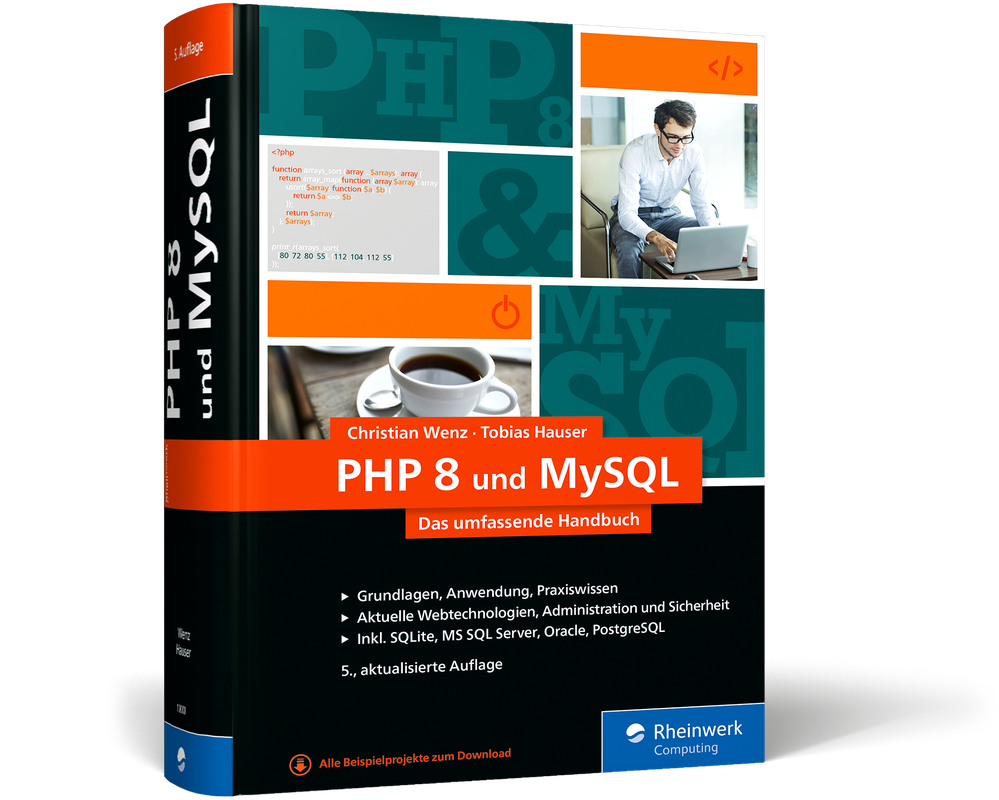
PHP 8 und MySQL - Das umfassende Handbuch (5. Auflage)
PHP 8 und MySQL - Das umfassende Handbuch. In 5., aktualisierter Auflage (2024).Dynamische Webseiten mit PHP und MySQL programmieren: Alles, was Sie dafür wissen müssen, steht in diesem bewährten Standardwerk. Profitieren Sie von einer praxisorientierten Einführung und lernen Sie auch alle neuen Sprachfeatures von PHP 8 kennen. Die Autoren Christian Wenz und Tobias Hauser sind erfahrene PHP-Programmierer und Datenbankspezialisten. Sie zeigen Ihnen, wie Sie MySQL und andere Datenbanksysteme effektiv einsetzen. Mit diesem Wissen machen Sie sich rundum fit für die Entwicklung dynamischer Websites. Aktuell zur Version 8.3.Webtechnologien im Zusammenspiel1. Lernen Sie die Grundlagen von PHPDie erfahrenen Autoren begleiten Sie sicher bei Ihren ersten Schritten: von der Installation (Linux, macOS und Windows), einer kompletten Spracheinführung bis hin zur Wahl des richtigen Datenbanksystems (SQLite, Microsoft SQL Server, PostgreSQL u. v. m.). Inkl. allen Neuerungen von PHP 8!2. Entwickeln Sie leistungsfähige WebsitesSie erfahren, wie Sie wichtige Basis-Webtechniken anwenden. Egal, ob Sie Formulare, Sessions oder Cookies einsetzen oder von PHP aus E-Mails versenden möchten. Anhand vieler Code- und Anwendungsbeispiele lernen Sie alles, was Sie im Alltag als PHP-Programmierer brauchen.3. Programmieren Sie sichere PHP-AnwendungenKommunizieren Sie mit der Außenwelt und greifen Sie via HTTP auf verschiedene Webdienste zu. Lernen Sie u. a. die Interaktion mit JavaScript kennen. Vermeiden Sie durch Benutzerauthentifizierung, PHP-Konfiguration, Fehlersuche und Debugging gefährliche Sicherheitslücken.Aus dem Inhalt:Installation von PHP und MySQLEinstieg in PHPAlle neuen Sprachfeatures von PHP 8Strings, Arrays, mathematische Funktionen und Datumsfunktionen, reguläre AusdrückeObjektorientiert programmieren, Namespaces, Traits und mehrFormulare, Cookies, Sessions, E-MailEinführung in SQLDatenbanken: MySQL, SQLite, Microsoft SQL Server, Oracle, PostgreSQL, MongoDBLeseprobe (PDF-Link)Über die Autoren: Christian Wenz ist Berater und Trainer mit Schwerpunkt Webtechnologien und Web-Security und führt Digitalisierungsprojekte im Unternehmensumfeld im In- und Ausland durch.Als Buchautor schreibt Tobias Hauser zu wichtigen Webthemen. Als Berater und Trainer unterstützt er Unternehmen mit seinem Schwerpunkt auf PHP-basierten Webanwendungen in allen Fragen von der Systemauswahl bis hin zur Schnittstellenarchitektur.
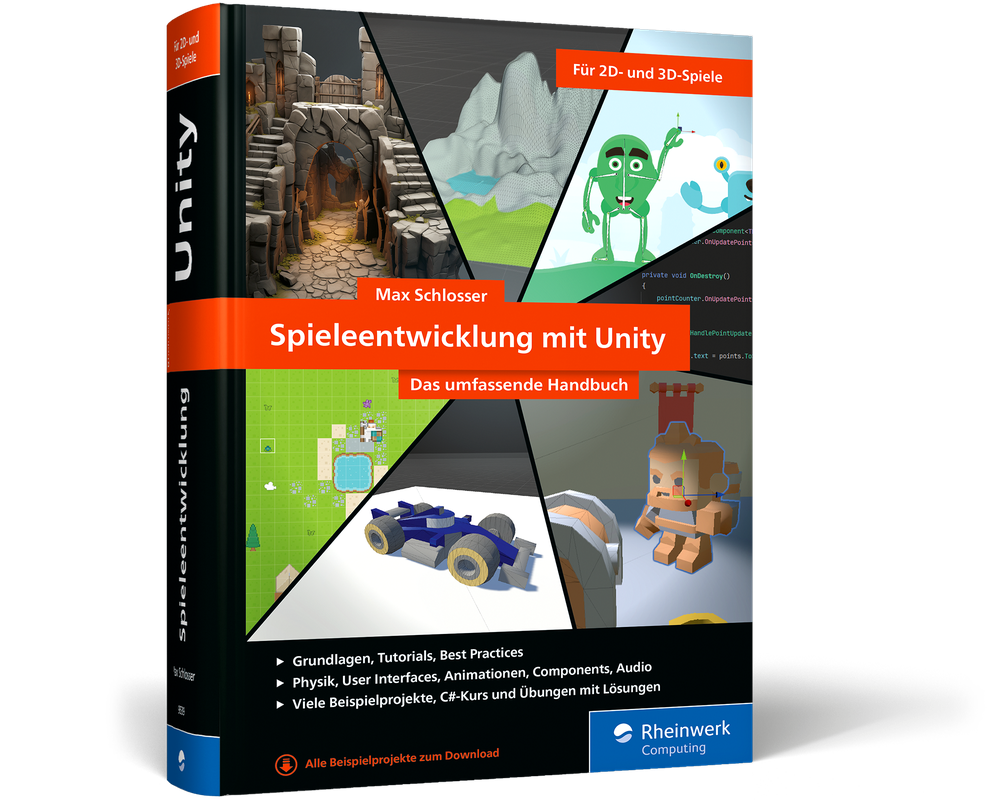
Spieleentwicklung mit Unity - Das umfassende Handbuch
Spieleentwicklung mit Unity - Das umfassende Handbuch (2024).Unity ist die Plattform für die Spieleentwicklung – egal, ob du gerade einsteigst oder schon eine Karriere in der Games-Branche im Blick hast. Unity steckt hinter großen Games wie Among Us und Pokémon Go und wird in der Indie-Szene geliebt. Lerne die sehr mächtigen und vielfältigen Möglichkeiten kennen! Dieses Handbuch ist dafür der perfekte Begleiter. Von den Grundkonzepten der Engine über Prefabs und Scripts bis zum komplexen 3D-Spiel mit coolen Features wirst du nach und nach zum Profi. Also: Wenn du Unity meistern willst und etwas Zeit und Ehrgeiz mitbringst, dann geht die Reise hier los.So baust du deine Skills auf1. Einsteigen und los – und dann immer weiter lernenDieses Handbuch ist einstiegsfreundlich und umfassend. Autor Max zeigt dir von der Installation an, wie es geht, hält Praxisbeispiele bereit und hört auch bei anspruchsvollen Themen nicht auf, alles genau zu erklären.2. Praxis – mehr als BeispielprojekteMit den vielen Übungen im Buch trainierst du deine Skills. Du programmierst dabei nicht einfach Fertiges nach, sondern lernst die Konzepte, das Scripting mit C# und die Logik dahinter gründlich kennen. Bau dir ein immer besseres Repertoire auf und mach aus deinen eigenen Ideen spielbare Games!3. Professionell in 2D wie 3DOb in zwei oder drei Dimensionen: Übersichtliche UIs, robuster und sauberer Code, aufregende Spielewelten und realistische Effekte kommen nicht von ungefähr. Auch zu den Profi-Themen gibt es haufenweise Material zum Üben. Und wohin führt bekanntlich Übung? Genau – zur Meisterschaft!Aus dem Inhalt:Installation und erste SchritteAnimationen und SoundLebewesen automatisch navigierenKlassiker wie Pong, Flappy Bird und Tower Defense selbst entwickelnUI-Layouts optimierenDas Physik-System geschickt einsetzenScripting-Grundlagen mit C#Objektorientierung, Generics, LINQ u.v.m.Partikel und ModelleLeseprobe (PDF-Link)Über den Autor:Max Schlosser ist Masterstudent und wissenschaftlicher Mitarbeiter in der Medieninformatik an der Hochschule Mittweida und durch und durch Games-Fan.

Einstieg in Flutter mit Dart
Dieses Buch vermittelt kompakt und praxisorientiert die wesentlichen Grundlagen von Flutter und Dart. Die Praxismodule, aufgebaut als Schritt-für-Schritt-Anleitungen, sind durchgehend mit Screenshots und Abbildungen illustriert und bieten eine fundierte Basis auch für die weitergehende Arbeit mit Flutter. Dartcodes veranschaulichen ergänzend Wort und Bild der Anleitungen, so kann das Programm durch praktische Arbeit erlernt werden.Die im Buch verwendeten Codedateien stehen zum Download auf GitHub bereit.PETER BÜHLER war viele Jahre als Lehrer für Mediengestaltung Digital und Print an der Johannes-Gutenberg-Schule in Stuttgart tätig. Gleichzeitig war er Fachberater im Berufsfeld Druck- und Medientechnik am Regierungspräsidium Stuttgart. Er war Mitglied in Rahmenlehrplankommissionen für Mediengestalter sowie für Industriemeister und Medienfachwirte in den Bereichen Print und Digital. Darüber hinaus in IHK-Prüfungsausschüssen, in der Koordinierungsgruppe Druck und Medien am Kultusministerium Baden-Württemberg sowie im Zentral-Fachausschuss für Druck und Medien.Peter Bühler ist Autor mehrerer Fachbücher im Bereich Medientechnik, unter anderem in der Reihe Bibliothek der Mediengestaltung, die ebenfalls bei Springer Vieweg erscheint.Installation.- New Flutter Project.- Erste App - Hallo Welt.- Layout.- Dart.- Interaktion - Projekte.- Navigation.- SQFLite - Offline-Datenbank.
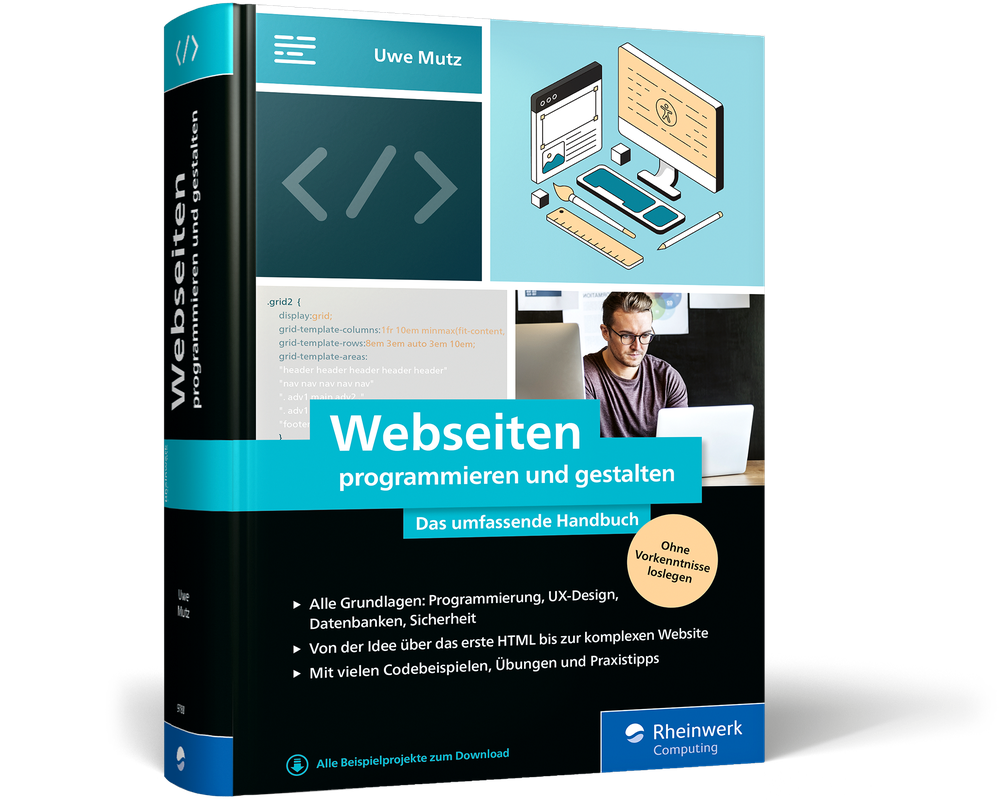
Webseiten programmieren und gestalten - Das umfassende Handbuch
Webseiten programmieren und gestalten - Das umfassende HandbuchGute Webseiten zu entwickeln ist eine vielseitige Kunst: Ein Gespür für die Gestaltung ist ebenso gefragt wie solide Kenntnisse der Web-Sprachen HTML und JavaScript. Hinzu kommt die Serverseite, hier ist PHP die beliebteste Wahl. Der erfahrene Webexperte und Dozent Uwe Mutz beweist mit diesem Handbuch, dass sich lehren und lernen lässt, was Sie als Webseiten-Profi brauchen. Es ist der perfekte Begleiter für eine ganzheitliche Ausbildung und für den Beruf. Frisch ans Werk, programmieren und gestalten Sie professionelle Webauftritte! Ideal zum Lernen, Auffrischen und Nachschlagen.Ihr Weg zum Webseiten-Profi1. Grundlagen zuerstZum Einstieg ist ein gutes Fundament unverzichtbar: HTML, CSS und JavaScript wollen ebenso verstanden werden wie das Vorgehen beim Aufbau einer neuen Website. Dieses Buch nimmt Sie zu allen Themen an die Hand und hilft auch, Ihre Entwicklungsumgebung aufzusetzen.2. Technologie und MenschFarbeinsatz, User Experience, Inhaltsarchitektur ... in diesem Handbuch kommen auch die gestalterischen Themen nicht zu kurz. Auch Performanz und Barrierefreiheit spielen eine wichtige Rolle. Eignen Sie sich technisches Know-how an und blicken Sie über den Tellerrand – im Dienste wirklich guter Webentwicklung!3. Den Fullstack im BlickZum Frontend kommt ein Backend, wenn eine Website Funktionalitäten wie Buchungen oder Informationsdienste bieten soll. Nicht immer gibt es hier eine Arbeitsteilung – nutzen Sie die Chance und nehmen Sie die beliebte Backend-Sprache PHP sowie das Datenbanksystem MySQLi in Ihr Repertoire auf!4. Experten-NiveauLernen Sie wichtige Konzepte und Best Practices kennen und programmieren Sie effizient und effektiv. Werden Sie Profi für Webauftritte, die höchsten Ansprüchen genügen!Aus dem Inhalt:Eine Arbeitsumgebung einrichtenClientseitige Grundlagen: HTML, CSS und JavaScriptUser-Zentrierung und GestaltungsprinzipienEinblicke in Usability und BarrierefreiheitGrundlagen der ProgrammierungServerseitige Technologien: PHP und MySQLEin Datenbankschema entwerfenVerschlüsselungsstandardsSQL-Injections und anderen Angriffen vorbeugenBeispielprojekte: Bibliotheksverwaltung, Onlineshop, Mitgliederverwaltung, Dienstpläne u. v. m.Leseprobe(PDF-Link)Über den Autor: Uwe Mutz ist Web-Entwickler der ersten Stunde, Geschäftsführer der SYNE Marketing & Consulting GmbH, Autor zahlreicher Fachbücher und Vortragender an der Universität für Weiterbildung Krems.

Reinforcement Learning
In uralten Spielen wie Schach oder Go können sich die brillantesten Spieler verbessern, indem sie die von einer Maschine produzierten Strategien studieren. Robotische Systeme üben ihre Bewegungen selbst. In Arcade Games erreichen lernfähige Agenten innerhalb weniger Stunden übermenschliches Niveau. Wie funktionieren diese spektakulären Algorithmen des bestärkenden Lernens? Mit gut verständlichen Erklärungen und übersichtlichen Beispielen in Java und Greenfoot können Sie sich die Prinzipien des bestärkenden Lernens aneignen und in eigenen intelligenten Agenten anwenden. Greenfoot (M.Kölling, King’s College London) und das Hamster-Modell (D.Bohles, Universität Oldenburg) sind einfache, aber auch mächtige didaktische Werkzeuge, die entwickelt wurden, um Grundkonzepte der Programmierung zu vermitteln. Wir werden Figuren wie den Java-Hamster zu lernfähigen Agenten machen, die eigenständig ihre Umgebung erkunden. Die zweite Auflage enthält neue Themen wie "Genetische Algorithmen" und "Künstliche Neugier" sowie Korrekturen und Überarbeitungen.UWE LORENZ war nach seinem Studium der Informatik und Philosophie mit Schwerpunkt künstliche Intelligenz und maschinelles Lernen an der Humboldt-Universität in Berlin und einigen Jahren als Projektingenieur für 10 Jahr als Gymnasiallehrer für Informatik und Mathematik tätig. Seit seinem Erstkontakt mit Computern Ende der 80er Jahre hat ihn das Thema Künstliche Intelligenz nicht mehr losgelassen. Derzeit arbeitet er als wissenschaftlicher Mitarbeiter in der Arbeitsgruppe Didaktik der Informatik bei Prof. Dr. Romeike an der Freien Universität Berlin in einem Projekt zur Thematik "Verantwortungsvolle Künstliche Intelligenz in der Lehramtsausbildung".Bestärkendes Lernen als Teilgebiet des Maschinellen Lernens.- Grundbegriffe des Bestärkenden Lernens.- Optimale Entscheidungen in einem bekannten Umweltsystem.- Entscheiden und Lernen in einem unbekannten Umweltsystem.- Neuronale Netze als Schätzer für Zustandsbewertungen und Aktionspreferenzen.- Werden digitale Agenten bald intelligenter als Menschen sein?.- Leitbilder in der KI.

JavaScript Essentials For Dummies
THE CONCISE AND DIGESTIBLE GET-STARTED GUIDE TO JAVASCRIPT PROGRAMMINGJavaScript Essentials For Dummies is your quick reference to all the core concepts about JavaScript—the dynamic scripting language that is often the final step in creating powerful websites. This no-nonsense book gets right to the point, eliminating review material, wordy explanations, and fluff. Find out all you need to know about the foundations of JavaScript, swiftly and crystal clear. Perfect for a brush-up on the basics or as an everyday desk reference on the job, this is the reliable little book you can always turn to for answers.* Get a quick and thorough intro to the basic concepts of coding with JavaScript* Review what you've already learned or pick up essential new skills* Add interactive features to websites with JavaScript programming* Keep this concise reference book handy for jogging your memory as you workThis book is to the point, focusing on the key topics you need to know about this popular programming language. Great for supplementing classroom learning, reviewing for a certification, or staying knowledgeable on the job. PAUL MCFEDRIES is a longtime technical author with more than 100 published titles. His work includes Web Coding & Development All-in-One For Dummies, iPad and iPad Pro For Dummies, Alexa For Dummies, G Suite For Dummies, and Excel Data Analysis For Dummies.

Python Essentials For Dummies
THE NO-NONSENSE WAY TO GET STARTED CODING IN THE PYTHON PROGRAMMING LANGUAGEPython Essentials For Dummies is a quick reference to all the core concepts in Python, the multifaceted general-purpose language used for everything from building websites to creating apps. This book gets right to the point, with no excess review, wordy explanations, or fluff, making it perfect as a desk reference on the job or as a brush-up as you expand your skills in related areas. Focusing on just the essential topics you need to know to brush up or level up your Python skill, this is the reliable little book you can always turn to for answers.* Get a quick and thorough intro to the basic concepts of coding in Python* Review what you've already learned or pick up essential new skills* Create websites, software, machine learning, and automation for school or work* Keep this concise reference book handy for jogging your memory as you codeThis portable Dummies Essentials book focuses on the key topics you need to know about the popular Python language. Great for supplementing a course, reviewing for a certification, or staying knowledgeable on the job. JOHN C. SHOVIC, PHD, is a computer science faculty member specializing in robotics and artificial intelligence at the University of Idaho. ALAN SIMPSON is a web development professional and prolific tech author with more than 100 publications to his credit.

R für Data Science (2. Auflg.)
R für Data Science. Daten importieren, bereinigen, umformen und visualisieren. In 2., aktualisierter und erweiterter Auflage (März 2024).Erfahren Sie, wie Sie mit R aus Ihren Daten Erkenntnisse und Einsichten gewinnen. Dieses Buch führt Sie in R und RStudio ein sowie in Tidyverse, eine Sammlung von R-Paketen, mit denen Data-Science-Aufgaben effektiv und zeitsparend erledigt werden können. Auch wenn Sie keine Programmiererfahrung haben, können Sie mit diesem aktualisierten Standardwerk schnell in die Praxis der Data Science einsteigen.Sie lernen, Daten zu importieren, aufzubereiten, zu visualisieren und die Ergebnisse zu präsentieren. Darüber hinaus bekommen Sie einen umfassenden Überblick über den Data-Science-Zyklus und die Tools, die für die Detailarbeit erforderlich sind. Die zweite Auflage behandelt die neuesten Funktionen und Best Practices von Tidyverse und zeigt Ihnen in neu hinzugekommenen Kapiteln, wie Sie Daten aus Spreadsheets, Datenbanken und Websites nutzen. Zahlreiche Übungen unterstützen Sie dabei, das Gelernte praktisch auszuprobieren.Themen des Buchs sind:Visualisieren – Erstellen Sie Diagramme für die Datenauswertung und die Kommunikation von ErgebnissenTransformieren – Erkunden Sie Variablentypen und die Werkzeuge, um mit ihnen zu arbeitenImportieren – Lesen Sie Daten in R ein und bringen Sie sie in eine für die Analyse geeignete FormProgrammieren – Lernen Sie leistungsfähige R-Tools kennen, mit denen Sie Datenprobleme leichter lösen könnenKommunizieren – Verwenden Sie Quarto, um Text, Code und Ergebnisse kombiniert darzustellenLeseprobe (PDF-Link)Zielgruppe: Data Scientists, Datenanalyst*innen, Studierende der InformatikÜber die Autoren:Hadley Wickham ist Chief Scient ist bei Posit, PBC, Gewinner des COPSS-Preises 2019 und Mitglied der R Foundation. Er erstellt Tools (sowohl im Bereich der Datenverarbeitung als auch kognitive), die Data Science einfacher, schneller und unterhaltsamer machen. Zu seinen Arbeiten gehören Pakete für Data Science (Tidyverse: ggplot2, dplyr und tidyr) und die Entwicklung prinzipieller Software (beispielsweise roxygen2, testthat und pkgdown). Außerdem ist er Autor, Lehrer und gefragter Redner, der den Einsatz von R für Data Science propagiert. Mehr erfahren Sie auf seiner Website unter http://hadley.nz.Mine Çetinkaya-Rundel ist Professor of the Practice am Department of Statistical Science an der Duke University in Durham, North Carolina. Außerdem ist sie Developer Educator bei Posit, PBC. Mines Arbeit konzentriert sich auf Innovationen in der Statistik und der Data-Science-Pädagogik, wobei der Schwerpunkt auf Informatik, reproduzierbarer Forschung, studentenzentriertem Lernen und Open-Source-Bildung liegt. Sie hat im Rahmen des Open-Intro-Projekts einführende Statistik-Lehrbücher verfasst, sie ist die Initiatorin und Betreuerin von Data Science in a Box und unterrichtet die beliebte Statistics with R Specialization auf Coursera. Mine wurde 2021 mit dem Hogg Award for Excellence in Teaching Introductory Statistics, 2018 mit dem Harvard Pickard Award und 2016 mit dem ASA Waller Education Award ausgezeichnet. Mehr erfahren Sie auf ihrer Website (https://minecr.com).Garrett Grolemund ist Statistiker, Lehrer und Director of Learning bei der Posit Academy. Er ist Autor von Hands-On Programming with R (O’Reilly) und hat schon früh zu Tidyverse beigetragen.

Tidy First?
Unordentlicher Code ist ein Ärgernis und schwer zu lesen. In diesem praktischen Leitfaden demonstriert Kent Beck, Schöpfer von Extreme Programming, wann und wie Sie kleinere Aufräumarbeiten durchführen können, um Ihren Code zu optimieren und dabei die Gesamtstruktur Ihres Systems immer besser zu verstehen.Anstatt sich mit zu viel Aufräumen auf einmal zu überfordern, zeigt Kent Beck, wie Sie pragmatisch vorgehen. Sie lernen etwa, wie Sie eine Funktion mit vielen Codezeilen logisch in kleinere Stücke aufteilen. Und nebenbei verstehen Sie wichtige Aspekte der Theorie wie Kopplung, Kohäsion, abgezinste Zahlungsströme und Optionalität.Dieses Buch unterstützt Sie dabei:• die grundlegende Theorie zu verstehen, wie SoftwareDesign funktioniert und welche Kräfte darauf einwirken• unterschiedliche Auswirkungen bei Änderungen am Verhalten eines Systems und bei Änderungen an seiner Struktur einzuschätzen• Ihr Programmiererlebnis zu verbessern, indem Sie manchmal zuerst aufräumen und manchmal später• zu lernen, wie Sie große Veränderungen in kleinen, sicheren Schritten vornehmen• Softwareentwicklung als ein Pflegen menschlicher Beziehungen zu verstehenKent Beck ist Programmierer, Erfinder von Extreme Programming, Pionier im Bereich der Software Patterns, Mitautor von JUnit, Wiederentdecker der testgetriebenen Entwicklung und engagierter Beobachter von 3X: Explore/Expand/Extract. Beck ist – in der alphabetischen Reihenfolge – der erste Unterzeichner des Agilen Manifests. Er lebt in San Francisco, Kalifornien, und ist Chief Scientist bei Mechanical Orchard. Dort vermittelt er Entwicklerinnen und Entwicklern Fähigkeiten, die Geeks dabei helfen sollen, sich in der Welt sicher zu fühlen. Kents Website ist hier zu finden: https://www.kentbeck.com
Statistical Analysis with R Essentials For Dummies
THE EASY WAY TO GET STARTED CODING AND ANALYZING DATA IN THE R PROGRAMMING LANGUAGEStatistical Analysis with R Essentials For Dummies is your reference to all the core concepts about R—the widely used, open-source programming language and data analysis tool. This no-nonsense book gets right to the point, eliminating review material, wordy explanations, and fluff. Understand all you need to know about the foundations of R, swiftly and clearly. Perfect for a brush-up on the basics or as an everyday desk reference on the job, this is the reliable little book you can always turn to for answers.* Get a quick and thorough intro to the basic concepts of coding for data analysis in R* Review what you've already learned or pick up essential new skills* Perform statistical analysis for school, business, and beyond with R programming* Keep this concise reference book handy for jogging your memory as you workThis book is to the point, focusing on the key topics readers need to know about this popular programming language. Great for supplementing classroom learning, reviewing for a certification, or staying knowledgeable on the job. JOSEPH SCHMULLER, PHD, is a cognitive scientist and statistical analyst. He creates online learning tools and writes books on the technology of data science. His books include R All-in-One For Dummies and R Projects For Dummies.

Spring Boot 3 Recipes
Solve all your Spring Boot 3 micro-framework problems using complete, real-world Java-based code snippets and examples inspired by various problems and corresponding solutions to those problems . When you start a new project, you’ll be able to copy the code and configuration files from this book, and then modify them for your own specific software programming needs. This can save you a great deal of work over creating a project from scratch.Spring Boot 3 Recipes has been revised to include new features like the new Spring Native, newly repackaged Spring Data, Spring Kafka for messaging and more on Kubernetes/deployment than in the previous edition. It includes Java 17 long term support code and Jakarta EE 9+ code as a base for Spring Boot 3. This handy code reference takes advantage of these things as it introduces you to VMWare's Spring Boot 3 and Spring Native. Quickly, it dives into code snippets on how to apply and integrate SpringBoot 3 with the Spring MVC web framework, web sockets and WebFlux for the rapid development of web applications, web services, microservices and more.You'll also get solutions to common problems with data persistence, integrating Spring Boot with batch processing, algorithmic programming via Spring Batch, and much more. These enable you to enhance or round out your web applications or microservices with a data and/or transaction-tier to boot. Other recipes cover topics such as using and integrating Boot with Spring's enterprise services, Spring Integration, testing, monitoring and more.At the end of the book, you'll have the code snippets and packages to deploy your Spring Boot-created microservices or applications on a cloud platform like Amazon using the popular Kubernetes container. Finally, this code reference is a must have for your Spring library.WHAT YOU'LL LEARN* Get reusable code recipes and snippets for the Spring Boot 3 micro-framework * Discover how Spring Boot 3 integrates with other Spring APIs, tools, and frameworks* Access Spring MVC, web sockets and WebFlux for easier web development* Work with microservices for web services development and integration with your Spring Boot applications* Add persistence and a data tier seamlessly to make your Spring Boot web application do more* Integrate enterprise services via Spring Integration and Jakarta EE to create a more complex Java application using Spring BootWHO THIS BOOK IS FORThis book is for experienced Java and Spring software programmers, developers.MARTEN DEINUM is a submitter on the open source Spring Framework project. He is also a Java/software consultant working for Conspect. He has developed and architected software, primarily in Java, for small and large companies. He is an enthusiastic open source user and long-time fan, user, and advocate of the Spring Framework. He has held a number of positions, including Software Engineer, Development Lead, Coach, and also as a Java and Spring Trainer.1. Spring Boot Introduction.- 2. Spring Boot - Basics.- 3. Spring MVC.- 4. WebFlux.- 5. Spring Security.- 6.Spring Boot - Data Access.- 7. Java Enterprise Services.- 8. Spring Messaging.- 9. Spring Boot - Actuator.- 10.Spring Boot - Packing.

Building Generative AI-Powered Apps
Generative AI has gone beyond the responsibility of researchers and data scientists and is being used by production engineers. However, there is a lot of confusion where to get started when building an end-to-end app with generative AI. This book consolidates core models, frameworks, and tools into a single source of knowledge. By providing hands-on examples, the book takes you through the generative AI ecosystem to build applications for production.The book starts with a brief and accessible introduction to transformer models before delving into some of the most popular large language models and diffusions models (image generation). These models are the foundations of both AI and your potential new apps. You will then go through various tools available to work with these models, starting with Langchain, a framework to develop foundational models, which is the next building block you should grasp after understanding generative AI models. The next chapters cover databases, caching, monitoring, etc., which are the topics necessary to build larger-scale applications. Real-world examples using these models and tools are included.By the end of this book, you should be able to build end-to-end apps that are powered by generative AI. You also should be able to apply the tools and techniques taught in this book to your use cases and business.WHAT YOU WILL LEARN* What is Generative AI?* What is ChatGPT and GPT4?* What are language models and diffusions models?* How do we deploy LangChain and HuggingFace?WHO THIS BOOK IS FORSoftware engineers with a few years of experience building applications in any language or infrastructureAARUSHI KANSAL is an experienced principal engineer. She has worked in a variety of technologies, including mobile development, Python, Go, and cloud, along with booming generative AI space. She has spearheaded AI initiatives in the workplace and regularly works on creative POCs in her spare time to stay at the top of the generative AI space.Chapter 1: Introduction to Generative AI.- Chapter 2: LangChain + AI.- Using Chains.- Chapter 3: AI + Embeddings.- Chapter 4: AI + Text at Scale.- Chapter 5: AI and Audio.- Chapter 6: Finetuning GPT.- Chapter 7: Monitoring.- Chapter 8: UI + UX.- Appendix A: .

JavaScript Essentials For Dummies
THE CONCISE AND DIGESTIBLE GET-STARTED GUIDE TO JAVASCRIPT PROGRAMMINGJavaScript Essentials For Dummies is your quick reference to all the core concepts about JavaScript—the dynamic scripting language that is often the final step in creating powerful websites. This no-nonsense book gets right to the point, eliminating review material, wordy explanations, and fluff. Find out all you need to know about the foundations of JavaScript, swiftly and crystal clear. Perfect for a brush-up on the basics or as an everyday desk reference on the job, this is the reliable little book you can always turn to for answers.* Get a quick and thorough intro to the basic concepts of coding with JavaScript* Review what you've already learned or pick up essential new skills* Add interactive features to websites with JavaScript programming* Keep this concise reference book handy for jogging your memory as you workThis book is to the point, focusing on the key topics you need to know about this popular programming language. Great for supplementing classroom learning, reviewing for a certification, or staying knowledgeable on the job. PAUL MCFEDRIES is a longtime technical author with more than 100 published titles. His work includes Web Coding & Development All-in-One For Dummies, iPad and iPad Pro For Dummies, Alexa For Dummies, G Suite For Dummies, and Excel Data Analysis For Dummies.

Scalable AI and Design Patterns
Understand and apply the design patterns outlined in this book to design, develop, and deploy scalable AI solutions that meet your organization's needs and drive innovation in the era of intelligent automation.This book begins with an overview of scalable AI systems and the importance of design patterns in creating robust intelligent solutions. It covers fundamental concepts and techniques for achieving scalability in AI systems, including data engineering practices and strategies. The book also addresses scalable algorithms, models, infrastructure, and architecture considerations. Additionally, it discusses deployment, productionization, real-time and streaming data, edge computing, governance, and ethics in scalable AI. Real-world case studies and best practices are presented, along with insights into future trends and emerging technologies.The book focuses on scalable AI and design patterns, providing an understanding of the challenges involved in developing AI systems that can handle large amounts of data, complex algorithms, and real-time processing. By exploring scalability, you will be empowered to design and implement AI solutions that can adapt to changing data requirements.WHAT YOU WILL LEARN* Develop scalable AI systems that can handle large volumes of data, complex algorithms, and real-time processing* Know the significance of design patterns in creating robust intelligent solutions* Understand scalable algorithms and models to handle extensive data and computing requirements and build scalable AI systems* Be aware of the ethical implications of scalable AI systemsWHO THIS BOOK IS FORAI practitioners, data scientists, and software engineers with intermediate-level AI knowledge and experienceABHISHEK MISHRA is a seasoned data science and analytics professional with extensive expertise in information technology services and products. With a remarkable 15-year track record, Abhishek has leveraged his data science knowledge and engineering skills to analyze vast datasets, interpret findings, and communicate actionable insights to drive effective business decision making. He has successfully led global analytics teams, developed cutting-edge machine learning solutions, and formulated data analytics strategies for esteemed organizations such as Marsh and McLennan, Fiserv India Pvt Ltd, and Deloitte Inc.Chapter 1: Introduction to Scalable AI Systems.- Chapter 2: Fundamentals of Scalability in AI.- Chapter 3: Data Engineering for Scalable AI.- Chapter 4: Scalable AI Algorithms and Models.- Chapter 5: Scalable AI Infrastructure and Architecture.- Chapter 6: Scalable AI Deployment and Productionization.- Chapter 7: Scalable AI for Real-time and Streaming Data.- Chapter 8: Scalable AI for Edge Computing.- Chapter 9: Scalable AI Governance and Ethics.- Chapter 10: Case Studies and Best Practices.- Chapter 11: Future Trends and Emerging Technologies.- Chapter 12: Conclusion and Final Thoughts.

Modern C for Absolute Beginners
Learn the basics of C, the C standard library, and modern C standards. Complete with modern, up-to-date examples and screenshots, this new edition is fully updated and reworked with the latest C23 standards and features.C is a language that is as popular today as it was decades ago. It can be used to program a microcontroller or to develop an entire operating system. Author Slobodan Dmitrović takes you on a journey through the C programming language, the standard library, and the C standards basics. Each chapter is the right balance of theory and code examples.Written in a concise and easy-to-follow manner, this book will provide you all the essentials needed to start programming in modern C.WHAT YOU WILL LEARN* Understand C programming language and C standard library fundamentals* Work with new C standards features* Study the basics of types, operators, statements, arrays, functions, and structs* Review the fundamentals of pointers, memory allocation, and memory manipulation* Take advantage of best practices in CWHO THIS BOOK IS FORBeginner or novice programmers who wish to learn the C programming language. No prior programming experience is required.SLOBODAN DMITROVIĆ is a software consultant, trainer, and entrepreneur. He is the CEO and founder of “Clear Programming Paradigm”, an LLC that provides outsourcing and training services. Slobodan’s ability to summarize complex topics and provide insightful training made him a sought after consultant for the automotive, fintech, and other industries. Slobodan has a strong interest in C, C++, software architecture, training, and R&D.Part I: The C Programming Language.- Chapter 1: Introduction.- Chapter 2: Our First Program.- Chapter 3: Types and Declarations.- Chapter 4: Exercises.- Chapter 5: Operators.- Chapter 6: Expressions.- Chapter 7: Statements.- Chapter 8: Exercises.- Chapter 9: Arrays.- Chapter 10: Pointers.- Chapter 11: Command-line Arguments.- Chapter 12: Exercises.- Chapter 13: Functions.- Chapter 14: Exercises.- Chapter 15: Structures.- Chapter 16: Unions.- Chapter 17: Conditional Expression.- Chapter 18: Typedef.- Chapter 19: Const Qualifier.- Chapter 20: Enumerations.- Chapter 21: Function Pointers.- Chapter 22: Exercises.- Chapter 23: Preprocessor.- Chapter 24: Exercises.- Chapter 25: Dynamic Memory Allocation.- Chapter 26: Storage and Scope.- Chapter 27: Exercises.- Chapter 28: Standard Input and Output.- Chapter 29: File Input and Output.- Chapter 30: Exercises.- Chapter 31: Header and Source Files.- Part II: The C Standard Library.- Chapter 32: Introduction to C Standard Library.- Part III: Modern C Standards.- Chapter 33: Introduction to C 11 Standards.- Chapter 34: The C 17 Standard.- Chapter 35: The Upcoming C2X Standard.- Part IV: Dos and Don'ts.- Chapter 36: Do Not Use the gets Function.- Chapter 37: Initialize Variables Before Using Them.- Chapter 38: Do Not Read Out of Bounds.- Chapter 39: Do Not Free the Allocated Memory Twice.- Chapter 40: Do Not Cast the Result of malloc.- Chapter 41: Do Not Overflow a Signed Integer.- Chapter 42: Cast a Pointer to void* When Printing Through printf.- Chapter 43: Do Not Divide by Zero.- Chapter 44: Where to Use Pointers?.- Chapter 45: Prefer Functions to Function-like Macros.- Chapter 46: Static Global Names.- Chapter 47: What to Put in Header Files?.- Part V: Appendices.- Appendix A: Linkage.- Appendix B: Time and Date.- Appendix C: Bitwise Operators.- Appendix D: Numeric Limits.- Appendix E: Summary and Advice.

Python All-in-One For Dummies
EVERYTHING YOU NEED TO KNOW TO GET INTO PYTHON CODING, WITH 7 BOOKS IN ONEPython All-in-One For Dummies is your one-stop source for answers to all your Python questions. From creating apps to building complex web sites to sorting big data, Python provides a way to get the work done. This book is great as a starting point for those new to coding, and it also makes a perfect reference for experienced coders looking for more than the basics. Apply your Python skills to data analysis, learn to write AI-assisted code using GitHub CoPilot, and discover many more exciting uses for this top programming language.* Get started coding in Python—even if you’re new to computer programming* Reference all the essentials and the latest updates, so your code is air-tight* Learn how Python can be a solution for large-scale projects and big datasets* Accelerate your career path with this comprehensive guide to learning PythonExperienced and would-be coders alike will love this easy-to-follow guide to learning and applying Python. JOHN C. SHOVIC, PHD, is a computer science faculty member specializing in robotics and artificial intelligence at the University of Idaho. ALAN SIMPSON is a web development professional and prolific tech author with more than 100 publications to his credit.

Datenbanksysteme
Datenbanken sind das Rückgrat moderner IT-Systeme. Wie Sie sicher mit ihnen arbeiten, zeigt Ihnen Dr. Michael Kofler in diesem umfassenden Handbuch. Sie lernen grundlegende Begriffe und Konzepte kennen, die Sie für gutes Datenbankdesign brauchen, und erfahren, wie Sie Daten modelliere und strukturieren. Ein Schnellkurs in SQL zeigt Ihnen, wie Daten abgefragt und geändert werden, Praxiswissen zur Client-Entwicklung und DBMS-Administration machen Sie fit für den Berufsalltag, Übungen und anschauliche Beispiele helfen Ihnen beim Selbststudium und der Prüfungsvorbereitung. Aus dem Inhalt: Datenbankmodellierung: vom ER-Modell zum perfekten SchemaDatentypenPrimary Keys, Foreign Keys und referenzielle IntegritätIndizesDaten mit SQL abfragen und ändernSQL für Fortgeschrittene: Subqueries, Transaktionen, Rekursion, DDLClient-ProgrammierungBenutzerverwaltung und Access ControlBackups und LoggingReplikation und High AvailabilityStored Procedures und TriggerNoSQL: Datenverarbeitung jenseits relationaler Datenbanken Materialien zum Buch ... 12 Vorwort ... 13 TEIL I. Grundlagen ... 17 1. Wozu Datenbanken? ... 19 1.1 ... Datenbanken sind allgegenwärtig ... 19 1.2 ... Warum eine Excel-Tabelle nicht ausreicht ... 24 1.3 ... Die erste eigene Datenbank ... 27 1.4 ... Realisierung des Beispiels mit der MySQL Workbench ... 35 2. Grundlagen relationaler Datenbanken ... 47 2.1 ... Datenbank versus Datenbankmanagementsystem ... 47 2.2 ... Das relationale Modell ... 56 2.3 ... Transaktionen ... 65 2.4 ... Datensicherheit und ACID ... 68 2.5 ... Codds zwölf Gebote ... 78 2.6 ... Kritik am relationalen Modell ... 81 2.7 ... Wiederholungsfragen ... 86 TEIL II. Datenbanken modellieren ... 91 3. Datenbankmodellierung ... 93 3.1 ... Datenbankschema ... 94 3.2 ... Modellierungsstufen ... 96 3.3 ... Modellierungstechniken ... 100 3.4 ... Das Entity-Relationship-Modell ... 104 3.5 ... Sonderfälle im ER-Modell ... 110 3.6 ... Alternative Diagrammformen und Notationen (IDEF1X, Min-Max, UML) ... 118 3.7 ... Vom ER-Diagramm zum Tabellenschema ... 129 3.8 ... Namensregeln ... 137 3.9 ... Normalformen ... 142 3.10 ... Normalisierungsbeispiel ... 154 3.11 ... Modellierung hierarchischer bzw. unstrukturierter Daten ... 157 3.12 ... Wiederholungsfragen ... 164 4. Datentypen ... 169 4.1 ... SQL und das Kommando »CREATE TABLE« ... 169 4.2 ... Ganze Zahlen ... 172 4.3 ... Gleit- und Festkommazahlen ... 174 4.4 ... Zeichenketten ... 178 4.5 ... Datum und Uhrzeit ... 183 4.6 ... Boolesche Zustände ... 184 4.7 ... Binäre Daten (BLOBs) ... 185 4.8 ... NULL, Defaultwerte und Werteinschränkungen (CHECKs) ... 188 4.9 ... Besondere Datentypen ... 191 4.10 ... Eigene Datentypen ... 195 4.11 ... Virtuelle Spalten (Generated Columns) ... 197 4.12 ... Beispiele ... 198 4.13 ... Wiederholungsfragen ... 200 5. Primary Keys, Foreign Keys und referenzielle Integrität ... 203 5.1 ... Primary Keys (Primärschlüssel) ... 204 5.2 ... Foreign Keys (Fremdschlüssel) ... 217 5.3 ... Foreign-Key-Beispiele ... 225 5.4 ... Wiederholungsfragen ... 232 6. Indizes ... 235 6.1 ... Indexformen ... 236 6.2 ... Index-Interna und B-Trees ... 242 6.3 ... Indizes -- Pro und Kontra ... 257 6.4 ... Cache-Systeme für Abfragen ... 260 6.5 ... Wiederholungsfragen ... 262 7. Physische Modellierung ... 265 7.1 ... DBMS-Auswahl ... 265 7.2 ... Dimensionierung von Datenbanken ... 269 7.3 ... Views ... 274 7.4 ... Partitionen ... 281 7.5 ... Wiederholungsfragen ... 286 8. Modellierungsbeispiele ... 289 8.1 ... »books«-Datenbank ... 290 8.2 ... »todo«-Datenbank ... 292 8.3 ... »school«-Datenbank ... 301 8.4 ... »clouddb«-Datenbank ... 312 8.5 ... »sakila«-Datenbank ... 323 8.6 ... »employees«-Datenbank ... 329 8.7 ... Noch mehr Musterdatenbanken ... 332 8.8 ... Wiederholungsfragen ... 334 TEIL III. Structured Query Language (SQL) ... 337 9. Relationale Algebra und SQL ... 339 9.1 ... Relationale Algebra ... 340 9.2 ... Relationenkalkül (relationaler Calculus) ... 350 9.3 ... Structured Query Language (SQL) ... 355 9.4 ... Elementare SQL-Syntaxregeln ... 360 9.5 ... Wiederholungsaufgaben ... 362 10. Daten abfragen (SELECT) ... 365 10.1 ... Zugriff auf die Beispieldatenbanken ... 365 10.2 ... Einfache Abfragen (WHERE, DISTINCT) ... 368 10.3 ... Tabellen verknüpfen (JOIN) ... 373 10.4 ... Ergebnisse gruppieren (GROUP BY) ... 385 10.5 ... Ergebnisse sortieren (ORDER BY) ... 389 10.6 ... Ergebnisse limitieren (LIMIT) ... 390 10.7 ... SELECT-Syntax-Zusammenfassung ... 392 10.8 ... Der Umgang mit NULL ... 393 10.9 ... Abfragen kombinieren (UNION) ... 395 10.10 ... Abfrageausführung und -optimierung ... 396 10.11 ... Wiederholungsaufgaben ... 407 11. Daten ändern (INSERT, UPDATE, DELETE) ... 411 11.1 ... Daten einfügen (INSERT) ... 412 11.2 ... Daten ändern (UPDATE) ... 417 11.3 ... Daten löschen (DELETE) ... 421 11.4 ... Wiederholungsaufgaben ... 424 12. Transaktionen ... 425 12.1 ... Transaktionen in SQL ... 426 12.2 ... Isolation Level ... 429 12.3 ... Dirty Read, Phantom Read und andere Isolation-Probleme ... 435 12.4 ... Locking-Verfahren ... 446 12.5 ... Multiversion Concurrency Control (MVCC) ... 453 12.6 ... Wiederholungsaufgaben ... 458 13. Subqueries, Rekursion, Zusatzfunktionen ... 461 13.1 ... SQL-Funktionen ... 461 13.2 ... Subqueries ... 468 13.3 ... Window-Funktionen (OVER) ... 474 13.4 ... Rekursion ... 479 13.5 ... Data Definition Language (DDL) ... 484 13.6 ... Systemkatalog ... 489 13.7 ... Wiederholungsaufgaben ... 494 14. Volltextsuche, geografische Daten, XML und JSON ... 495 14.1 ... Volltextindex und Volltextsuche ... 495 14.2 ... Geografische Daten (GIS-Funktionen) ... 500 14.3 ... XML ... 506 14.4 ... JSON ... 512 14.5 ... Wiederholungsaufgaben ... 515 TEIL IV. Administration und Programmierung ... 517 15. Benutzerverwaltung ... 519 15.1 ... Authentifizierung ... 520 15.2 ... Privilegien und Rollen ... 522 15.3 ... Administration der Benutzerrechte (DCL) ... 526 15.4 ... Ein Blick hinter die Kulissen ... 532 15.5 ... Server-Konfiguration und -Absicherung ... 534 16. Logging und Backups ... 539 16.1 ... Logging ... 539 16.2 ... Backups ... 543 16.3 ... Import und Export ... 551 17. Replikation und High Availability ... 555 17.1 ... Replikation ... 555 17.2 ... Replikations-Setup in MySQL ... 562 17.3 ... High Availability ... 566 18. Stored Procedures und Trigger ... 567 18.1 ... Programmierung auf DBMS-Ebene versus Client-Code ... 567 18.2 ... Hello, Stored Procedure! ... 570 18.3 ... Stored Procedures und Funktionen ... 575 18.4 ... Fehlerabsicherung und Cursor ... 583 18.5 ... Administration und Sicherheit ... 587 18.6 ... Trigger ... 589 19. Client-Programmierung ... 591 19.1 ... Konzepte der Client-Programmierung ... 591 19.2 ... Beispiel 1: Java und JDBC ... 596 19.3 ... Beispiel 2: Kotlin und Exposed ... 600 TEIL V. NoSQL ... 607 20. Von relationalen Datenbanken zu NoSQL ... 609 20.1 ... Verteilte Datenbankmanagementsysteme ... 610 20.2 ... Objektorientierte Datenbanken ... 619 20.3 ... Online Analytical Processing (OLAP) ... 625 20.4 ... NoSQL ... 633 20.5 ... Wiederholungsfragen ... 648 21. MongoDB ... 651 21.1 ... Installation ... 651 21.2 ... Abfragen durchführen ... 656 21.3 ... Nicht relationales Datenbankdesign ... 662 21.4 ... »todo«-Datenbank ... 665 Anhang ... 669 A. MySQL installieren und einrichten ... 669 A.1 ... MySQL Workbench ... 670 A.2 ... Onlinezugriff auf die Beispieldatenbanken ... 672 A.3 ... MySQL-Server unter Windows installieren ... 673 A.4 ... MySQL-Server unter macOS installieren ... 676 A.5 ... MySQL-Server unter Linux installieren ... 677 A.6 ... Der Kommando-Client mysql ... 679 A.7 ... Die MySQL-Shell mysqlsh ... 683 A.8 ... Beispieldatenbanken lokal installieren ... 685 A.9 ... Server-Konfiguration für den Unterricht ... 686 B. Lösungen ... 691 B.1 ... Kapitel 2: »Grundlagen relationaler Datenbanken« ... 691 B.2 ... Kapitel 3: »Datenbankmodellierung« ... 699 B.3 ... Kapitel 4: »Datentypen« ... 711 B.4 ... Kapitel 5: »Primary Keys, Foreign Keys und referenzielle Integrität« ... 714 B.5 ... Kapitel 6: »Indizes« ... 720 B.6 ... Kapitel 7: »Physische Modellierung« ... 726 B.7 ... Kapitel 8: »Modellierungsbeispiele« ... 729 B.8 ... Kapitel 9: »Relationale Algebra und SQL« ... 738 B.9 ... Kapitel 10: »Daten abfragen (SELECT)« ... 741 B.10 ... Kapitel 11: »Daten ändern (INSERT, UPDATE, DELETE)« ... 747 B.11 ... Kapitel 12: »Transaktionen« ... 750 B.12 ... Kapitel 13: »Subqueries, Rekursion, Zusatzfunktionen« ... 753 B.13 ... Kapitel 14: »Volltextsuche, geografische Daten, XML und JSON« ... 759 B.14 ... Kapitel 20: »Von relationalen Datenbanken zu NoSQL« ... 760 Index ... 769
Einstieg in Python (8. Auflg.)
Einstieg in Python,. In 8., aktualisierter Auflage (Februar 2024)Programmieren lernen mit Python leicht gemacht! Dieses Buch zeigt Ihnen, wie Sie Schritt für Schritt ein Computerspiel mit Python entwickeln. Dabei lernen Sie alle Grundlagen der Python-Programmierung. Viele Übungsaufgaben und Beispielanwendungen unterstützen Sie zusätzlich und sorgen für einen raschen Lernerfolg. Schon bald schreiben Sie Ihre eigenen Python-Programme und verstehen die grundlegenden Konzepte der Programmiersprache. Der ideale Start für alle Programmieranfänger, die Python lernen wollen!Jetzt lernen Sie Python!1. Steigen Sie ein in PythonSie erhalten eine gründliche Einführung in die Sprachelemente und alle wichtigen Programmiertechniken. Dabei entwickeln Sie Ihre ersten Programme und vertiefen Ihr Wissen mit Übungsaufgaben.2. Lernen am konkreten BeispielAlle Themen werden an praxisnahen Beispielen erklärt. An einem Spiel, das über das ganze Buch weiterentwickelt wird, lernen Sie die Programmierung eigener Python-Projekte.3. Eigene Programme entwickelnSie lernen die vielfältigen Möglichkeiten von Python kennen und entwickeln anspruchsvolle GUIs sowie Datenbankanwendungen.Aus dem Inhalt:Python installierenSprachgrundlagenObjektorientierte ProgrammierungDatenbankanwendungen mit SQLite und MySQL erstellenGUIs programmierenLeseprobe (PDF-Link)

IDoc-Entwicklung für SAP
Über den Standard hinaus: Mit diesem Buch lernen Sie, IDocs selbstständig zu programmieren und zu erweitern. Die Autorin beschreibt Customizing-Techniken, die Erweiterung der Standardbausteine und Eigenentwicklungen. Neu in dieser Auflage: Das SAP S/4HANA Output Management und die Transaktion WLF_IDOC. Aus dem Inhalt: IDoc-ErzeugungÄnderungen an IDocsShared Master Data ToolIDoc-Copymanagement-ToolSAP S/4HANA Output ManagementTransaktion WLF_IDOCBackground Remote Function CallNachrichtensteuerungFilterobjekte, Regeln, VersionsverwaltungFehler-WorkflowE-Mail-AnbindungIDocs in SAP Process IntegrationRückmeldung und SerialisierungTestwerkzeuge und AdministrationSAP Application Interface Framework Einleitung ... 15 1. Einführung ... 19 1.1 ... Was ist ALE? ... 19 1.2 ... BAPIs und IDocs -- eine Einführung ... 22 1.3 ... Abgrenzung von ALE und EDI ... 29 2. IDocs erzeugen ... 33 2.1 ... Standardmethoden zur IDoc-Erzeugung ... 33 2.2 ... Porttypen in der Ausgangsverarbeitung ... 62 3. Testwerkzeuge ... 73 3.1 ... Einzelne IDocs testen ... 74 3.2 ... Verarbeitung mehrerer IDocs testen ... 79 3.3 ... Verarbeitung von Statusdateien testen ... 83 4. IDocs per Customizing anpassen ... 87 4.1 ... Filtern mit Filterobjekten ... 87 4.2 ... Eigene Filterobjekte ... 93 4.3 ... IDocs mit eigenen Filtern unterdrücken ... 95 4.4 ... Segmente filtern ... 96 4.5 ... IDocs durch Sichten reduzieren ... 97 4.6 ... IDoc-Inhalt durch Regeln ändern ... 100 4.7 ... Versionswandlung ... 103 4.8 ... Spezielle Umsetzungen für die FI-Organisationseinheit ... 104 5. Bestehende IDoc-Typen anpassen ... 109 5.1 ... Unterschiedliche Exit-Typen am Beispiel des Materialstamms ... 109 5.2 ... Allgemeine Exits ... 137 5.3 ... Eigene Segmente ... 141 5.4 ... Spezielle Anforderungen bei Stammdaten ... 153 5.5 ... Eigene Funktionsbausteine zur Dateierzeugung bei Dateiports ... 157 6. Eigene IDocs entwickeln ... 161 6.1 ... Daten für das eigene IDoc ... 161 6.2 ... Eigene IDoc-Typen und Nachrichtentypen anlegen ... 163 6.3 ... IDoc erzeugen ... 173 6.4 ... IDoc verbuchen ... 181 6.5 ... IDoc-Funktionsbausteine generieren ... 192 6.6 ... Fehler-Workflow für eigene IDocs ... 195 7. Rückmeldungen ... 205 7.1 ... ALEAUD-IDocs ... 205 7.2 ... STATUS-IDocs ... 208 7.3 ... TXTRAW-IDocs ... 210 8. Optimierung der IDoc-Verarbeitung ... 215 8.1 ... IDocs serialisieren ... 215 8.2 ... IDoc-Verarbeitung über bgRFC ... 231 9. Administration ... 237 9.1 ... IDoc-Verknüpfungen ... 237 9.2 ... Fehler-Workflows an E-Mail-Accounts weiterleiten ... 242 9.3 ... Sicherheitsrelevante Felder ausblenden ... 249 9.4 ... IDoc-Verarbeitung (Transaktion WLF_IDOC) ... 253 9.5 ... Archivierung ... 269 9.6 ... Statusumsetzung ... 278 10. SAP Application Interface Framework ... 291 10.1 ... Einführung in das SAP Application Interface Framework ... 291 10.2 ... IDocs im SAP Application Interface Framework ... 293 10.3 ... Szenario 1 ... 297 10.4 ... Szenario 5 ... 314 10.5 ... Szenario 6 ... 320 10.6 ... Empfängerermittlung abhängig von Feldinhalten bei Verwendung einer Indextabelle ... 335 10.7 ... Fehlerbehandlung ... 337 11. IDocs in Verbindung mit SAP Process Integration ... 347 11.1 ... IDocs als Service-Interfaces im Enterprise Services Repository von SAP Process Integration ... 348 11.2 ... Funktionsweise des IDoc_AAE-Adapters ... 350 11.3 ... Szenarien mit dem IDoc_AAE-Adapter konfigurieren ... 361 11.4 ... Logische Systeme in Business-Systeme umsetzen ... 373 11.5 ... IDoc-Partnerrollen umsetzen ... 375 11.6 ... Header-Mapping ... 376 11.7 ... Handling des Kontrollsatzes in SAP Process Integration ... 378 11.8 ... Monitoring von IDocs in SAP Process Integration ... 380 Anhang ... 387 A ... Nützliche Funktionsbausteine ... 389 B ... Regelmäßige Jobs ... 391 C ... Transaktionscodes im Überblick ... 393 Die Autorin ... 402 Index ... 403