

Programmierung

Java 17 for Absolute Beginners
Write your first code in Java 17 using simple, step-by-step examples that model real-word objects and events, making learning easy. With Java 17 for Absolute Beginners you’ll be able to pick up the concepts without fuss. It teaches Java development in language anyone can understand, giving you the best possible start.You’ll see clear code descriptions and layout so that you can get your code running as soon as possible. Author Iuliana Cosmina focuses on practical knowledge and getting you up to speed quickly—all the bits and pieces a novice needs to get started programming in Java.First, you’ll discover what type of language Java is, what it is good for, and how it is executed. With the theory out of the way, you’ll install Java, choose an editor such as IntelliJ IDEA, and write your first simple Java program. Along the way you’ll compile and execute this program so it can run on any platform that supports Java. As part of this tutorial you’ll see how to write high-quality code by following conventions and respecting well-known programming principles, making your projects more professional and efficient.Java 17 for Absolute Beginners gives you all you need to start your Java programming journey. No experience necessary. After reading this book, you'll come away with the basics to get started writing programs in Java.WHAT YOU WILL LEARN* Get started with Java 17 from scratchUse data types, operators, and the stream API * Install and use the IntelliJ IDEA and the Gradle build tool* Exchange data using the new JSON APIs * Play with images using multi-resolution APIs* Implement the publish-subscribe architectureWHO THIS BOOK IS FORThose who are new to programming and who want to start with Java.IULIANA COSMINA is currently a software engineer for NCR Edinburgh. She has been writing Java code since 2002 and contributed to various types of applications such as experimental search engines, ERPs, track and trace, and banking. During her career, she has been a teacher, a team leader, software architect, DevOps professional, and software manager. She is a Spring-certified Professional, as defined by Pivotal, the makers of Spring Framework, Boot, and other tools, and considers Spring the best Java framework to work with. When she is not programming, she spends her time reading, blogging, learning to play piano, travelling, hiking, or biking.Chapter 1: An Introduction to Java- When every version was released, how were they called and what were the particularities- What is Java, how it is executed, what type of language it is and what is it good for-Chapter 2: Preparing your development environment- Installing Java, choosing an editor, choosing a build tool-Chapter 3: Getting your feet wet- Writing a simple program, compile and execute- Adding a dependency of somebody else’s code through dependencies of existing libraries- Mention best tools for java and most used frameworks like SpringChapter 4: Java syntax- what is a package, module- class- enums- interface ( private methods & default methods)- class, constructor, methods… etc- removal of _Chapter 5: Data Types- primitive, object types (emphasis on String, Collections, Calendar API)- String – compact Strings- Collections: Immutable collections, factory methods for Collections(JEP 269)- mention Generics- optional – enhancements- threads, futures – CompletableFuture (JEP 266)Chapter 6: Operators- unary, binary, ternary, logic, and the diamond operator (used in conjunction with anonymous inner classes)Chapter 7: Controlling the flow- if, loops- try catch (try with resources with managed variables)- recursionChapter 8: The Stream API- streams , optional to Stream, enhancementsChapter 9: Debugging , testing and documenting- what is a break point- loggers : unified JVM logging (JEP 264)- mocks and stubs- jmc, jps, jcmd – JDK utilities- The new Doclet API- the JShell Command Line Tool- accessing the process API- @Deprecated enhancements (JEP 277)Chapter 10: Making your application interactive- request data with System.in- Swing- Web applications (use the new HTTP client)- JavaFX UI (JEP 253)- Internationalization (JEP 267)Chapter 11: Writing files- storing data to files, reading it from them- serialization to Binary, XML, JSON, YML (JEP290)- playing with images – multi-resolution APIChapter 12: Publish-Subscribe Framework- reactive streamsChapter 13: Garbage Collection- JEP 214,248,271,291

Nature-Inspired Optimization Algorithms with Java
Gain insight into the world of nature-inspired optimization techniques and algorithms. This book will prepare you to apply different nature-inspired optimization techniques to solve problems using Java.You'll start with an introduction to the hidden algorithms that nature uses and find the approximate solutions to optimization problems. You'll then see how living creatures such as fish and birds are able to perform computation to solve specific optimization tasks. This book also covers various nature-inspired algorithms by reviewing code examples for each one followed by crisp and clear explanations of the algorithm using Java code. You'll examine the use of each algorithm in specific industry scenarios such as fleet scheduling in supply chain management, and shop floor management in industrial and manufacturing applications.Nature-Inspired Optimization Algorithms with Java is your pathway to understanding a variety of optimization problems that exist in various industries and domains and it will develop an ability to apply nature-inspired algorithms to find approximate solutions to them.WHAT YOU'LL LEARN* Study optimization and its problems* Examine nature-inspired algorithms such as Particle Swarm, Gray wolf, etc.* See how nature-inspired algorithms are being used to solve optimization problems* Use Java for solving the different nature-inspired algorithms with real-world examplesWHO THIS BOOK IS FORSoftware developers/architects who are looking to hone their skills in area of problem solving related to optimization with Java.Shashank Jain has been working in the IT industry for about 20 years, mainly in areas of cloud computing and distributed systems. He has a keen interest in virtualization techniques, security, and complex systems. Shashank has 32 software patents (many yet to be published) in the area of cloud computing, IoT, and machine learning. He is a speaker at multiple reputed cloud conferences. Shashank holds Sun, Microsoft, and Linux kernel certifications. He is also the author of the book "Linux Containers and Virtualization" published by Apress.1. Intro to Optimization Problems2. Nature Inspired Optimization Methods3. Birdsa. Particle swarm Optimizationb. Cuckoo search algorithmc. Pigeon inspired optimization4. Mammalsa. Grey wolf optimizerb. Lion Pride optimizerc. Cat swarm optimizationd. Bat algorithme. Monkey algorithm5. Insectsa. Ant colony optimizationb. Artificial Bee colonyc. Grasshopper optimizationd. Pigeon inspired algorithme. Social spider optimizationf. Mosquito host seeking optimization6. Sea Creaturesa. Whale optimization algorithmb. Artificial fish swarm algorithmc. Fish school search7. Simple Organismsa. Bacteria foraging optimizationb. Slime mould optimization

Introducing Qt 6
Get started quickly with Qt, the popular open source C++ framework for building C++-based applications and games. This book will have you building both fully functional desktop and mobile applications in no time, including some simple game applications.Introducing Qt 6 begins by guiding you in setting up your tools and environment, and then walks you through the first "baby steps" of Qt framework. Next, you'll learn the basics of how project and app structure are set up using Qt. Then, you’ll begin your first real hands-on projects using Qt, including a task and problem management application and two games.As you progress, you can enhance these apps and games using additional Qt components and features. The book then delves into advanced topics in Qt, learning above and beyond what the Qt docs can offer, including local storage, C++ integration, deployment to Windows and Android, custom components and how to work with them.Upon completing this book, you'll come away knowing how to build a C++ application from design to deployment, top to bottom. And, you'll have actual application and game examples that you can apply to your own work or hobby.WHAT YOU WILL LEARN* Learn to build your first applications and games using Qt 6 framework* Design, create, build and deploy your first Qt applications or games as finished products* Explore local storage integration in theory and practice* Cover deployment on Windows and on Android* Integrate with C++ language to leverage additional functionality* Dive into Custom Components and how to work with them* Explore different project structures and moreWHO THIS BOOK IS FORSoftware programmers, developers who are new to C++ or the Qt framework. Some prior programming experience though may be helpful.Ben Cöppicus is a software developer, trainer, and author specializing in native C++ development as well as some web development. He builds mostly web, mobile and desktop applications. It is his hope that his work and writing can help you learn new things, experience the wonderful world of programming and maybe make you a better programmer, developer as well. Part 11. IntroductionPart 2 - Content2. Setting up the Tools3. First Baby Steps with Qt4. Explaining the Basics of Project and App Structure5. First Real Projects6. Taskmaster7. Hang-Man Game8. Rock, Paper, Scissors GamePart 3 - Components, Features and Things9. Components10. Features11. Writing Diagrams in Qt12. Advanced Topics in Qt

Practical C++ Design
Go from competent C++ developer to skilled designer or architect using this book as your personal C++ design master class. Updated for the C++20 standard, this title will guide you through the design and implementation of an engaging case study that forms the backdrop for learning the art of applying design patterns and modern C++ techniques to create a high quality, robust application.Starting with a quick exploration of the requirements for building the application, you'll delve into selecting an appropriate architecture, eventually designing and implementing all of the necessary modules to meet the project’s requirements. By the conclusion of Practical C++ Design, you'll have constructed a fully functioning calculator capable of building and executing on any platform that supports both Qt and C++20. Access to the complete source code will help speed your learning.Utilize the Model-View-Controller pattern as the basis for the architecture of the calculator; the observer pattern to design an event system; the singleton pattern as you design the calculator’s central data repository, a reusable stack; the command pattern to design a command system supporting unlimited undo/redo; the abstract factory pattern to build a cross-platform plugin infrastructure for extensibility; coroutines to implement a command line interface with a lazy tokenizer; and more.After reading and using this book, you’ll have begun the transition from C++ programmer to architect.WHAT YOU WILL LEARN* Read a specification document and translate it into a practical C++ design using some of the latest language features from C++20* Understand trade-offs in selecting between alternative design scenarios* Gain practical experience in applying design patterns to realistic development scenarios* Learn how to effectively use language elements of modern C++ to create a lasting design* Develop a complete C++ program from a blank canvas through to a fully functioning, cross platform application* Read, modify, and extend existing, high quality code* Learn the fundamentals of API design, including class, module, and plugin interfacesWHO THIS BOOK IS FORThe experienced C++ developer ready to take the next step to becoming a skilled C++ designer.ADAM B. SINGER graduated first in his class at the Georgia Institute of Technology in 1999 with a bachelors degree in chemical engineering. He subsequently attended the Massachusetts Institute of Technology on a National Defense, Science, and Engineering Graduate Fellowship. He graduated from MIT with a Ph.D. in chemical engineering in 2004 after defending his thesis titled Global Dynamic Optimization. Since graduation, Adam has been a member of the research and engineering staff at an oil and gas major, where he has worked in software development, design, and project management in areas such as optimization, reservoir simulation, decision support under uncertainty, basin modeling, well log modeling, and stratigraphy. He has also served on and chaired committees designing in-house training in the areas of technical software development and computational and applied mathematics. He currently holds a research supervisory position. Adam additionally held the title of adjunct assistant professor in the Department of Computational and Applied Mathematics at Rice University from 2007-2012. In both 2006 and 2007, he taught a graduate level course, CAAM 520, on computational science. The course focused on the design and implementation of high performance parallel programs.Preface (5 pages)The preface details my motivation for writing the book, the target audience for the book, thegeneral structure of the book, and how to contact the author. Of particular importance is therationale behind choosing the case study, the target language (C++), and the GUI toolkit (Qt).Chapter 1: Defining the Case Study (6 pages)The first chapter describes, in detail, the case study to be examine in the book. The chapterdiscusses requirements in the abstract and then transitions to the calculator’s specific requirements.This sets the stage for the remainder of the book, which describes, in detail, the design andimplementation of the calculator, pdCalc, proposed in Chapter 1.1. A Brief Introduction2. A Few Words About Requirements3. Reverse Polish Notation (RPN)4. The Calculator’s Requirements5. The Source Code1The advice, information, and conclusions discussed in this book are those of the author and have not beenendorsed by, or reflect the opinions or practices of, ExxonMobil Corporation or its affiliates.5Chapter 2: Decomposition (18 pages)In this chapter, I explain the elements of a good decomposition and strategies for decomposing aproblem into manageable pieces. Subsequently, an architecture for pdCalc is selected, the calculatoris modularized, and use cases are used to develop interfaces for the high level calculator modules.The four high level modules are the stack, the command dispatcher, the user interface (subdividedinto a command line interface and a graphic user interface), and a plugin manager.1. The Elements of a Good Decomposition2. Selecting An Architecture3. Interfaces4. Assessment of Our Current Design5. Next StepsChapter 3: The Stack (20 pages)The stack is the first module discussed in detail. The stack is the fundamental data repositoryof the calculator. As part of the calculator’s design and implementation, the singleton pattern isexplored. The stack also affords the first opportunity to discuss an event system for the calculator,which provides a backdrop for exploration of the observer pattern, including the design andimplementation of reusable publisher and observer abstract classes.1. Decomposition of the Stack Module2. The Stack Class3. Adding Events4. A Quick Note on TestingChapter 4: The Command Dispatcher (32 pages)This chapter describes the design and implementation of the command dispatcher, the module ofthe calculator responsible for the creation, storage, and execution of commands. Of particular notein this chapter is the exposition on the command pattern and how it can be used to implement apractical undo/redo framework. In addition to exploring a traditional deep hierarchy method forimplementing commands, a C++11 alternative using lambda expressions and the standard functiontemplate are presented as a modern alternative design.1. The Decomposition of the Command Dispatcher2. The Command Class3. The Command Repository4. The Command Manager5. The Command Dispatcher6. Revisiting Earlier Decisions6Chapter 5: The Command Line Interface (14 pages)This chapter marks an important milestone, the creation of the first user executable program.In addition to building a simple command line interface, we’ll explore how to create an abstractsoftware interface suitable for both a command line interface and a graphical user interface. Withinthe context of the command line interface, we’ll learn techniques for simple parsing and tokenizingof input text streams.1. The User Interface Abstraction2. The Concrete CLI Class3. Tying It Together: A Working ProgramChapter 6: The Graphical User Interface (24 pages)In this chapter, we build the Qt-based graphical user interface for the calculator. Here, we’llexamine different strategies for building GUIs, abstraction of GUI elements, and modularization ofthe overall GUI design. Included in the discussion is design for the separation of on-screen widgetsfrom look-and-feel.1. Requirements2. Building GUIs3. Modularization4. A Working Program5. A Microsoft Windows Build NoteChapter 7: Plugins (38 pages)In this chapter, I describe how to build a cross-platform plugin system. This system includes theabstract interface for C++ plugins as well as the operating system specific mechanics involved withloading plugins and executing plugin functions. In the concrete case of the plugin loader, I explainthe many build tricks that can be used to handle cross-platform code and demonstrate how theabstract factory pattern provides an elegant design solution to this problem.1. What Is a Plugin?2. Problem 1: The Plugin Interface3. Problem 2: Loading Plugins4. Problem 3: Retrofitting pdCalc5. Incorporating Plugins6. A Concrete Plugin7. Next Steps7Chapter 8: New Requirements (24 pages)Any developer who has ever worked on a production software project quickly learns that newrequirements are always added late in the development cycle. In this chapter, we explore theaddition of new user requests after the original requirements have already been satisfied. Thediscussion progresses from fully implemented solutions to design only solutions to vague ideas forthe reader to explore on her own.1. Fully Designed New Features2. Designs Toward a More Useful Calculator3. Some Interesting Extensions for Self-ExplorationAppendix A: Acquiring, Building, and Executing pdCalc (4 pages)This appendix explains how to download the source code from GitHub and how to build the casestudy on Linux and Windows. Once the program is built, readers will want to execute the codeand its included test suite; execution instructions are therefore provided.1. Getting The Source Code2. Dependencies3. Building pdCalc4. Executing pdCalcAppendix B: Organization of the Source Code (6 pages)This appendix simply explains the organization of the source tree for pdCalc. This appendix isuseful for finding the locations for the source files referenced in the text.1. The src Directory2. The test DirectoryReferences (2 pages)This section lists twenty-nine references cited in the book.Index (3 pages)This section is a complete index for the book.

Stylish F# 6
Why just get by in F# when you can program in style. This book goes beyond syntax and into design. It provides F# developers with best practices, guidance, and advice to write beautiful, maintainable, and correct code. This second edition, fully updated for .NET 6 and F# 6, includes all new coverage of anonymous records, the task {} computation expression, and the relationship between types and modules.Stylish F# 6 covers every design decision that a developer makes in constructing F# programs, helping you make the most educated and valuable design choices at every stage of code development. You will learn about the design of types and function signatures, the benefits of immutability, and the uses of partial function application. You will understand best practices for writing APIs to be used by F#, C#, and other languages. Each carefully vetted design choice is supported with compelling examples, illustrations, and rationales.WHAT YOU WILL LEARN* Know why, when, and how to code in immutable style* Use collection functions, piping, and function composition to build working software quickly* Be aware of the techniques available to bring error handling into the mainstream of program logic* Optimize F# code for maximum performance* Identify and implement opportunities to use function injection to improve program design* Appreciate the methods available to handle unknown data values* Understand asynchronous and parallel programming in F#, and how it differs from C# asynchronous programming* Exploit records and anonymous records as low-overhead, easily comparable containers for structured dataWHO THIS BOOK IS FORAny developer who writes F# code and wants to write it betterKIT EASON is a software developer and educator with more than 20 years of experience. He has been programming in F# since 2011 and is employed at Perpetuum Ltd., working on an extensive network of energy-harvesting vibration sensors fitted to railway rolling stock and infrastructure. Kit is an avid F# user who is passionate about teaching others. He has contributed to several publications, including Apress books Beginning F# and F# Deep Dives. He often teaches on the topic of F# and his popular videos appear on Udemy and Pluralsight. Chapter 1: The Sense of StyleChapter 2: Designing Functions Using TypesChapter 3: Missing DataChapter 4: Working Effectively with Collection FunctionsChapter 5: Immutability and MutationChapter 6: Pattern MatchingChapter 7: Record TypesChapter 8: ClassesChapter 9: Programming With FunctionsChapter 10: Asynchronous and Parallel ProgrammingChapter 11: Railway Oriented ProgrammingChapter 12: PerformanceChapter 13: Layout and NamingChapter 14: Summary

Natural Language Processing Projects
Leverage machine learning and deep learning techniques to build fully-fledged natural language processing (NLP) projects. Projects throughout this book grow in complexity and showcase methodologies, optimizing tips, and tricks to solve various business problems. You will use modern Python libraries and algorithms to build end-to-end NLP projects.The book starts with an overview of natural language processing (NLP) and artificial intelligence to provide a quick refresher on algorithms. Next, it covers end-to-end NLP projects beginning with traditional algorithms and projects such as customer review sentiment and emotion detection, topic modeling, and document clustering. From there, it delves into e-commerce related projects such as product categorization using the description of the product, a search engine to retrieve the relevant content, and a content-based recommendation system to enhance user experience. Moving forward, it explains how to build systems to find similar sentences using contextual embedding, summarizing huge documents using recurrent neural networks (RNN), automatic word suggestion using long short-term memory networks (LSTM), and how to build a chatbot using transfer learning. It concludes with an exploration of next-generation AI and algorithms in the research space.By the end of this book, you will have the knowledge needed to solve various business problems using NLP techniques.WHAT YOU WILL LEARN* Implement full-fledged intelligent NLP applications with Python* Translate real-world business problem on text data with NLP techniques* Leverage machine learning and deep learning techniques to perform smart language processing* Gain hands-on experience implementing end-to-end search engine information retrieval, text summarization, chatbots, text generation, document clustering and product classification, and moreWHO THIS BOOK IS FORData scientists, machine learning engineers, and deep learning professionals looking to build natural language applications using PythonAKSHAY R KULKARNIis a renowned AI and machine learning (ML) evangelist and thought leader. He has consulted with Fortune 500 and global enterprises to drive AI and data science-led strategic transformations. Akshay has experience building and scaling AI and ML businesses and creating significant impact. He is currently Manager of Data Science & AI at Publicis Sapient on their core data science and AI team where he is part of strategy and transformation interventions through AI. He manages high-priority growth initiatives around data science and works on AI engagements by applying state-of-the-art techniques. He is a Google Developers Expert–Machine Learning, published author of books on NLP and deep learning, and a regular speaker at major AI and data science conferences (including Strata, O’Reilly AI Conf, and GIDS). Akshay is a visiting faculty member for some of the top graduate institutes in India. In 2019, he was featured as one of Top40 under 40 Data Scientists in India. In his spare time, he enjoys reading, writing, and coding, and help aspiring data scientists. He lives in Bangalore with his family.ADARSHA SHIVANANDA is a senior data scientist on Indegene's Product and Technology team where he works on building machine learning and artificial intelligence (AI) capabilities for pharma products. He aims to build a pool of exceptional data scientists within and outside of the organization to solve problems through training programs, and always wants to stay ahead of the curve. Previously, he worked with Tredence Analytics and IQVIA. Adarsha has worked extensively in the pharma, healthcare, retail, and marketing domains. He lives in Bangalore and loves to read and teach data science.ANOOSH KULKARNI is a data scientist and senior consultant focused on artificial intelligence (AI). He has worked with global clients across multiple domains and helped them solve their business problems using machine learning (ML), natural language processing (NLP), and deep learning. Presently, he is working with Subex AI labs. Previously, he was a data scientist at one of the leading ecommerce companies in the UAE. Anoosh is passionate about guiding and mentoring people in their data science journey. He leads data science/machine learning meet ups in Bangalore and helps aspiring data scientists navigate their careers. He also conducts ML/AI workshops at universities and is actively involved in conducting webinars, talks, and sessions on AI and data science. He lives in Bangalore with his family. Chapter 1: Natural Language Processing & Artificial Intelligence OverviewChapter Goal: This is an introductory chapter. This chapter provides a quick refresher of the topics to be covered in this book. Since this book teaches projects surrounding a specific area of technology, we will provide a brief introduction to the key concepts required for these projects. We will not be working on a specific project, rather discuss some important concepts without going into details. The depth on each of these topics will be covered in the specific chaptersNo of pages: 25Sub - Topics:1. Artificial intelligence paradigm2. NLP and AI life cycle3. NLP concepts (TF-IDF, word embeddings, many more)4. Machine learning concepts (supervised learning, classification, unsupervised learning)5. Deep learning concepts (CNN, RNN, LSTM)Chapter 2: Product360 - Sentiment, Emotion & Trend Capturing SystemChapter Goal: Sentiment analysis involves finding the polarity of a sentence and labels it as positive, negative or neutral. Emotion detection involves identifying emotions(sad, anger, happy, etc) from the sentences. Data is extracted from social media like Twitter, Facebook etc. and Ecommerce website, processed and analyzed using different NLP techniques will provide a 360 degree view of that product which enables better decision making. This chapter introduces sentiment analysis to the reader and the various techniques that can be used to analyze text. We will apply sentiment, emotion and trend analysis on reviews data for any E-commerce website like Amazon, Zomato, and IMDb, etc. which contains millions of customer reviews and star ratings. For this task, we will use Python libraries such as Vader, Textblob, etc.No of pages: 30Sub - Topics1. Text mining and various available libraries.2. Data preprocessing.3. Data cleaning tricks, optimized feature engineering4. EDA5. Sentiment analysis6. Emotion and trend analysisChapter 3: TED Talks Segmentation & Topics Extraction Using Machine LearningChapter Goal: Document clustering is an unsupervised learning process for grouping documents. For example, there are number of e-books and they have to be grouped to build a structure around them saves time while finding the books. Articles grouping, product clustering are the other few examples. Once we identify the clusters, it is important to understand the properties of clusters. So, Topic modeling is performed to extract topics from a set of documents and articles to understand the content of the documents using keywords and be able to tag the articles or documents using those topics.In this chapter will see how to group TED talks based on description using various clustering techniques like K-Means and Hierarchical clustering. Then we will perform topic modeling using Latent Dirichlet Allocation (LDA) to understand what defines each cluster. Important libraries include Gensim, NLTK, Scikit-learn and word2vec for this problem. We will use over 100k articles from different American publications.No of pages: 30Sub - Topics1. Data understanding and pre-processing2. Computing TF-IDF3. K-Means and hierarchical clustering4. Evaluation and visualization5. Topic modeling using Latent Dirichlet AllocationChapter 4: Enhancing E-commerce Through Advanced Search Engine and Recommendation SystemChapter Goal: An information retrieval system will search product descriptions based on a search query text and gives the results. Search engines are the most common and best use case of information retrieval models. The concept of information retrieval started from a string or word comparison, but it won’t be accurate as it doesn’t capture semantics. Advanced deep learning techniques made information retrieval work more accurately.Recommender systems are everywhere and used to create a personalized recommendations to increase the user experience. There are many types of recommender systems from collaborative filtering to graph-based. But the one dependent on Natural language processing is content-based recommender systems. It leverages the content of the item or the demographics of the user to recommend and this information is purely in the form of text. In this chapter, we will use advanced deep learning and word embedding techniques to search and recommend items/products to customers and libraries like SciKit-learn, NLTK, Keras, Word2vec, etc. We will use Flipkart e-commerce sample data which has the product name and its description.No of pages: 30Sub - Topics:1. Information retrieval, word embeddings for IR, similarity scoring.2. Content-based recommendation systems working3. Data understanding and preprocessing4. Search engine using word embeddings5. Recommender system using KNNChapter 5: E-Commerce Product Categorization Model Using Deep learningChapter Goal: Most of the time, classification problems won’t be binary rather they will be multiclass. For example, categorizing the retail products based on the description, categorizing the call center complaints, etc. Complexity increases as the number of classes increases. Let’s solve this problem by using deep learning techniques. We leverage deep neural networks using the Keras library. Feature engineering techniques like TF-IDF and word embeddings are considered. We will use product description data for an E-commerce company to categorize the products.No of pages: 25Sub - Topics:1. Text pre-processing2. Text to features using TF-IDF and word embeddings3. Multi-class classification using deep neural networks4. Parameter tuning and optimizationChapter 6: Movie Genre TaggingChapter Goal: Categorizing movies into genres is one of the classic AI problems. Online movie booking platforms, review websites like IMDB would tag movies into respective genres. The genre can be action, adventure, comedy, romance and so on.Our goal here is to tag possible movie genres given the description of the movie. Machine/model has to predict all possible classes(genres) the movie would belong to. We have solved simple multi-class classification but, in this chapter, let's explore how to solve a multi-label learning and classification problem.No of pages: 25Sub - Topics:1. Text processing2. Data preparation for modeling3. Text to features4. Multi-label classification using different algorithms5. Parameter tuning and evaluationChapter 7: Content Recommendation for the Marketing CampaignChapter Goal: A content recommendation engine collects and analyzes data based on users' behavior on marketing content. This data is then used to offer personalized and relevant marketing materials. We can tailor the subjects of the emails based on historical interactions. We will use deep learning techniques using Keras along with word embeddings.No of pages: 25Sub - Topics: 1. Why content recommendation2. Feature engineering3. Open rate to find the right contentChapter 8: Quora Question Pair SimilarityChapter Goal: Over 100 million people visit Quora every month, so it's no surprise that many people ask similarly worded questions. Multiple questions with the same intent can cause seekers to spend more time finding the best answer to their question and make writers feel they need to answer multiple versions of the same question. The goal of this chapter is to predict which of the provided pairs of questions contain two questions with the same meaning using advanced deep learning techniques. Keras will be used to find the similarity score.No of pages: 25Sub - Topics:1. Why predicting the similar questions?2. Text pre processing3. Word embeddings4. Finding similar questionsChapter 9: Resume Parsing & Shortlisting with Machine LearningChapter Goal: In the recruitment industry, millions of people are uploading resumes and applying for jobs every day on thousands of employment platforms. Businesses have their openings listed on these platforms and job seekers come to apply. Every business has a dedicated recruitment team that manually goes through the applicant's resumes and extracts relevant data to see if they are a fit. To automate this task, this project tries to converts an unstructured form of resume data into a structured format. It's a model that analyses and extracts resume data, returns the machine-readable output and ranks the top resume’s that are best match to the given job description. This helps to store and analyze data automatically.No of pages: 25Sub - Topics:1. Resume parsing using various NLP techniques2. NER3. Shortlisting and ranking resumesChapter 10: Building Chatbot Using Transfer learningChapter Goal: Question Answering (QA) System - also termed as “Chatbot” is very useful as most of the deep learning-related problems can be modeled as a question answering problem. Consequently, the field is one of the most researched fields in computer science today. The last few years have seen considerable developments and improvement in the state of the art, much of which can be credited to the upcoming of deep learning. In this chapter, we will build end to end QA system using NLTK, modern deep learning algorithms, and transfer learning.No of pages: 25Sub - Topics:1. Q&A system explained2. Q&A architecture3. Natural Language Understanding4. Learn possible approaches and algorithms5. How to use transfer learning6. Fine Tuning and optimizing the network7. End to end implementation and evaluationChapter 11: Summarization System Using RNNChapter Goal: With the ever-growing data, reading the whole document is just time-consuming. We need to summarize the huge text corpus to make life easier. Text summarization is the process of creating a short summary of a longer document with accurate meaning. It’s widely used in headlines generation, summarizing the reviews, etc. There are many approaches to solve this problem like feature-based, graph-based, using sentence embeddings, etc. Abstractive methods like deep learning and reinforcement learning are providing excellent results since it generates an entirely new sentence which captures the meaning of source document. In this chapter, we will discuss all these Extractive and Abstractive methods to summarize the text. We will be using NLTK, Gensim, SciKit-learn, and Keras libraries.No of pages: 30Sub - Topics:1. Text summarization using Extractive methods2. Abstractive methods3. Text summarization using deep learning4. Text summarization using reinforcement learningChapter 12: Automated Text Generation Using LSTM and EncodersChapter Goal: Text Generation is a type of Language Modelling problem. Language Modelling is the core problem for several natural language processing tasks such as speech to text, conversational system, and text summarization. A trained language model learns the likelihood of occurrence of a word based on the previous sequence of words used in the text. Language models can be operated at the character level, n-gram level, sentence level, or even paragraph level. In this chapter, we will create a language model for generating natural language text by implement and training state-of-the-art recurrent neural network. We will use the Python programming language for this purpose. The objective of this model is to generate new text, given that some input text is present. We will start building the architecture. We will be using NLTK, Gensim, SciKit-learn and Keras libraries.No of pages: 25Sub - Topics: 1. Text generation concepts and application2. Text generation architecture3. Text preprocessing and feature engineering4. Building the LSTM network model5. Seq2Seq modelsChapter 13: Future of NLP & Next-Gen Artificial IntelligenceChapter Goal: In this chapter, let's summarize what we learned so far in this book. We started from basics, traditional tasks to advanced text generation problems. We implemented and explored how deep learning is perfect for natural language understanding. We learned classification, information retrieval systems, Q&A systems, and also text generation. We will also explore why deep learning and other next-gen AI algorithms like GANS, Capsule networks, Differentiable Neural Computers, Unsupervised/Semi-supervised Deep Learning, Attention Networks, Transfer Learning, Deep Reinforcement Learning, Meta-Learning, is uniquely suited to NLP or their short comes, and how these algorithms would evolve and give state-of-the-art results in a slew of tasks under NLU and NLG.No of pages: 12Sub - Topics:1. What did we learn2. Future of NLP3. Next-Gen learning algorithms for NLP4. Deep reinforcement learning5. What are the current challenges in NLP?6. Research directions to solve the challenges7. Current research in the NLP world

Python Unit Test Automation
Learn how to automate unit tests of Python 3 with automation libraries, such as doctest, unittest, nose, nose2, pytest, and selenium. This book explores important concepts in software test automation and demonstrates how to automate, organize, and execute unit tests with Python. It also introduces readers to the concepts of web browser automation and logging.This new edition starts with an introduction to Python 3. Next, it covers doctest and pydoc. This is followed by a discussion on unittest, a framework that comes packaged with Python 3 itself. There is a dedicated section on creating test suites, followed by an explanation of how nose2 provides automatic test module discovery. Moving forward, you will learn about pytest, the most popular third-party library and testrunner for Python. You will see how to write and execute tests with pytest. You’ll also learn to discover tests automatically with pytest.This edition features two brand new chapters, the first of which focuses on the basics of web browser automation with Selenium. You’ll learn how to use Selenium with unittest to write test cases for browser automation and use the Selenium IDE with web browsers such as Chrome and Firefox. You’ll then explore logging frameworks such as Python’s built-in logger and the third-party framework loguru.The book concludes with an exploration of test-driven development with pytest, during which you will execute a small project using TDD methodology.WHAT YOU WILL LEARN* Start testing with doctest and unittest* Understand the idea of unit testing* Get started with nose 2 and pytest* Learn how to use logger and loguru* Work with Selenium and test driven developmentWHO THIS BOOK IS FORPython developers, software testers, open source enthusiasts, and contributors to the Python community. Ashwin Pajankar holds a Master of Technology from IIIT Hyderabad, and has over 25 years of programming experience. He started his journey in programming and electronics with BASIC programming language and is now proficient in Assembly programming, C, C++, Java, Shell Scripting, and Python. Other technical experience includes single board computers such as Raspberry Pi and Banana Pro, and Arduino. He is currently a freelance online instructor teaching programming bootcamps to more than 60,000 students from tech companies and colleges. His Youtube channel has an audience of 10000 subscribers and he has published more than 15 books on programming and electronics with many international publications.Chapter 1: Introduction to PythonChapter Goal: Brief intro into Python 3No of pagesSub -Topics1. History of Python2. Features3. Python 34. Installation5. Running a Python program6. IDEsChapter 2: GettingSstarted with Unit TestingChapter Goal: Brief acquaintance with the subject of the book and some hands onNo of pages:Sub - Topics:1. Software Testing concepts2. Docstrings3. pydoc4. DoctestChapter 3: UnittestChapter Goal: Getting to understand the Unittest frameworkNo of pages:Sub - Topics:1. xUnit2. Using unittest3. Test discovery4. Coding conventions for unittest5. Assertions in unittest6. Other useful methods7. Failing a test8. Advanced functionalitya) More command line optionsb) Test suitec) AssertRaisesWarnChapter 4: Nose and Nose 2Chapter Goal: Concepts of Nose and Nose 2No of pages:Sub - Topics:1. Introduction to nose2. Fixtures3. Testing Tools4. Reports5. Running unittests and doctests6. Advantages and disadvantages7. Introduction to nose 28. Advanced topics in nose 2a) Running tests and conventionsb) Parameterized testsc) Generating reportChapter 5: pytestChapter Goal: work with pytest1. Introduction to pytest2. Fixtures3. Command line optionsChapter 6: TestifyChapter Goal: work with testify1. Fixtures2. Advanced featuresChapter 7: Logging in PythonChapter Goal: work with logging1. Logger2. LoguruChapter 8: Additional TopicsChapter Goal: work with testify1. Naming conventions2. TDD with Python3. Selenium with pytest and logger

More Java 17
Work with the essential and advanced features of the Java 17 release. This book covers features such as annotations, reflection, and generics. These topics are then complemented by details of how to use lambda expressions, allowing you to build powerful and efficient Java programs. Furthermore, added to this edition you'll find topics on network programming, Java RMI, the process API, and custom runtime images. The authors provide a multitude of diagrams and complete programs to help you visualize and better understand the topics covered in this book.More Java 17, Third Edition starts with a series of chapters on the essential language features provided by Java before moving on to Java module development and packaging, and improved interop with other languages. After reading this book, you'll have the know-how of a professional Java programmer and be able to tackle most projects with confidence.This book's source code can be accessed at github.com/Apress/more-java-17.WHAT YOU WILL LEARN* Use essential and advanced features of the Java language* Code Java annotations* Work with reflection and generics* Manage streams with the Stream APIWHO THIS BOOK IS FORThose new to Java programming who are continuing the Java learning journey; it is recommended that you read an introductory Java programming book first, such as Java 17 for Absolute Beginners, from Apress.KISHORI SHARAN has earned a master of science in computer information systems degree from Troy State University, Alabama. He is a Sun Certified Java 2 programmer. He has vast experience in providing training to professional developers in Java, JSP, EJB, and web technology. He possesses over ten years of experience in implementing enterprise-level Java applications.PETER SPÄTH graduated in 2002 as a physicist and soon afterward became an IT consultant, mainly for Java-related projects. In 2016, he decided to concentrate on writing books on various aspects, but with a main focus on software development. With two books about graphics and sound processing, three books on Android app development, and a beginner’s book on Jakarta EE development, the author continues his effort in writing software development-related literature.1. Annotations2. Inner Classes3. Reflection4. Generics5. Lambda Expressions6. Threads7. Input Output8. Working with Archive Files9. New Input Output NIO10. New Input Output 2.011. Garbage Collection12. Collections13. Streams14. Implementing Services15. The Module API16. Breaking Module Encapsulation17. Reactive Streams18. Stack Walking19. Network Programming20. JDBC API21. Java Remote Method Invocation22. Java Native Interface23. Process API24. Packaging Modules25. Custom Runtime Images

API Marketplace Engineering
This is your hands-on guide to designing, building, and operating an API Marketplace to allow your organization to expose internal services and customer data securely for use by external developers. The book shows the mutual nature of a relationship in which organizations benefit from revenue and the reach of a new digital channel and third-party developers benefit from leveraging APIs to build unique applications.Providing open access is a regulatory requirement in some sectors, such as financial services, and this book helps you to build a platform to comply with regulatory requirements while at the same time encouraging and supporting use by external development teams. The book provides the blueprints for assembling teams and systems to build and support an API ecosystem. It offers insight into how the Marketplace can be constructed in a way to allow agility and flexibility to meet aggressive startup developer timelines while balancing established enterprise requirements of stability, reliability, and governance. The goal of this book is to provide engineering teams with a view of the operational requirements and how to meet and exceed these by establishing foundational elements at design time.An API Marketplace presents a unique challenge as organizations have to share internal capability and customer data with external developers. Security practices and industry standards are contrasted and discussed in this book. Practical approaches are provided to build and support a third-party developer ecosystem, manage sandbox environments hosting APIs of varying complexities, and cover monetization strategies that are yielding positive results to achieve self-sustainability.WHAT YOU WILL LEARN* Understand the motivation and objectives for an API economy* Build key technical components of an API platform* Comply with regulatory requirements such as Open Banking* Secure APIs and customer data from external attack* Deliver APIs quickly while satisfying governance requirements* Get insight into a real-world API Marketplace implementationWHO THIS BOOK IS FORSolution architects, API product owners, delivery and development leads, and developers; anyone developing APIs for consumption by external business partners; API developers who want more insight into regulatory complianceRENNAY DORASAMY has spent the last 20 years in various technology roles, ranging from development to operations to architecture, across a number of industries. He has worked in telecoms, with government, and most recently in financial services. He has considerable hands-on integration experience working on middleware platforms from C-based messaging to Java Enterprise Edition. He is experienced in both core enterprise and digital contexts. As a full-stack engineer, he is intimately familiar with technologies such as containerization, cloud, and serverless technology for building and deploying mission-critical solutions. He is currently the Engineering Lead of an API Marketplace implementation, the first of its kind in financial services on the African continent. 1. API Engineering2. Regulation3. Consumption4. Monetization5. Platform Architecture6. Security7. API Design8. API Development9. Sandbox10. API Operations11. Conclusion

Coole Spiele mit Scratch 3 (2. Auflg.)
Mit Videospielen programmieren lernen – ohne Code zu schreiben! 2. überarbeitete und aktualisierte Auflage.Scratch, die farbenfrohe Drag-and-drop-Programmiersprache, wird auf der ganzen Welt von Millionen von Anfängern verwendet, und die zweite Ausgabe von »Coole Spiele mit Scratch« wurde jetzt vollständig aktualisiert. Die Verwendung mit Scratch 3 macht es einfacher denn je, deine Programmierfähigkeiten Block für Block aufzubauen. Du lernst spielerisch zu programmieren, indem du Videospiele erschaffst, in denen beim Katzenwerfen ins Schwarze getroffen, Asteroiden zerstört und ein KI-Feind überlistet werden können. Mit Scratch 3 geht das jetzt auch auf Mobilgeräten und dem Raspberry Pi – und immer ganz ohne Installation.»Coole Spiele mit Scratch 3« leitet Kinder und Programmierneulinge zum Programmieren an. Beispiele und Sprache des Buches sind leichtverständlich gehalten; für Kinder in den ersten Grundschulklassen wird empfohlen, die Kapitel gemeinsam mit Älteren durchzugehen.In jeden Kapitel wirst du ein Spiel erstellen und dabei die wichtigsten Programmierkonzepte kennenlernen und direkt anwenden. Von einer Skizze, die festlegt, wie das Spiel aussehen soll, führt eine Schritt-für-Schritt-Anleitung zum funktionierenden Videospiel. Diese Spiele kannst du nach eigenen Vorstellungen gestalten, indem du spezielle Funktionen, zusätzliche Level und sogar Cheat-Modi hinzufügst.Zu den Programmierbeispielen gehören Spiele wie z.B.:Maze Runner, mit acht verschiedenen Levels, durch die man entkommen mussKörbewerfen unter Schwerkraftbedingungen (und mit Katzen!), inklusive realistischer FlugbahnEin Brick-Breaker-Spiel mit Animationen und Soundeffekten von simpel bis edelAsteroidenknacker, ein Klon des klassischen Asteroids-Spiels mit einem tastaturgesteuertem RaumschiffEin Mario-Bros.-ähnliches Jump-&-Run-Spiel mit viel Action und KI-gesteuerten FeindenEs ist nie zu früh (oder zu spät), mit dem Programmieren anzufangen, und »Coole Spiele mit Scratch 3« macht den Lernprozess nicht nur lustig – es lässt die Programmiererinnen und Coder in spe auch ein Spiel daraus machen!Über den Autor:Al Sweigart ist Softwareentwickler und vermittelt Coding-Kenntnisse an Erwachsene und Kinder. Er hat mehrere Programmierlehrbücher für Einsteiger (und auch solche für Fortgeschrittene) geschrieben, unter anderem Routineaufgaben mit Python automatisieren, das ebenfalls bei dpunkt erschienen ist.

Beginning Java 17 Fundamentals
Learn the fundamentals of the Java 17 LTS or Java Standard Edition version 17 Long Term Support release, including basic programming concepts and the object-oriented fundamentals necessary at all levels of Java development. Authors Kishori Sharan and Adam L. Davis walk you through writing your first Java program step-by-step. Armed with that practical experience, you'll be ready to learn the core of the Java language. Beginning Java 17 Fundamentals provides over 90 diagrams and 240 complete programs to help you learn the topics faster.While this book teaches you the basics, it also has been revised to include the latest from Java 17 including the following: value types (records), immutable objects with an efficient memory layout; local variable type inference (var); pattern matching, a mechanism for testing and deconstructing values; sealed types, a mechanism for declaring all possible subclasses of a class; multiline text values; and switch expressions.The book continues with a series of foundation topics, including using data types, working with operators, and writing statements in Java. These basics lead onto the heart of the Java language: object-oriented programming. By learning topics such as classes, objects, interfaces, and inheritance you'll have a good understanding of Java's object-oriented model. The final collection of topics takes what you've learned and turns you into a real Java programmer.You'll see how to take the power of object-oriented programming and write programs that can handle errors and exceptions, process strings and dates, format data, and work with arrays to manipulate data.WHAT YOU WILL LEARN* Write your first Java programs with emphasis on learning object-oriented programming* How to work with switch expressions, value types (records), local variable type inference, pattern matching switch and more from Java 17* Handle exceptions, assertions, strings and dates, and object formatting* Learn about how to define and use modules* Dive in depth into classes, interfaces, and inheritance in Java* Use regular expressions* Take advantage of the JShell REPL toolWHO THIS BOOK IS FORThose who are new to Java programming, who may have some or even no prior programming experience.KISHORI SHARAN has earned a Master of Science in Computer Information Systems degree from Troy State University, Alabama. He is a Sun Certified Java 2 programmer. He has vast experience in providing training to professional developers in Java, JSP, EJB, and Web technology. He possesses over ten years of experience in implementing enterprise level Java application.ADAM L. DAVIS makes software. He’s spent many years developing in Java (since Java 1.2) and has enjoyed using Spring and Hibernate for more than a decade. Since 2006 he’s been using Groovy, Grails, HTML, CSS, and JavaScript, in addition to Java, to create SaaS web applications that help track finances for large institutions (among other things). Adam has a master’s and a bachelor’s degree in Computer Science from Georgia Tech. He is also the author of Reactive Streams in Java (Apress, 2019), Learning Groovy 3, Second Edition (Apress, 2019) and Modern Programming Made Easy, Second Edition (Apress, 2020).1. Programming Concepts2. Setting Up the Environment3. Writing Java Programs4. Data Types5. Operators6. Statements7. Classes and Objects8. Methods9. Constructors10. Modules11. Object and Objects Classes12. Wrapper Classes13. Execution Handling14. Assertions15. Strings16. Dates and Times17. Formatting Data18. Regular Expressions19. Arrays20. Inheritance21. Interfaces22. Enum Types23. Java ShellAppendix A: Character EncodingsAppendix B: Documentation Comments

Hands-on Matplotlib
Learn the core aspects of NumPy, Matplotlib, and Pandas, and use them to write programs with Python 3. This book focuses heavily on various data visualization techniques and will help you acquire expert-level knowledge of working with Matplotlib, a MATLAB-style plotting library for Python programming language that provides an object-oriented API for embedding plots into applications.You'll begin with an introduction to Python 3 and the scientific Python ecosystem. Next, you'll explore NumPy and ndarray data structures, creation routines, and data visualization. You'll examine useful concepts related to style sheets, legends, and layouts, followed by line, bar, and scatter plots. Chapters then cover recipes of histograms, contours, streamplots, and heatmaps, and how to visualize images and audio with pie and polar charts.Moving forward, you'll learn how to visualize with pcolor, pcolormesh, and colorbar, and how to visualize in 3D in Matplotlib, create simple animations, and embed Matplotlib with different frameworks. The concluding chapters cover how to visualize data with Pandas and Matplotlib, Seaborn, and how to work with the real-life data and visualize it. After reading Hands-on Matplotlib you'll be proficient with Matplotlib and able to comfortably work with ndarrays in NumPy and data frames in Pandas.WHAT YOU'LL LEARN* Understand Data Visualization and Python using Matplotlib* Review the fundamental data structures in NumPy and Pandas * Work with 3D plotting, visualizations, and animations* Visualize images and audio dataWHO THIS BOOK IS FORData scientists, machine learning engineers and software professionals with basic programming skills.Ashwin Pajankar holds a Master of Technology from IIIT Hyderabad, and has over 25 years of programming experience. He started his journey in programming and electronics with BASIC programming language and is now proficient in Assembly programming, C, C++, Java, Shell Scripting, and Python. Other technical experience includes single board computers such as Raspberry Pi and Banana Pro, and Arduino.Chapter 1: Getting Started with Python and Jupyter NotebookChapter Goal: Introduce the reader to the basics of Python programming language, philosophy, and installation. We will also learn how to install it on various platforms. This chapter also introduces the readers to Python programming with Jupyter notebook. In the end, we will also have a brief overview of the constituent libraries of SciPy stack.No of pages - 26Sub -Topics• Python Programming Language• Installing Python on various platforms• Python Modes• Python IDEs• Scientific Python Ecosystem• Overview of Jupyter Notebook• Setting up Jupyter Notebook• Running Code in Jupyter NotebookChapter 2: Getting Started with NumPyChapter Goal: Get started with NumPy Ndarrays and basics of NumPy library. The chapter covers the instructions for installation and basic usage of NumPy.No of pages: 9Sub - Topics:· Introduction to the NumPy Ndarrays· Ndarray Properties· NumPy ConstantsChapter 3 : NumPy Routines and Getting started with MatplotlibChapter goal – In this chapter, we will discuss the various Ndarray creation routines available in NumPy. We will also get started with visualizations with Matplotlib. We will learn how to visualize the various numerical ranges with Matplotlib.No of pages: 15Sub - Topics:· Routines for creating Ndarrays· Matplotlib· Visualization with NumPy and MatplotlibChapter 4 : Revisiting Matplotlib VisualizationsChapter goal – This chapter is focused on learning the details of Matplotlib styles for visualizing NumPy Ndarrays.No of pages: 24Sub - Topics:• Single Line Plots• Multiline plots• Grid, Axes, and Labels• Colors, Lines, and Markers• Subplots• Object Oriented Style• Working with the textChapter 5 : Styles and LayoutsChapter goal – This chapter is focused on learning the details of Matplotlib styles and layouts.No of pages: 12Sub - Topics:1. Styles2. layoutsChapter 6 : Line, Bar, and Scatter PlotsChapter goal – In this chapter, we will learn how to create nice visualizations with lines, bars, and scatter.No of pages: 14Sub - Topics:· Lines and Logs· Errorbar· Bar Graphs· Scatter PlotChapter 7 : Histograms, Contours, and StreamplotsChapter goal – In this chapter, we will learn how to create nice visualizations histograms, contours, and streamplots.No of pages: 15Sub - Topics:• Histograms• Contours• Plot vector entities with streamplotsChapter 8 : Image and Audio VisualizationChapter goal – Learn to work with Image Processing using NumPy and Matplotlib. Also learn how to process and visualize audio data as waveforms.No of pages: 15Sub - Topics:• Visualizing images• Interpolation Methods• Audio Visualization• Audio ProcessingChapter 9 : Pie and Polar ChartsChapter goal – Learn to work with Pie and Polar charts.No of pages: 12Sub - Topics:1. Pie charts2. Polar chartsChapter 10 : PColor, Pcolormesh, and ColorbarChapter goal – In this chapter, we will learn Pcolor, Pcolormesh, and colorbar.No of pages: 10Sub - Topics:1. PColor2. Pcolormesh3. ColorbarChapter 11 : 3D Visualizations in MatplotlibChapter goal – In this chapter, we will learn how to create 3D visualizations.No of pages: 17Sub - Topics:• Getting Ready• Plotting 3D Line• 3D Scatter plot• 3D Contours• Wireframe, Surface, and Sample Data• Bar graphs• Quiver and Stemplot• 3D VolumesChapter 12 : Animations with MatplotlibChapter goal – In this chapter, we will learn how to create simple animations with Matplotlib.No of pages: 8Sub - Topics:• Animation Basics• Celluloid libraryChapter 13 : More Recipes of Visualizations with MatplotlibChapter goal – In this chapter, we will learn more types of visualizations with Matplotlib.No of pages: 14Sub - Topics:· Visualizing Function as an image and a contour· 3D Vignette· Decorated Scatter Plots· Time plots and Signals· Filled Plots· Step Plots· Hexbins· XKCD StyleChapter 14 : Introduction to PandasChapter goal – Get started with Pandas data structuresNo of pages: 10Sub - Topics:• Introduction to Pandas• Series in Pandas• Dataframe in PandasChapter 15 : Data AcquisitionChapter goal – Read the data from various sourcesNo of pages: 18Sub - Topics:• Plain Text File Handling• Handling CSV with Python• Python and Excel• Writing and reading files with NumPy• Reading the data from a CSV file with NumPy• Matplotlib CBook• Reading data from a CSV• Reading data from an Excel• Reading data from JSON• Reading data from Pickle• Reading data from Web• Reading data from Relation databases• Reading Data from the clipboardChapter 16 : Visualizing Data with Pandas and MatplotlibChapter goal – Get started with Data Visualization with MatplotlibNo of pages: 25• Simple Plots• Bar Graphs• Histogram• Box Plot• Area Plots• Scatter Plot• Hexagonal Bin Plot• Pie ChartsChapter 17 : Introduction to Data Visualization with SeabornChapter goal – Get started with Pandas and seabornNo of pages: 20Sub - Topics:• What is Seaborn?• Plotting statistical Relationships• Plotting Lines• Visualizing the distribution of dataChapter 18 : Visualizing real-life Data with Matplotlib and SeabornChapter goal – Get started with COVID and Animal disease datasets and Visualize themNo of pages: 20Sub - Topics:• COVID-19 Pandemic Data• Fetching the Pandemic Data Programmatically• Preparing the data for visualization• Visualization with Matplotlib and Seaborn• Visualization of Animal Disease Data

Spring REST
Design and develop Java-based RESTful APIs using the latest versions of the Spring MVC and Spring Boot frameworks. This book walks you through the process of designing and building a REST application while delving into design principles and best practices for versioning, security, documentation, error handling, paging, and sorting.Spring REST provides a brief introduction to REST, HTTP, and web infrastructure. You will learn about several Spring projects such as Spring Boot, Spring MVC, Spring Data JPA, and Spring Security, and the role they play in simplifying REST application development. You will learn how to build clients that consume REST services. Finally, you will learn how to use the Spring MVC test framework to unit test and integration test your REST API.After reading this book, you will come away with all the skills to build sophisticated REST applications using Spring technologies.WHAT YOU WILL LEARN* Build Java-based microservices, native cloud, or any applications using Spring REST* Employ Spring MVC and RESTful Spring* Build a QuickPoll application example* Document REST services, as well as versioning, paging, and sorting* Test, handle errors and secure your applicationWHO THIS BOOK IS FORIntermediate Java programmers with at least some prior experience with Spring and web/cloud application development.BALAJI VARANASI is a software development manager and technology entrepreneur. He has over 13 years of experience architecting and developing Java/.Net applications and, more recently, iPhone apps. During this period he has worked in the areas of security, web accessibility, search, and enterprise portals. He has a Master s Degree in Computer Science and serves as adjunct faculty, teaching programming and information system courses. When not programming, he enjoys spending time with his lovely wife in Salt Lake City, Utah.MAXIM BARTKOV is a staff engineer with more than seven years of commercial experience in Java. Maxim specializes in building architecture for high-load systems. He is skilled in the development of Distributed High-Load Systems, Microservice architecture, Spring Framework, System Architecture, and In-Memory Data Grid (IMDG). In his spare time, he writes articles for the Java community.1. Introduction to REST2. Spring MVC & Spring Boot Primer3. RESTful Spring4. Beginning the QuickPoll Application5. Error Handling6. Documenting REST Services7. Versioning, Paging, and Sorting8. Security9. Clients and Testing10. HATEOASA. Installing cURL on Windows

Practical Docker with Python
Learn the fundamentals of containerization and get acquainted with Docker. This second edition builds upon the foundation of the first book by revising all the chapters, updating the commands, code, and examples to meet the changes in Docker. It also introduces a new chapter on setting up your application for production deployment and breaks down terminologies like Dockerfile and Docker volumes while taking you on a guided tour of building a telegram bot using Python.You'll start with a brief history of how containerization has changed over the years. Next, we look at how to install (including using the new WSL2 mode) and get started with Docker. The next couple of chapters will focus on understanding the Dockerfile, including the structure and the core instructions used in building a Docker image. You'll also see how to distribute Docker images using Docker hub and other private registries. From there, you'll look at using Docker volumes for persisting data. Then learn how to run multi-container applications with Docker compose and learn inter-container networking works with Docker networks. Finally, you'll look at how to prepare a containerized application for production deployments.Throughout the book you'll apply the techniques learned through the chapters by building a Telegram messenger Chatbot and see how much easier Docker makes it possible to build, release, contribute and distribute an application. In addition, the book shows how optimize the Docker images for production servers by using multi-stage builds and improve the reliability of your services by using health checks and restart policies. Practical Docker with Python will break down terminologies like Dockerfile and Docker volumes, and take you on a guided tour of building a telegram bot using Python.WHAT YOU'LL LEARN* Compare the difference between containerization and virtualization* Understand the Dockerfile and converting your application to Docker image* Define and run multi-container applications with Docker compose* Review data persistency with Docker volumesWHO THIS BOOK IS FORBeginner and intermediate developers, DevOps practitioners who are looking improving their build and release workflow by containerizing applications as well as system administrators learning to implement DevOps principles.Sathyajith Bhat is a seasoned DevOps/SRE professional currently working as a DevOps Engineer on Adobe I/O, which is Adobe’s developer ecosystem and community. Prior to this, he was the lead Ops/SRE at Styletag.com. He transitioned to Ops/SRE after being a lead analyst at CGI, working primarily on Oracle Fusion stack (Oracle DB/PL/SQL/Oracle Forms and other related middleware) designing, architecting, and implementing complete end-to-end solutions for a major insurance provider in the Nordics.In his free time, Sathya is part of the Barcamp Bangalore planning team, handling DevOps and Social Media for BCB. He is also a volunteer Community Moderator at Super User and Web Apps Stack Exchange, keeps the servers for Indian Video Gamer forums up and running, and was previously a Moderator for Chip-India and Tech 2 forums.Chapter 1: Introduction to Containerization & DockerChapter Goal: Brief intro into containerization, how they compare to virtual machines, Intro to Docker and getting the reader ready for the practical aspects of the bookNo of pagesSub -Topics1. What are containers2. Containers vs Virtual machines3. Introduction to Docker4. CONTAINER RUNTIMES (OCI, CRI-O, CONTAINERD)Chapter 2: Docker 101Chapter Goal: Getting started with Docker, running a sample containerNo of pages:Sub - Topics:1. INSTALLING DOCKER (INCLUDING CHANGES FOR INSTALLING DOCKER FOR WINDOWS USING THE WSL2 ENGINE)2. Checking if Docker is ready3. Docker client4. Understanding Jargon around Docker (INCLUDING DOCKER REGISTRIES, REPOSITORIES, TAGS)5. Running/stopping/ connecting a docker container6. Dockerfile brief7. Practical: Running a simple container, hands-on some common Docker commandsChapter 3: Building the Python AppChapter Goal: Getting to understand the project, APIs involved, pre-requisitesNo of pages:Sub - Topics:1. Project description (delivering latest content from Reddit to Telegram messenger)2. Setting up the Python workspace (installing the required libraries, setting up virtualenv)3. Creating a Telegram bot4. Running the Python application and confirming bot worksChapter 4: Understanding DockerfileChapter Goal: Getting to know Dockerfile, the different constructs and conceptsNo of pages:Sub - Topics:1. Dockerfile, dockerignore2. Base image & using them with “from …”3. RUN/CMD/Environment variables4. HOW AND WHY TO TAG DOCKER IMAGES5. WHY TO AVOID THE ‘LATEST’ TAG6. Practical: Modifying sample Dockerfile to run our ProjectChapter 5: Understanding Docker VolumesChapter Goal: Containers are meant for stateless applications. Chapter explains steps needed to persist data1. Problem of stateful applications in containers2. Docker volumes3. Practical: Show how data in containers is lost when container is killed and how Docker volumes avoid this4. Practical: Modifying our project Dockerfile to add Docker volumesChapter 6: Docker NetworkingChapter Goal: Overview of Docker networking, linking containers1. Docker bridged network2. User defined networks3. Practical: Create a Database container and link it with our project application server containerChapter 7: Multi Container ApplicationsChapter Goal: Building multi-container applications with Docker compose1. A LOOK AT DOCKER-COMPOSE VERSUS DOCKER COMPOSE2. Docker Compose file reference3. Linking/establishing dependencies across containers4. Environment variables across linked containers5. Practical: Moving our project from separate linked containers to Docker Compose projectCHAPTER 8: PREPARING FOR PRODUCTION DEPLOYMENTS1. WHAT IS ORCHESTRATION AND WHY DO WE NEED ORCHESTRATION2. SETTING UP CI WITH GITHUB ACTIONS TO BUILD A NEW IMAGE ON EVERY COMMIT3. TIPS TO SETUP YOUR PRODUCTION DOCKER HOSTS AND CONTAINERS4. DEPLOYING YOUR CONTAINER IMAGE TO KUBERNETES
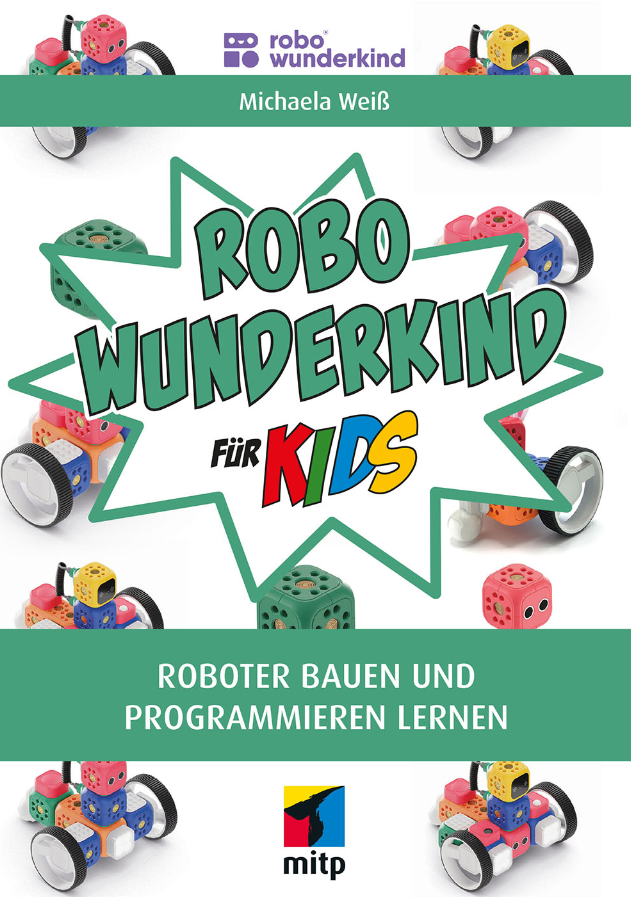
Robo Wunderkind für Kids
Roboter bauen und programmieren lernen - die spannende Erstauflage.Ein Roboter, der Nachrichten überbringen kann? Oder ein Roboter-Tier, das man selbst steuert und das genau das macht, was man möchte? Mit Robo Wunderkind und diesem Buch kannst man in die spannende Welt der Robotik eintauchen und selbst entworfenen Roboter nach eigenen Vorstellungen programmieren. Die Autorin führt einen Schritt für Schritt in die Welt von Robo ein. Egal, ob man die ersten Schritte in der Programmierung macht oder etwas komplexere Aufgaben programmieren möchte, in diesem Buch findet man für jedes Level Ideen und Anleitungen. Im ersten Teil des Buchs stellt die Autorin die einzelnen Robo-Sets und Blöcke vor: Manche Blöcke können Sounds abspielen, andere senden Lichtsignale oder schreiben Textnachrichten. Man kann die Blöcke beliebig kombinieren und so der eigenen Fantasie freien Lauf lassen.Im zweiten Teil lernst man die Coding-App kennen. Für jedes der drei Level »Robo Live«, »Robo Code« oder »Robo Blockly« findest man Ideen für die verschiedenen Sets: zum Beispiel die Musikmaschine für Robo Live, den Postboten-Robo für Robo Code und den Mondforscher-Robo für Robo Blockly. Die Autorin erklärt leicht verständlich die Befehle und verschiedenen Optionen der Coding-App – und man findet im Buch ganz viele tolle Robo-Projekte, mit denen man sich austoben und alles ausprobieren kann.Aus dem Inhalt:Die verschiedenen Blöcke und SetsVorstellung der drei Programmierlevels: Robo Live, Robo Code, Robo BlocklyProjekte für jedes Set und Level:Mars-RoverAngst-Hasen-RoboLichtweckerPostboteLinienfolgeru.v.m.Erklärungen zu allen Befehlen:den Robo flitzen oder sein LED-Licht leuchten lassenHupen- oder Lasergeräusche erzeugenHindernisse erkennen und ausweichenNachrichten in einem Display anzeigenOft verwendete Begriffe in der ProgrammierungAnregungen zu eigenen IdeenFragen und Antworten in jedem KapitelInhalt & Leseprobe (PDF-Link)

PHP & MySQL Schnelleinstieg
* PHP PROGRAMMIEREN LERNEN OHNE VORKENNTNISSE* ALLE GRUNDLAGEN FÜR DEN PROFESSIONELLEN EINSATZ* EINFACHE PRAXISBEISPIELE UND ÜBUNGSAUFGABENMit diesem Buch gelingt Ihnen der einfache Einstieg in die Webentwicklung mit PHP und MySQL.Alle Grundlagen werden in 14 Kapiteln anschaulich und leicht nachvollziehbar anhand von Codebeispielen erläutert. Übungsaufgaben am Ende der Kapitel helfen Ihnen, das neu gewonnene Wissen schnell praktisch anzuwenden und zu vertiefen.Der Autor führt Sie Schritt für Schritt in die Welt der Programmierung mit PHP ein: von den Grundlagen über Objektorientierung bis zur Entwicklung dynamischer Webseiten mit MySQL-Datenbanken. Dabei lernen Sie ebenfalls, was guten Programmierstil ausmacht und wie sich Fehler von vornherein vermeiden lassen.So sind Sie perfekt auf die Webentwicklung mit PHP und MySQL im professionellen Umfeld vorbereitet.* Alle Grundlagen einfach erläutert* Dynamische Webseiten und Formulare* Webseiten im Internet veröffentlichen* Anbindung einer Webschnittstelle (API)* Cookies und Sessions* Objektorientierte* Programmierung* Einsatz mit MySQL-Datenbanken* Abschlussprojekt:* Programmierung eines Blogs* Programmcode, Lösungen und Glossar zum DownloadFÜR WINDOWS, LINUX UND MACOSPhilipp Rieber entwickelt seit über 20 Jahren Internet-Anwendungen und begeistert gerne andere für die Webentwicklung. Als Software-Architekt gestaltet er seit ihrer Gründung die erste digitale Krankenversicherung Deutschlands.

C and Python Applications
Solve problems by embedding Python code in a C programs, SQL methods, Python sockets. This book uses rudimentary mathematics and basic programming to create practical Python applications for embedding.You'll start with an introduction to C and Python, assuming a fundamental understanding of what programming is. You will also review the basics of the database management language, SQL. You will learn how to use SQL from a C program and from a Python program. C and Python have different programming strengths, and you will learn how to write a Python program embedded within a C program to profit from the strength of each, in one program. Finally, you will explore how socket programs enable two computers to communicate with each other. Here the book covers basic server-client, basic threaded, and basic chat programs.WHAT YOU WILL LEARN* Review basic Python and C coding * Understand the methods of embedding Python code within a C program* Create typical programs in Python and C using SDK* Work with socket applications in PythonWHO THIS BOOK IS FORProgrammers and computational modelers with at least some prior experience with programming in C and Python as well as programming in general. Philip Joyce has 28 years experience as a software engineer – working on control of steel production, control of oil refineries, communications software (pre-Internet), office products (server software), and computer control of airports. Programming in Assembler, COBOL, Coral66, C, and C++. Mentor to new graduates in the company. He also has a MSc in computational physics (including augmented matrix techniques and Monte Carlo techniques using Fortran) - Salford University 1996. Chartered scientist, chartered physicist, member of the Institute of Physics (member of the higher education group). Chapter 1 :Review of C and PythonChapter goal: Load up all of the software eg sqlite3, C, Python etc1.1 : Pythona. Defining different types of variablesb. Reading in data from command linec. Arithmetic operationsd. Switches (user-written)e. If-then-elsef. Arraysg. For loopsh. Stringsi. Math functionsj. User-written functionsk. Dictionariesl. File usem. Use of Matplotlibn. Create typical programs in Python using SDK1.2 : Ca. Read and write charactersb. Arithmetic operationsc. Switchesd. If-then-elsee. Arraysf. For loops and Do loopsg. Stringsh. Data arraysi. Structuresj. Math functionsk. User-written functionsl. File usem. Create typical programs in C using SDKExercisesChapter 2: SQL in CChapter goal: Load up all of the software eg sqlite3, C compiler, Python etc. Demonstrate using SQL in C by writing separate C programs to:-a) create a tableb) insert a row of data into the tablec) select a row or rows of data in the tabled) amend a row of data in the tablee) delete a row of data from the tableExercisesChapter 3 :SQL in PythonChapter goal: Load up appropriate eg sqlite3, Python etc. Demonstrate using SQL in Python by writing separate Python programs to:-a) create a tableb) insert a row of data into the tablec) select a row or rows of data in the tabled) amend a row of data in the tablee) delete a row of data from the tableExercisesChapter 4 : Embedded Python in Ca. Introduction to why you might want to embed python in cb. Basic example “hello”c. Plot a graph with preset points in python programd. Plot a graph with user-entered points in pythone. Print from a dictionaryExercisesChapter 5: Sockets in Pythona. Show basic server-client programsb. Show basic threaded programsc. Show basic chat programsExercisesAppendicesC Programming Code GuidePython Programming Code Guide

Modern Deep Learning Design and Application Development
Learn how to harness modern deep-learning methods in many contexts. Packed with intuitive theory, practical implementation methods, and deep-learning case studies, this book reveals how to acquire the tools you need to design and implement like a deep-learning architect. It covers tools deep learning engineers can use in a wide range of fields, from biology to computer vision to business. With nine in-depth case studies, this book will ground you in creative, real-world deep learning thinking.You’ll begin with a structured guide to using Keras, with helpful tips and best practices for making the most of the framework. Next, you’ll learn how to train models effectively with transfer learning and self-supervised pre-training. You will then learn how to use a variety of model compressions for practical usage. Lastly, you will learn how to design successful neural network architectures and creatively reframe difficult problems into solvable ones. You’ll learn not only to understand and apply methods successfully but to think critically about it.Modern Deep Learning Design and Methods is ideal for readers looking to utilize modern, flexible, and creative deep-learning design and methods. Get ready to design and implement innovative deep-learning solutions to today’s difficult problems.WHAT YOU’LL LEARN* Improve the performance of deep learning models by using pre-trained models, extracting rich features, and automating optimization.* Compress deep learning models while maintaining performance.* Reframe a wide variety of difficult problems and design effective deep learning solutions to solve them. * Use the Keras framework, with some help from libraries like HyperOpt, TensorFlow, and PyTorch, to implement a wide variety of deep learning approaches.WHO THIS BOOK IS FORData scientists with some familiarity with deep learning to deep learning engineers seeking structured inspiration and direction on their next project. Developers interested in harnessing modern deep learning methods to solve a variety of difficult problems.Andre Ye is a data science writer and editor; he has written over 300 data science articles for various top data science publications with over ten million views. He is also a cofounder at Critiq, a peer revision platform that uses machine learning to match users’ essays. In his spare time, Andre enjoys keeping up with current deep learning research, playing the piano, and swimming.Chapter 1: “A Deep Dive Into Keras”Chapter Goal: To give a structured yet deep overview of Keras and to lay the groundwork for implementations in future chapters.Number of Pages: ~30Subtopics1. Why Keras? Versatility and simplicity.2. Steps needed to create a Keras model: define architecture, compile, fit.a. Compile: discuss TensorFlow optimizers, losses, and metrics.b. Fit: discuss callbacks.3. Sequential model + example.4. Functional model + example.5. Visualizing Keras models.6. Data: using NumPy arrays, Keras Image Data Generator, and TensorFlow datasets.7. Hardware: using and accessing CPU, GPU, and TPU.Chapter 2: Pre-training Strategies and Transfer LearningChapter Goal: To understand the importance of transfer learning and to use a variety of transfer learning methods to solve deep learning problems efficiently.Number of Pages: ~30Subtopics1. Transfer learning theory, practical tips and tricks.2. Accessing and using Keras and TensorFlow pretrained models.a. Bonus: converting PyTorch models (PyTorch has a wider variety) into Keras models for greater access to pretrained networks.3. Manipulating pretrained models with other network elements.4. Layer freezing.5. Self-supervised learning methods.Chapter 3: “The Versatility of Autoencoders”Chapter Goal: To understand the versatility of autoencoders and to be able to use them in a wide variety of problem scenarios.Number of Pages: ~30Subtopics1. Autoencoder theory.2. One-dimensional data autoencoder implementation, tips and tricks.3. Convolutional autoencoder implementation, tips and tricks, special concerns.4. Using autoencoders for pretraining.a. Example case study: TabNet.5. Using autoencoders for feature reduction.6. Variational autoencoders for data generation.Chapter 4: “Model Compression for Practical Deployment”Chapter Goal: To understand pruning theory, implement pruning for effective model compression, and to recognize the important role of pruning in modern deep learning research.Number of Pages: ~20Subtopics1. Pruning theory.2. Pruning Keras models with TensorFlow.3. Exciting implications of pruning – the Lottery Ticket Hypothesis.a. Example case-study: no-training neural networks.b. Example case-study: extreme learning machines.Chapter 5: “Automating Model Design with Meta-Optimization”Chapter Goal: To understand what meta-optimization is and to be able to use it to effectively automate the design of neural networks.Number of Pages: ~20Subtopics1. Meta-optimization theory.2. Demonstration of meta-optimization using HyperOpt on Keras.3. Demonstration of Auto-ML and Neural Architecture Search.Chapter 6: “Successful Neural Network Architecture Design”Chapter Goal: To gain an understanding of principles in successful neural network architecture design through three case studies.Number of Pages: ~25Subtopics1. Diversity of neural network designs and the need to design specific architectures for particular problems.2. Theory and implementation of block/cell/module design and considerations.a. Example case study: Inception model.3. Theory and implementation of “Normal” and “extreme” usages of skip connections.a. Parallel towers and cardinalityb. Example case study: UMAP model.4. Neural network scaling.a. Example case study: EfficientNet.Chapter 7: “Reframing Difficult Deep Learning Problems”Chapter Goal: To explore how hard problems can be reframed to be solved by deep learning with three case studies.Number of Pages: ~30Subtopics1. The diversity of problems deep learning is being used to solve.2. Example case study: Siamese networks – experimenting with architecture.3. Example case study: DeepInsight – experimenting with data representation.4. Example case study: Semi-supervised generative adversarial networks – experimenting with data availability.

Digineering
Als Folge der zunehmenden Verfügbarkeit neuer Informationstechnologien entstehen völlig neue Kundenerwartungen, Geschäftsmodelle und Prozesse. Die umfassende Neugestaltung digitaler Prozesse ist mit Konzepten der Vergangenheit nicht zu bewältigen. Business Process Management benötigt angepasste Methoden, Fähigkeiten, Technologien und Strukturen.„Digineering“ steht für die Kombination der Aspekte einer zunehmenden Digitalisierung mit den Methoden und Vorgehensweisen des Re-Engineering und überträgt damit Ansätze aus dem Business Process Management, dem Management der digitalen Transformation und dem Software-Engineering auf die aktuellen Herausforderungen der Prozessdigitalisierung.„Digineering“ liefert einen agilen Lösungsansatz, der alle Phasen der Prozessdigitalisierung von der Analyse der Kundenanforderungen über die Prozessgestaltung bis zur Implementierung neuer IT-Anwendungen umfasst. In allen Phasen werden die Potenziale innovativer IT einbezogen, um so ganzheitliche Prozesse mit einzigartigem Kundenerlebnis und hoher Effizienz zu schaffen.PROF. DR. ARNO MÜLLER lehrt an der NORDAKADEMIE Hochschule der Wirtschaft Prozessmanagement, strategisches IT-Management und Logistik und ist Geschäftsführer der bps business process solutions GmbH.PROF. DR. HINRICH SCHRÖDER ist Professor und Studiengangsleiter für Wirtschaftsinformatik an der NORDAKADEMIE Hochschule der Wirtschaft.LARS VON THIENEN ist Geschäftsführer der bps business process solutions GmbH und berät Unternehmen bei der Transformation der IT-Organisation und dem Aufbau von innovativen IT-Management-Methoden.Bausteine des Digineering.- Fitness-Check zur Entwicklung der Technology- und Capability-Roadmap.- Methoden und Rollenmodell für die Prozessdigitalisierung: (Ro)-Bots: Orchestrierung von digitalen Services und Mensch-Maschine-Kommunikation.- Roadmap zur Aufdeckung und Realisierung der KI-Potenziale in der Prozessdigitalisierung.- Dataism: Wertschöpfung mit datengetriebenen Geschäftsmodellen.- Steuerung der unternehmensweiten Prozessdigitalisierung.- Operating-Model für digitalisierte Prozesse.

Beginning IntelliJ IDEA
Get started quickly with IntelliJ, from installation to configuration to working with the source code and more. This tutorial will show you how to leverage IntelliJ’s tools to develop clean, efficient Java applications.Author TED HAGOS will first walk you through buidling your first Java applications using IntelliJ. Then, he’ll show you how to analyze your application, top to bottom; using version control and tools that allow you expand your application for big data or data science applications and more. You'll also learn some of the IDE’s advanced features to fully maximize your application's capabilities.The last portion of the book focuses on application testing and deployment, and language- and framework- specific guidelines. After reading this book and working through its freely available source code, you'll be up to speed with this powerful IDE for today's Java development.WHAT YOU WILL LEARN* Use IntelliJ IDEA to build Java applications* Set up your IDE and project* Work with source code* Extend your Java application to data science and other kinds of applications* Test and deploy your application and much moreWHO THIS BOOK IS FORProgrammers new to IntelliJ IDEA who may have some prior exposure to Java programming.Ted Hagos is a software developer by trade; at the moment, he’s Chief Technology Officer and Data Protection Officer of RenditionDigital International, a software development company based out of Dublin. He wore many hats in his 20+ years in software development e.g. team lead, project manager, architect and director for development. He also spent time as a trainer for IBM Advanced Career Education, Ateneo ITI and Asia Pacific College. He wrote a couple of books for Apress.1. Install IntelliJ2. Getting Started3. Configuring the IDE4. Configuring Projects5. Working with Source Code6. Building Applications7. Analyzing Applications8. Version Control9. Big Data / Data Science Tools10. Other Tools11. Advanced IDE Features12. Migration Guides13. Language and Framework Specific Guidelines14. Testing15. Deployment

Language Server Protocol and Implementation
Understand the important aspects of implementing a production-grade language server in support of language-smart tools such as code editors and other programming utilities. This book shows you how to create a single implementation of a language server that can be used by multiple tools, enabling you to do the job once in a way that can be shared and reused.This book covers the language server protocol used for communication between programming tools and your language server. The book also provides an in-depth understanding of the design, implementation, and user experience aspects which should be considered when implementing a language server. The book walks you through an example language server implementation to illustrate the basic concepts, then goes on to cover advanced aspects of language server use such as progress reporting, launchers, and extension points.User experience is an important aspect of language server implementation and different tooling vendors strive to provide their own unique user experiences. This book explains how the protocol features can be leveraged to address the unique developer experience provided by different tooling vendors. The book also shows how to enhance the smoothness of the editing experience by orchestrating multiple features together.WHAT YOU WILL LEARN* Implement a language server from scratch* Understand language server protocol and its data models* Leverage the protocol while preserving the unique user experience of different editors* Extend the protocol to support more than its standard capabilities* Run a language server on top of launchers such as standard I/O and TCP socket* Seamlessly incorporate language semantics into your protocol featuresWHO THIS BOOK IS FORDevelopers focused on and passionate about implementing language development tools such as plug-ins and extensions for interactive development environments (IDEs) or other tools that rely upon parsing of language statements and commands, and developers who need an in-depth understanding of the language server protocol as well as how to use the language server protocol to develop extensible language servicesNADEESHAAN GUNASINGHE is Technical Lead at WSO2 and has more than five years of experience in enterprise integration, programming languages, and developer tooling. He leads the Ballerina Language Server team and is a key contributor to Ballerina, which is an open-source programming language and platform for the cloud, and he is an active contributor to the WSO2 Enterprise Service Bus.NIPUNA MARCUS is Technical Lead at WSO2 and has more than five years of experience in front end development, programming languages, and developer tooling. He was a member of the Ballerina Language Server team and a key contributor to the Ballerina programming language. 1. Developer Tools and Language Services2. Understanding the Language Server Protocol3. Implementing a Language Server4. General Messages5. Text Synchronization6. Diagnostics, Smart Editing, and Documentation7. Refactoring and Code Fixes8. Code Navigation and Navigation Helpers9. Presentation and Folding10. Workspace Operations11. Advanced ConceptsA. Data Models and Resources

LoRaWAN-Knoten im IoT
LoRaWAN hat sich als Kommunikationslösung im IoT hervorragend entwickelt. The Things Network (TTN) hat hierzu seinen Beitrag geleistet. Aktuell wird The Things Network auf The Things Stack Community Edition (TTS (CE)) aktualisiert. Die Cluster von TTN V2 werden gegen Ende 2021 geschlossen.Der Autor zeigt Ihnen die notwendigen Schritte, damit Sie in gewohnter Weise LoRaWAN-Knoten mit Hilfe von TTS (CE) betreiben und vielleicht auch das Netz der Gateways durch ein eigenes Gateway erweitern. Mittlerweile gibt es sogar für den mobilen Einsatz geeignete LoRaWAN-Gateways mit denen Sie über Ihr Mobiltelefon Verbindung zum TTN-Server aufbauen können.In diesem Buch werden eine Reihe kommerzieller und Arduino-basierter LoRaWAN-Knoten als auch neue, kostengünstige und für den Batteriebetrieb geeignete Hardware zum Aufbau autonomer LoRaWAN-Knoten vorgestellt.Die Registrierung von LoRaWAN-Knoten und Gateways im TTS (CE) sowie die Bereitstellung der erhobenen Daten über MQTT und die Visualisierung über Node-RED, Cayenne, Thingspeak und Datacake ermöglichen komplexe IoT-Projekte und völlig neue Anwendungen zu sehr geringen Kosten.Das vorliegende Buch versetzt Sie in die Lage, mit batteriebetriebenen Sensoren (LoRaWAN-Knoten) erfasste Daten drahtlos im Internet bereitzustellen und zu visualisieren.Sie lernen die Grundlagen für Smart-City- und IoT-Anwendungen, die beispielsweise die Messung von Luftqualität, Wasserständen, Schneehöhen, das Ermitteln von freien Parkfeldern (Smart Parking) und die intelligente Steuerung der Straßenbeleuchtung (Smart Lighting) u.a.m. ermöglichen.Dr. Claus Kühnel studierte Informationstechnik an der Technischen Universität Dresden und hat über viele Jahre Embedded Systems für Geräteder Labordiagnostik u.a. entwickelt. In diesem interdisziplinären Spannungsfeld kam er mit der Maker-Szene in Berührung. Er hat zahlreiche Artikel und Bücher zu Hard- und Software von Mikrocontrollern im In- und Ausland verö entlicht. Mit Leidenschaft befasst er sich mit neuen Technologien rund um das Thema Mikrocontroller

The Definitive Guide to Modern Java Clients with JavaFX 17
Build enhanced visual experiences and design and deploy modern, easy-to-maintain, client applications across a variety of platforms. This book will show you how these applications can take advantage of JavaFX’s latest user interface components, 3D technology, and cloud services to create immersive visualizations and allow high-value data manipulation. The Definitive Guide to Modern Java Clients with JavaFX 17 is a professional reference for building Java applications for desktop, mobile, and embedded in the Cloud age. It offers end-to-end coverage of the latest features in JavaFX 17 and Java 17.Among the many new or updated JavaFX features covered are the FX Robot API, for simulating user interaction; customized step repeat timing for the Spinner control; Marlin FX; the ColorPicker color palette; and the GetCenter method.After reading this book, you will be equipped to upgrade legacy client applications, develop cross-platform applications in Java, and build enhanced desktop and mobile native clients.Note: source code can be downloaded from https://github.com/Apress/definitive-guide-modern-java-clients-javafx17.WHAT YOU WILL LEARN:* Create modern client applications in Java using the latest JavaFX 17 and Java 17 LTSBuild enterprise clients that will enable integration with existing cloud services * Use advanced visualization and 3D features* Deploy on desktop, mobile, and embedded devicesWHO THIS BOOK IS FOR:Professional Java developers who are interested in learning the latest client Java development techniques to fill out their skills set.STEPHEN CHIN is Senior Director of Developer Relations at JFrog, author of Raspberry Pi with Java and co-author of Pro JavaFX Platform. He has keynoted numerous Java conferences around the world, including Oracle Code One (formerly JavaOne), where he is an 8-time Rock Star Award recipient. Stephen is an avid motorcyclist who has done evangelism tours in Europe, Japan, and Brazil, interviewing hackers in their natural habitat. When he is not traveling, he enjoys teaching kids how to do embedded and robot programming together with his teenage daughter.JOHAN VOS started to work with Java in 1995. He was part of the Blackdown team, porting Java to Linux. His main focus is on end-to-end Java, combining back-end systems and mobile/embedded devices. He received a Duke Choice award in 2014 for his work on javafx on mobile. In 2015, he co-founded Gluon, which allows enterprises to create (mobile) Java Client applications leveraging their existing backend infrastructure. Gluon received a Duke Choice award in 2015. Johan is a Java Champion and an Oracle Developer Champion, a member of the BeJUG steering group, the Devoxx steering group and he is a JCP member. He has been a speaker at numerous conferences on Java.JAMES WEAVER is a Java developer, author, and speaker with a passion for cloud-native applications, machine learning, and quantum computing. He is a Java Champion, and a JavaOne Rockstar. James has written books including Inside Java, Beginning J2EE, the Pro JavaFX series, and Java with Raspberry Pi. As a Pivotal Developer Advocate, James speaks internationally at software technology conferences. He tweets as @JavaFXpert.1: Getting Started with Client Java2: JavaFX Fundamentals3: Properties and Bindings4: JavaFX Controls Deep Dive5: Mastering Visual and CSS Design6: High Performance Graphics7: Bridging Swing JavaFX Style8: JavaFX 3D9: JavaFX to Web and Cloud10: Packaging Apps for the Desktop11: Native Mobile Apps12: JavaFX 11 on Raspberry Pi13: Maching Learning and JavaFX14: Java Science

Entwurfsmuster von Kopf bis Fuß
JETZT AKTUALISIERT UND ERWEITERT: DAS STANDARDWERK ZU ENTWURFSMUSTERN * »Dieses Buch vereint Spaß, herzhaftes Lachen, profundes technisches Verständnis und geniale Praxistipps zu einem denkwürdigen Lesegenuss.« Richard Helm, Gang of Four * Softwareentwickler wollen das Rad nicht neu erfinden: Mit Entwurfsmustern können Sie von den Erfahrungen und Best Practices anderer profitieren * Die Design Patterns werden detailliert und verständlich erklärt, inklusive Herleitung und geeigneten Anwendungsfällen Dieses Buch ist ein moderner Klassiker zum Thema Entwurfsmuster. Mit dem einzigartigen Von-Kopf-bis-Fuß-Lernkonzept gelingt es den Autoren, die anspruchsvolle Materie witzig, leicht verständlich und dennoch gründlich darzustellen. Jede Seite ist ein Kunstwerk für sich, mit vielen visuellen Überraschungen, originellen Comic-Zeichnungen, humorvollen Dialogen und geistreichen Selbstlernkontrollen. Spätestens, wenn es heißt "Spitzen Sie Ihren Bleistift", wird Leser:innen klar, dass bei diesem Buch Mitmachen gefragt ist. Das ist nicht nur unterhaltsam, sondern auch effektiv: Komplexe Sachverhalte lassen sich nach Erkenntnis der modernen Lernwissenschaft am gründlichsten über mehrere verschiedene Kanäle verstehen. Das Buch verspricht Ihnen daher nicht nur Spaß beim Lernen, Sie werden nach der Lektüre auch die Herausforderungen des Softwaredesigns meistern können.