

Programmierung

Programming Basics
Explore the basics of the three most popular programming languages: C#, Java, and Python and see what it's like to function in today's world from the perspective of a programmer. This book's uses is highly practical approach with numerous code listings aimed at bringing generations together through the intricacies of technology.You'll learn how understanding the basics of coding benefits non-programmers working with software developers. Those in the gaming/media industry will also benefit from understanding a programmer's point of view. The same applies to software testers and even company executives, who might have an education in business instead of computer science.WHAT YOU'LL LEARN* Think and read code-listings like a programmer* Gain a basic working proficiency in three popular programming languages* Communicate more efficiently with programmers of all experience levels in a work-based environment* Review advanced OOP concepts such as exceptions and error handling* Set up your programming environments for Windows, MacOS, and LinuxWHO THIS BOOK IS FORThose looking to discover programming, including beginners in all fields, and professionals looking to understand how code works.Robert Ciesla is an author and filmmaker from Helsinki, Finland. He is also a freelance-programmer working mostly in the indie game scene. He is the author of Encryption for Organizations and Individuals (2020), Game Development with Ren'Py (2019) and Mostly Codeless Game Development (2017).Chapter 1. Why kids love to code (and you will too)* Motivation for and the benefits of programming* The basic hardware components of a computerChapter 2. What is programming? (and what does it take)* Basic programming concepts explained with some specifics for C#, Java, and Python* What an integrated development environment (IDE) refers to* The gist of variables, variable manipulation, and flow control logicChapter 3. Setting up your programming environments for Windows, MacOS, and LinuxChapter 4. Object-Oriented Programming (OOP)* The object-oriented programming paradigm explained in detail* The basics of UMLChapter 5. File Operations, Multithreading, and Other Wonders of Java* Small tutorials for the language demonstrating the more advanced mechanics of the languageChapter 6. And now for something completely different: Python* More Python techniques (file operations etc.)Chapter 7. C#: A jack of most programming tasks* Deploying C# for desktop, online, and mobile platformsChapter 8. Advanced OOP Techniques* Advanced OOP concepts: exceptions, error handling, etc.Chapter 9. Unified Modeling Language (UML)* Detailed techniques (class relationships and multiplicity, etc.)* Software tools for modeling in UML

Programmieren mit LEGO® MIND-STORMS® 51515 und SPIKE® Prime
Scratch und Python mit der neuen LEGO-Roboter-Generation* Programmieren lernen leicht gemacht: Steuerungsbefehle schreiben und real mit LEGO-Robotern ausführen* Beispiele in Scratch und Python * für die neue LEGO-Mindstorms-Generation "Robot Inventor" und den kompatible Spike PrimeProgrammieren lernen muss nicht theoretisch sein: Zusammen mit den LEGO-Modellreihen Mindstorms Robot Inventor 51515 oder dem kompatiblen Spike Prime können Sie Ihre Programmzeilen direkt mit selbstgebauten Modellen ausprobieren. Die Code-Beispielen in diesem Buch erklären Schritt für Schritt, was gutes und effizientes Programmieren ausmacht. Die direkte Ausführung mit einem Roboter macht mehr Spaß als Befehlebüffeln und führt auf praktische Weise zum Lernerfolg.Das Buch bietet einen methodisch sinnvollen Weg, die zwei Sprachen zu erlernen, die LEGO für die Modellreihen vorsieht. Leserinnen und Leser können die Lösungen zu Programmier-Aufgabenstellungen jeweils in beiden Sprachen verfolgen und lernen dabei ihre Unterschiede und Stärken kennen:- Scratch, das mit grafischen Textblöcken arbeitet, eignet sich besonders gut für Einsteigerinnen und Einsteiger.- Python dient als einfacher Zugang zur textbasierten Programmierung und ermöglicht auch komplizierte Abläufe.- Experimente und intuitives Lernen mit dem exklusiven Beispielroboter, der aus Teilen der Sets gebaut werden kann.Das Robotermodell lässt sich aus Teilen des Sets LEGO Mindstorms Robot Inventor 51515 bzw. demLEGO-Education-Spike-Prime-Set 45678 aufbauen.Alexander Schulze blickt auf eine 35-jährige Erfahrung im Umgang mit Computern und Programmierung zurück und hat sein Hobby nach dem Studium der Technischen Informatik (Berufsakademie) zum Beruf gemacht. Mit mehr als 20 Jahren Erfahrung in der Java-Programmierung arbeitet er als Senior-IT-Architekt in Projekten für Großkunden.Seine LEGO-begeisterten Kinder haben ihn zu LEGO Mindstorms geführt und die Leidenschaft für die Programmierung von Robotern entfacht.Verschiedene Workshops an einer Grundschule sowie die Unterstützung der Robotik-AG an einem Gymnasium im Unterallgäu legten den Grundstein für das Buch "LEGO Mindstorms programmieren – Robotikprogrammierung mit grafischen Blöcken, Basic und Java für LEGO EV3" für den LEGO Mindstorms EV3 und für dieses Buch. Dabei stand von Beginn an die Teilnahme an verschiedenen Wettbewerben mit den Schülern im Vordergrund, um mit ihnen auf ein konkretes Ziel hinzuarbeiten.

Einfach Java
Java lernen – von Anfang an wie ein Experte* Grundlagen der Java-Programmierung leicht und verständlich* Java interaktiv im Selbststudium* Aufgaben und Musterlösungen, Code zum DownloadSie wollen endlich Programmieren lernen und ihre ersten Projekte umsetzen? Dazu bietet sich Java als eine der populärsten Programmiersprachen geradezu an. Dieses Buch erleichtert Ihnen den Einstieg, denn Sie werden auf Ihrer Entdeckungsreise vom Java-Experten Michael Inden begleitet. Er erklärt Ihnen die Grundlagen der Java-Programmierung leicht und verständlich. Insbesondere wird die trockene Theorie auf ein Minimum reduziert und Sie legen immer mit kleinen Beispielen los.Eine große Rolle dabei spielt der interaktive Einstieg mithilfe der JShell. Damit können kleine Programme direkt ausprobiert werden und Erfolgserlebnisse stellen sich schnell ein. Dieses Vorgehen eignet sich ideal, um im eigenen Tempo Java im Selbststudium zu erlernen. Allmählich werden sowohl die Themen anspruchsvoller als auch die zu erstellenden Programme größer. Als Hilfsmittel lernen Sie dann den Einsatz einer Entwicklungsumgebung sowie der objektorientierten Programmierung kennen. Mit den erlernten Grundlagen können Sie sich immer zielsicherer mit eigenen Projekten beschäftigen.Das Buch besteht aus in sich abgeschlossenen, aber aufeinander aufbauenden Kapiteln zu den wichtigen Bereichen der Programmiersprache Java. Jedes Kapitel beschreibt die für den Einstieg wichtigen Sprachelemente.Abgerundet werden viele Kapitel mit Aufgaben und Musterlösungen, sodass das zuvor Gelernte direkt anhand neuer Problemstellungen praktiziert und das Wissen vertieft werden kann. Auch lassen sich die eigenen Fortschritte abschätzen und gegebenenfalls eine Ehrenrunde zur Vertiefung des Wissens einlegen.Zahlreiche kurze Codebeispiele verdeutlichen die Lerninhalte und laden oftmals zum Experimentieren ein. Gleich von Anfang an lernen Sie, ihren Sourcecode sauber zu strukturieren und einen guten Stil zu verfolgen.Dipl.-Inform. Michael Inden ist Oracle-zertifizierter Java-Entwickler. Nach seinem Studium in Oldenburg hat er bei diversen internationalen Firmen in verschiedenen Rollen etwa als Softwareentwickler, -architekt, Consultant, Teamleiter, CTO sowie Leiter Academy gearbeitet. Zurzeit ist er freiberuflich als Autor und Trainer in Zürich tätig.Michael Inden hat über zwanzig Jahre Berufserfahrung beim Entwurf komplexer Softwaresysteme gesammelt, an diversen Fortbildungen und mehreren Java-One-Konferenzen teilgenommen. Sein besonderes Interesse gilt dem Design qualitativ hochwertiger Applikationen sowie dem Coaching. Sein Wissen gibt er gerne als Trainer in internen und externen Schulungen und auf Konferenzen weiter, etwa bei der JAX/W-JAX, JAX London, Oracle Code One, ch.open sowie bei der Java User Group Switzerland.
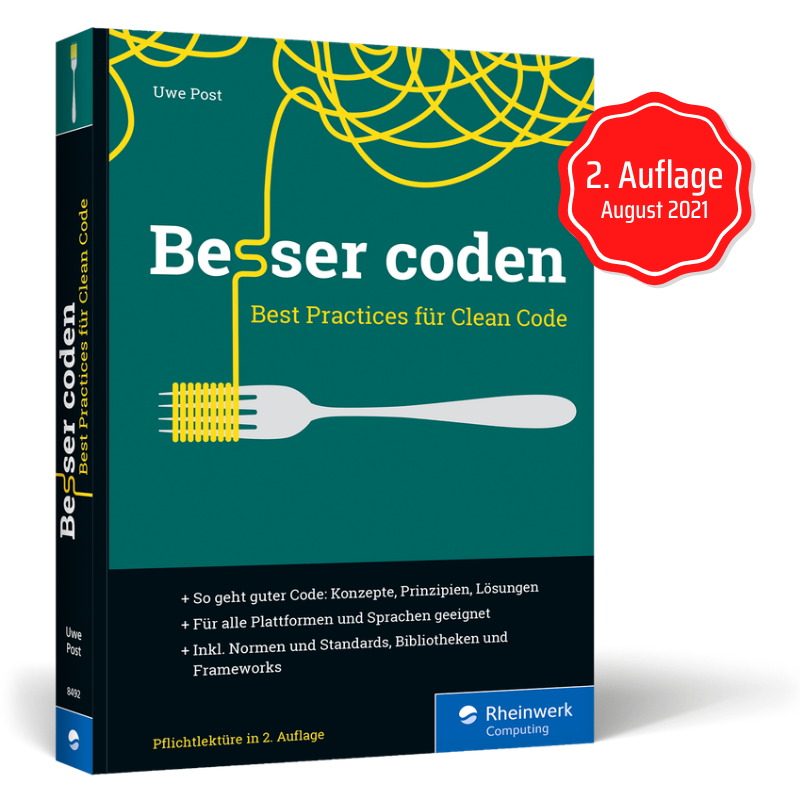
Besser coden (2. Auflg.)
Best Practices für Clean Code, der beste Weg zu gutem Code. In aktualisierter und erweiterter 2. Auflage August 2021. Guter Code ist essenziell für gute Software. Die Hürden bei der Programmierung sind aber oft vielfältig: Code glänzt mit schlechter Testbarkeit oder die Wartung lässt das Budget komplett aus dem Rahmen laufen. Punkten Sie mit besserem Code: performant, verständlich, wartbar. Uwe Post hat bereits einige Bugs in seinem Trophäenschrank. Mit einer ordentlichen Prise Humor und viel Projekterfahrung zeigt er, worauf es bei erfolgreichen Software-Projekten wirklich ankommt. In seinem Buch bietet er zeitlose Best Practices und aktuelle Tipps aus seinem Erfahrungsschatz. Seine Insider-Tipps und Anekdoten aus der Softwareentwicklung helfen Ihnen, stetig an der Qualität Ihres Codes zu arbeiten. Sie werden sehen: Clean Code geht jeden an, der besser programmieren möchte, ob in Java, C++ oder Python.Aus dem Inhalt:EntwurfsmusterReibungsloses TeamworkAktuelle Sicherheitsprobleme und was Sie damit zu tun habenTest Driven DevelopmentLegacy-Code und RefactoringQuizfragenDer Umgang mit den lieben KollegenDeadlocksContinuous IntegrationAutor: Uwe Post, Jahrgang 1968, ist Chefentwickler einer Firma, die Apps herstellt, hält Schulungen und berät Entwicklungsteams. Er schreibt neben IT-Büchern auch Science Fiction – davon sogar deutlich mehr. Sein Roman »Walpar Tonnraffir und der Zeigefinger Gottes«, gewann den Kurd-Laßwitz-Preis und den Deutschen Science-Fiction-Preis. Post lebt mit Frau und Tochter am südlichen Rand des Ruhrgebiets. Unter www.besser-coden.de geht er nicht nur auf Quellcode-Höllen ein, die er selbst er- und überlebt hat, sondern auch auf aktuelle Sicherheitsthemen und wie sie mit der Codequalität zusammenhängen. InhaltsverzeichnisLeseprobe (PDF-Link)

Introductory Guideline for Using Twilio Programmable Messaging and Programmable Voice Services
Twilio.com is an American cloud communications platform. Twilio allows software developers to programmatically make and receive phone calls, send and receive text messages, and perform other communication functions using its web service APIs.Twilio uses Amazon Web Services to host telephony infrastructure and provide connectivity between HTTP and the public switched telephone network (PSTN) through its APIsTwilio has very complicated system to understand and use. Its services mainly provided for qualified software developers. But in this report, I will provide introductory guideline for using the Twilio Programmable Messages and Programmable Voices services for simple use without the need to have deep knowledge in Programming. The report consists from the following sections:1.Opening a Twilio Account and get a Twilio Trial Number2.Upgrading the Twilio account 3.Twilio guideline for sending and receiving SMS 4.TwiML for Programmable SMS 5.TwiML for Programmable Voice 6.Basic steps to build Programmable Voice7.Using TwiML Bins functions8.Xampp and Ngrok web server setup for Twilio development 9.Sending messages from the dashboard of the Twilio account 10.Auto Dialer for Twilio Platform11.Summary of testing Programmable Voice using different options12.Summary of testing Programmable Messaging through different options13.Creating free website to save the files on it14.Making voice call using Twilio in browserI am Dr. Hidaia Mahmoud Mohamed Alassouli. I completed my PhD degree in Electrical Engineering from Czech Technical University by February 2003, and my M. Sc. degree in Electrical Engineering from Bahrain University by June 1995. I completed also one study year of most important courses in telecommunication and computer engineering courses in Islamic university in Gaza. So, I covered most important subjects in Electrical Engineering, Computer Engineering and Telecommunications Engineering during my study. My nationality is Palestinian from gaza strip.I obtained a lot of certified courses in MCSE, SPSS, Cisco (CCNA), A+, Linux.I worked as Electrical, Telecommunicating and Computer Engineer in a lot of institutions. I worked also as a computer networking administrator. I had considerable undergraduate teaching experience in several types of courses in many universities. I handled teaching the most important subjects in Electrical and Telecommunication and Computer Engineering. I could publish a lot of papers a top-tier journals and conference proceedings, besides I published a lot of books in Publishing and Distribution houses.I wrote a lot of important Arabic articles on online news websites. I also have my own magazine website that I publish on it all my articles: http:// www.anticorruption.000space.comMy personal website: www.hidaia-alassouli.000space.comEmail: hidaia_alassouli@hotmail.com
Continuous Integration mit Jenkins
Moderne Softwareentwicklung braucht mehr als nur guten Code und starken Kaffee. Ohne passende Deployment-Strategien und eine saubere Release-Verwaltung laufen selbst kleine Projekte schnell aus dem Ruder und werden unbeherrschbar. Dieses Praxisbuch gibt Ihnen einen Überblick über eine zeitgemäße CI-Pipeline aus Git, Jenkins und Nexus. So erfahren Sie, was für erfolgreiche Software-Projekte essenziell ist: gutes Source Control Management, flächendeckende Softwaretests mit einer sinnvollen Qualitätskontrolle und ein sauber organisiertes Deployment. Marco Schulz gibt Ihnen seine Erfahrung aus zahlreichen internationalen IT-Projekten weiter und hält eine Menge Tipps und Überlegungen zu gutem Software Engineering für Sie parat. Aus dem InhaltThe Big Picture: DevOps und die SoftwareentwicklungSoftware testen: Test Driven Development, Unit- und IntegrationstestsAgiles Release Management: Sprints vs ReleaseDeployment-StrategienSource Control ManagementJenkins einrichten und betreibenBuild ManagementBuild Jobs schreiben und optimierenJenkins Pipelines mit Blue OceanQualitätskontrolle mit SonarQubeRepository Management mit NexusAutor:Autor: Marco Schulz studierte an der HS Merseburg Informatik und twittert regelmäßig als @ElmarDott über technische Themen. Seine Schwerpunkte sind Build- und Konfigurationsmanagement, Software-Architekturen und Release Management. Seit über fünfzehn Jahren realisiert er anspruchsvolle Entwicklungsprojekten für namhafte Unternehmen aus aller Welt und arbeitet als unabhängiger Consultant/Trainer. Sein Wissen teilt er mit anderen Technikbegeisterten auf Konferenzen, wenn er nicht gerade wieder einmal an einem neuen Fachbeitrag schreibt.

Daten- und Prozessanalyse für Fachinformatiker*innen
Ideal für Aus- und Weiterbildung Big Data, Machine Learning und künstliche Intelligenz sind aktuell wohl die am schnellsten wachsenden Teilgebiete der Informatik. Nicht umsonst wurde daher 2020 der neue Fachinformatik-Ausbildungsgang Daten- und Prozessanalyse eingeführt. Worauf es dabei ankommt, zeigt dieses neue Lehr- und Praxisbuch. Auszubildende dieser Fachrichtung finden hier alle nötigen mathematischen Grundlagen, eine Einführung in die Python-Programmierung, Algorithmen und insbesondere Machine-Learning-Verfahren sowie in die Geschäftsprozessanalyse. Für alle Themen kommen praxiserprobte Sprachen, Tools und Bibliotheken zum Einsatz. Inkl. zahlreicher Übungsaufgaben. Arbeitsoberfläche, Navigation und ObjekteModelling und SculptingShading, Texturing und MappingLichtquellen, Kameras und TrackingAnimationen mit Keyframes, Pfaden und DrivernPartikelsysteme, Haare und KollisionenRauch, Feuer und FlüssigkeitenDie neuen Geometry Nodes2D-Animationen mit Grease PencilRendering mit Eevee und CyclesCompositing, Schnitt und TonImport und ExportAutor: Sascha Kersken arbeitet seit vielen Jahren als Softwareentwickler sowie als Trainer für EDV-Schulungen in den Themengebieten Netzwerke und Internet, interaktive Medien und Programmierung. Er hat zahlreiche Fachbücher und Artikel zu verschiedenen IT-Themen geschrieben.Leseprobe (PDF-Link)

Besser coden
Guter Code ist essenziell für gute Software. Und die Schwierigkeiten sind vielfältig: Code glänzt mit schlechter Testbarkeit oder die Wartung lässt das Budget komplett aus dem Rahmen laufen. Uwe Post packt die Praxisprobleme mit zeitlosen Best Practices und aktuellen Tipps aus seinem Erfahrungsschatz an. Punkten Sie mit besserem Code: performant, verständlich, wartbar. Uwe Post hat bereits einige Bugs in seinem Trophäenschrank. Mit einer ordentlichen Prise Humor und viel Projekterfahrung zeigt er, worauf es bei erfolgreichen Software-Projekten wirklich ankommt. Seine Insider-Tipps und Anekdoten aus der Softwareentwicklung helfen Ihnen, stetig an der Qualität Ihres Codes zu arbeiten. Sie werden sehen: Clean Code geht jeden an, der besser programmieren möchte, ob in Java, C++ oder Python. Aus dem Inhalt: GrundregelnCode ReviewTest Driven DesignContinuous IntegrationReibungsloses TeamworkAutomatisierte Build- und VersionskontrollsystemeEntwurfsmusterAutomatisierte UI-TestsDependency InjectionISO 25010Build ToolsUmgang mit Legacy Code 1. Verhindern Sie den Weltuntergang! ... 13 1.1 ... Vorwort ... 13 1.2 ... Schöne neue Welt ... 14 1.3 ... Was läuft falsch? ... 16 1.4 ... Weltuntergang verhindern - aber wie? ... 17 2. Konventionen ... 21 2.1 ... Vereinbarungen im Team ... 21 2.2 ... Wenn die Variable »a« sagt (und sonst nichts) ... 26 2.3 ... Code-Fokus ... 34 2.4 ... Checkliste ... 36 3. Willkommen im Team! ... 39 3.1 ... Check this out: Subversion ... 40 3.2 ... Teamwork integriert: Git ... 51 3.3 ... »Guckstu!« ... 58 3.4 ... Doppelt hält besser: Pair Programming ... 63 3.5 ... Wer macht wann was? ... 66 4. Gut, besser, 91,2 %: Software-Qualität messen ... 75 4.1 ... Muss funktionieren! ... 76 4.2 ... Muss schön sein! ... 81 4.3 ... ISO 25010 und andere Buzzword-Sammlungen ... 101 5. Jeder ist Architekt ... 107 5.1 ... Normalisierte Daten ... 107 5.2 ... Alles ist ein Objekt, aber welches? ... 117 5.3 ... Entwurfsmuster ... 120 5.4 ... Was ist eigentlich ein »Item«? ... 141 5.5 ... Effiziente Software ... 151 5.6 ... Do- und Don't-Merksatz-Akronyme ... 158 5.7 ... Neue Räder extra teuer! ... 163 5.8 ... Meins! (Wirklich?) ... 168 6. Erst mal testen ... 173 6.1 ... Gute und schlechte Unit-Tests ... 174 6.2 ... Testbar und nicht so gut testbar ... 187 6.3 ... Umgekehrt wird ein Schuh draus ... 194 6.4 ... Alles einzeln testen ... 199 6.5 ... Millionen Mausklicks ... 204 7. Continuous Integration ... 211 7.1 ... Digitaler Bauunternehmer ... 211 7.2 ... Java-Builds mit Maven ... 213 7.3 ... Gradle en vogue ... 227 7.4 ... Jenkins, stets zu Ihren Diensten! ... 234 7.5 ... Continuous Integration in der Cloud ... 239 7.6 ... Nicht nur eine Frage des Stils ... 244 7.7 ... NuGet für .NET und MS Azure ... 248 8. Dokumentation, Kommentare & Tools ... 257 8.1 ... Kommentare sind wie Tooltipps ... 257 8.2 ... Dokumentiert sich von allein ... 262 8.3 ... Teamwork online ... 269 9. Betriebssicherheit ... 283 9.1 ... »Es ist ein Fehler aufgetreten. Versuchen Sie es noch einmal.« ... 284 9.2 ... Festplattenweise Protokolle ... 296 9.3 ... Ungebetene Besucher ... 306 10. Schrottcode pimpen ... 323 10.1 ... Was macht der da? ... 323 10.2 ... Refactoring mit Tools ... 328 10.3 ... Who sprech Svenska? ... 340 10.4 ... Endlich: Tests ... 343 11. Trollfütterung ... 349 11.1 ... Umsteiger und Ahnungslose im kalten Wasser ... 349 11.2 ... Früher war alles besser, auch die Betonköpfe ... 352 11.3 ... Das Patchwork-Team ... 354 11.4 ... Billig im Osten ... 357 11.5 ... Der Hase der Produktmanagerin ... 361 11.6 ... Arbeiten wie die Profis ... 364 11.7 ... Leuchtendes Beispiel ... 366 12. Parallelwelten ... 369 12.1 ... Parallel arbeiten ... 369 12.2 ... Losgelöst ... 381 12.3 ... .NET async ... 385 Anhang ... 389 A ... Quizfragen ... 389 B ... Lösungen der Quizfragen ... 395 Index ... 399

Beginning Programming with Java For Dummies
BECOME A JAVA WIZARD WITH THIS POPULAR PROGRAMMING GUIDEConsider Beginning Programming with Java For Dummies your indispensable guide to learning how to program in one of the most popular programming languages—Java! Java is an invaluable language to master, as it's widely used for application development, including Android, desktop, and server-side applications.Beginning Programming with Java For Dummies is written specifically for newbies to programming. The book starts with an overview of computer programming and builds from there; it explains the software you need, walks you through writing your own programs, and introduces you to a few of the more-complex aspects of programming in Java. It also includes step-by-step examples you can try on your own (and email the author if you need help). As you work through the book, you'll get smart about these Java features:* Object-oriented programming (OOP), a Java mainstay* IntelliJ IDEA, an integrated development environment (IDE), that gives you one place to do all your programming, including debugging code* Loops, branches, and collections* Variables and operators* Expressions, statements, and blocksBeginning Programming with Java For Dummies translates all this foreign programming and computer syntax into plain English, along with plenty of helpful examples and tips. Learning a new language—and coding is definitely its own language—should be a fun endeavor. With this book as your handy interpreter, you’ll be on your way to fluency, speaking the language of coders everywhere!BARRY BURD, PHD holds an MS in Computer Science from Rutgers University and a PhD in Mathematics from the University of Illinois. Barry is the author of numerous For Dummies books, including Java For Dummies and Beginning Programming with Java For Dummies.Introduction 1PART 1: GETTING STARTED WITH JAVA PROGRAMMING 5Chapter 1: The Big Picture 7Chapter 2: Setting Up Your Computer 21Chapter 3: Running Programs 47PART 2: WRITING YOUR OWN JAVA PROGRAMS 71Chapter 4: Exploring the Parts of a Program 73Chapter 5: Composing a Program 95Chapter 6: Using the Building Blocks: Variables, Values, and Types 127Chapter 7: Numbers and Types 149Chapter 8: Numbers? Who Needs Numbers? 173PART 3: CONTROLLING THE FLOW 197Chapter 9: Forks in the Road 199Chapter 10: Which Way Did He Go? 219Chapter 11: Around and Around It Goes 251Chapter 12: Circling Back to Java Loops 275PART 4: THE INSIDE SCOOP 293Chapter 13: Programming with Objects and Classes 295Chapter 14: Using Methods and Fields from a Java Class 315Chapter 15: Creating New Java Methods 347PART 5: SMART JAVA TECHNIQUES 375Chapter 16: Piles of Files: Dealing with Information Overload 377Chapter 17: How to Flick a Virtual Switch 401Chapter 18: Creating Loops within Loops 423Chapter 19: Out of Many, One 443Chapter 20: Oooey-GUI Was a Worm 477PART 6: THE PART OF TENS 503Chapter 21: Ten Useful Classes in the Java API 505Chapter 22: Ten Bits of Advice for New Software Developers 511Index 517

Professional C# and .NET
GET THE LATEST COVERAGE OF THE NEWEST FEATURES IN C#9 AND .NET 5In Professional C# and .NET: 2021 Edition, Microsoft MVP for Visual Studio and Development Technologies and veteran developer, Christian Nagel, delivers a comprehensive tour of the new features and capabilities of C#9 and .NET 5.Experienced programmers making the transition to C# will benefit from the author’s in-depth explorations to create Web- and Windows applications using ASP.NET Core, Blazor, and WinUI using modern application patterns and new features offered by .NET including Microservices deployed to Docker images, GRPC, localization, asynchronous streaming, and much more.The book also offers:* Discussions of the extension of .NET to non-Microsoft platforms like OSX and Linux* Explanations of the newest features in C#9, including support for record types, and enhanced support for tuples, pattern matching, and nullable reference types* Integrating .NET applications with Microsoft Azure services such as Azure App* Configuration, Azure Key Vault, Azure Functions, the Azure Active Directory, and others Downloadable code examples from wrox.com and github.com with online updates for C# 10 and .NET 6Perfect for programmers with a background in C#, Visual Basic, Java, or C/C++, Professional C# and .NET: 2021 Edition will also earn a place in the libraries of software architects seeking an up-to-date and fulsome treatment of the latest C# and .NET releases.CHRISTIAN NAGEL is a Microsoft MVP for Visual Studio and Development Technologies, software architect, and veteran developer who has been building solutions with .NET technologies since 2000. He has authored many acclaimed .NET books, and he also speaks at such international conferences as Ignite (formerly TechEd) and Tech Days. A supporter of .NET user groups, Christian is a Microsoft Certified Trainer and Professional Developer for WinUI and .NET MAUI Apps, ASP.NET Core, and Microsoft Azure.Introduction xxxixPART I: THE C# LANGUAGEChapter 1: .Net Applications And Tools 3Chapter 2: Core C# 24Chapter 3: Classes, Records, Structs, And Tuples 59Chapter 4: Object-Oriented Programming In C# 95Chapter 5: Operators And Casts 119Chapter 6: Arrays 153Chapter 7: Delegates, Lambdas, And Events 177Chapter 8: Collections 193Chapter 9: Language Integrated Query 226Chapter 10: Errors And Exceptions 263Chapter 11: Tasks And Asynchronous Programming 288Chapter 12: Reflection, Metadata, And Source Generators 307Chapter 13: Managed And Unmanaged Memory 335PART II: LIBRARIESChapter 14: Libraries, Assemblies, Packages, And Nuget 377Chapter 15: Dependency Injection And Configuration 392Chapter 16: Diagnostics And Metrics 419Chapter 17: Parallel Programming 440Chapter 18: Files And Streams 485Chapter 19: Networking 52Chapter 20: Security 558Chapter 21: Entity Framework Core 582Chapter 22: Localization 644Chapter 23: Tests 668PART III: WEB APPLICATIONS AND SERVICESChapter 24: Asp.Net Core 687Chapter 25: Services 714Chapter 26: Razor Pages And Mvc 752Chapter 27: Blazor 779Chapter 28: Signalr 801PART IV: APPSChapter 29: Windows Apps 819Chapter 30: Patterns With Xaml Apps 876Chapter 31: Styling Windows Apps 899Index 933

MLOps - Kernkonzepte im Überblick
ERFOLGREICHE ML-PIPELINES ENTWICKELN UND MIT MLOPS ORGANISATORISCHE HERAUSFORDERUNGEN MEISTERN * Stellt DevOps-Konzepte vor, die die speziellen Anforderungen von ML-Anwendungen berücksichtigen * Umfasst die Verwaltung, Bereitstellung, Skalierung und Überwachung von ML-Modellen im Unternehmensumfeld * Für Data Scientists und Data Engineers, die nach besseren Strategien für den produktiven Einsatz ihrer ML-Modelle suchen Viele Machine-Learning-Modelle, die in Unternehmen entwickelt werden, schaffen es aufgrund von organisatorischen und technischen Hürden nicht in den produktiven Betrieb. Dieses Buch zeigt Ihnen, wie Sie erprobte MLOps-Strategien einsetzen, um eine erfolgreiche DevOps-Umgebung für Ihre ML-Modelle aufzubauen, sie kontinuierlich zu verbessern und langfristig zu warten. Das Buch erläutert MLOps-Schlüsselkonzepte, mit denen Data Scientists und Data Engineers ihre ML-Pipelines und -Workflows optimieren können. Anhand von Fallbeispielen, die auf zahlreichen MLOps-Anwendungen auf der ganzen Welt basieren, geben neun ML-Experten wertvolle Einblicke in die fünf Schritte des Modelllebenszyklus - Build, Preproduction, Deployment, Monitoring und Governance. Sie erfahren auf diese Weise, wie robuste MLOps-Prozesse umfassend in den ML-Produktworkflow integriert werden können.

Cloud Native Integration with Apache Camel
Address the most common integration challenges, by understanding the ins and outs of the choices and exemplifying the solutions with practical examples on how to create cloud native applications using Apache Camel. Camel will be our main tool, but we will also see some complementary tools and plugins that can make our development and testing easier, such as Quarkus, and tools for more specific use cases, such as Apache Kafka and Keycloak.You will learn to connect with databases, create REST APIs, transform data, connect with message oriented software (MOMs), secure your services, and test using Camel. You will also learn software architecture patterns for integration and how to leverage container platforms, such as Kubernetes. This book is suitable for those who are eager to learn an integration tool that fits the Kubernetes world, and who want to explore the integration challenges that can be solved using containers.WHAT YOU WILL LEARN* Focus on how to solve integration challenges* Understand the basics of the Quarkus as it’s the foundation for the application* Acquire a comprehensive view on Apache Camel* Deploy an application in Kubernetes * Follow good practices WHO THIS BOOK IS FORJava developers looking to learn Apache Camel; Apache Camel developers looking to learn more about Kubernetes deployments; software architects looking to study integration patterns for Kubernetes based systems; system administrators (operations teams) looking to get a better understand of how technologies are integrated.GUILHERME CAMPOSO is a solution architect. He started to use open source projects and completely fell in love with the OSS philosophy and potential, leading him to start working with an open source company in 2018. Throughout his more than 12-year career, starting as a Java developer, becoming a consultant and then an architect, Guilherme was able to acquire a vast experience helping customers from a great variety of business sectors, giving him a broad view on how integration and good software practices can help businesses to grow. Chapter 1: Welcome to Apache CamelCHAPTER GOAL: Introduce readers to Apache Camel, it's basic concepts and contextualize everything with integration patterns. Also introduce other base tools as Quarkus and Maven.NO OF PAGES Approximately 30 pagesSUB -TOPICS1. Apache Camel basics2. Quarkus basics3. Introduction to Enterprise Integration Patterns4. Hello World application (First Application)Chapter 2: Developing REST IntegrationsCHAPTER GOAL: Introduces the conversation on web services applications using REST, how to expose and how to consume those services. Also gives the first examples of unit testing.NO OF PAGES: Approximately 35 pagesSUB - TOPICS1. Web Services with REST2. Camel REST DSL3. Camel HTTP components4. Unit test with QuarkusChapter 3: Securing Web Services with KeycloakCHAPTER GOAL: Introduces the reader to Keycloak, an Open Source product that provides IAM(Identity and Access Management). Focus on OpenID Connect protocol and how important security isNO OF PAGES : Approximately 35 pagesSUB - TOPICS:1. Keycloak basics2. OpenId Connect Protocol3. Quarkus and Camel securityChapter 4: Access Databases with Apache CamelCHAPTER GOAL: Approaches a very common need in programming: access databases. Here we are going to show how to use two of the most used open source databases: H2 and PostgreSQL.NO OF PAGES: Approximately 40 pagesSUB - TOPICS:1. Camel database components2. Database integration patterns3. In-memory database with H24. Transaction controlChapter 5: Messaging with Apache KafkaCHAPTER GOAL: Introduces the reader to Message Oriented Middleware(MOM), which is a very common integration used. We dive into the architecture aspect of this kind of implementation, getting practical examples using Apache Kafka, another very popular Open Source project.NO OF PAGES: Approximately 40 pagesSUB - TOPICS:1. Message Oriented Middleware2. Apache Kafka3. Asynchronous integrationChapter 6: Deploying application into KubernetesCHAPTER GOAL: Here we discuss the architectural aspects of deploying applications into Kubernetes, discussing micro services architecture, scalability, configuration and patterns as The Twelve-Factor Apps. We also learn how to configure the application and plugins to allow us to test and deploy the application in Kubernetes.NO OF PAGES: Approximately 50 pagesSUB - TOPICS:1. The Twelve-Factor Apps2. Quarkus and Camel properties configuration3. Quarkus plugins for Kubernetes Deployments4. The main Kubernetes aspects to take into consideration for your architecture

Pro Java Microservices with Quarkus and Kubernetes
Build and design microservices using Java and the Red Hat Quarkus Framework. This book will help you quickly get started with the features and concerns of a microservices architecture. It will introduce Docker and Kubernetes to help you deploy your microservices.You will be guided on how to install the appropriate tools to work properly. For those who are new to enterprise development using Quarkus, you will be introduced to its core principles and main features through a deep step-by-step tutorial. For experts, this book offers some recipes that illustrate how to split monoliths and implement microservices and deploy them as containers to Kubernetes.By the end of reading this book, you will have practical hands-on experience of building microservices using Quarkus and you will master deploying them to Kubernetes.WHAT YOU WILL LEARN* Work with Quarkus and GraalVM* Split a monolith using the domain-driven design approach* Implement the cloud and microservices patterns* Rethink the deployment process* Introduce containerization, Docker, and Kubernetes to your toolkit* Boost microservices efficiency and performance with Azure* Play with Quarkus and distributed application runtimesWHO THIS BOOK IS FORJava developers who want to build microservices using Red Hat Quarkus and who want to deploy them in Kubernetes.Nebrass Lamouchi is a senior software engineer at Microsoft, addicted to Java and cloud technologies. He was a NetBeans Dream Team member until December 2017. Nebrass was one of the happy four winners of the Oracle Groundbreaker Awards in May 2019. Since March 2013 he has also worked as a project leader at the OWASP Foundation on the Barbarus Project.Table of ContentsDedication . . . . . . . . . . . . . . . . . . . . . . . . . . . . . . . . . . . . . . . . . . . . . . . . . . . . . . . . . . . . . . . . . . . . . . . . . . . . . . . . . . . . . . . . . . 2Acknowledgements . . . . . . . . . . . . . . . . . . . . . . . . . . . . . . . . . . . . . . . . . . . . . . . . . . . . . . . . . . . . . . . . . . . . . . . . . . . . . . . . . . 3Preface . . . . . . . . . . . . . . . . . . . . . . . . . . . . . . . . . . . . . . . . . . . . . . . . . . . . . . . . . . . . . . . . . . . . . . . . . . . . . . . . . . . . . . . . . . . . . 4What this book covers. . . . . . . . . . . . . . . . . . . . . . . . . . . . . . . . . . . . . . . . . . . . . . . . . . . . . . . . . . . . . . . . . . . . . . . . . . . . . . 5Reader feedback . . . . . . . . . . . . . . . . . . . . . . . . . . . . . . . . . . . . . . . . . . . . . . . . . . . . . . . . . . . . . . . . . . . . . . . . . . . . . . . . . . 6Introduction . . . . . . . . . . . . . . . . . . . . . . . . . . . . . . . . . . . . . . . . . . . . . . . . . . . . . . . . . . . . . . . . . . . . . . . . . . . . . . . . . . . . . . . . . 7Getting started with Containerization. . . . . . . . . . . . . . . . . . . . . . . . . . . . . . . . . . . . . . . . . . . . . . . . . . . . . . . . . . . . . . . . . . 9Introduction to containerization . . . . . . . . . . . . . . . . . . . . . . . . . . . . . . . . . . . . . . . . . . . . . . . . . . . . . . . . . . . . . . . . . . . 10Introducing Docker . . . . . . . . . . . . . . . . . . . . . . . . . . . . . . . . . . . . . . . . . . . . . . . . . . . . . . . . . . . . . . . . . . . . . . . . . . . . . . . 11Installation and first hands-on . . . . . . . . . . . . . . . . . . . . . . . . . . . . . . . . . . . . . . . . . . . . . . . . . . . . . . . . . . . . . . . . . . . . 12Docker Architecture . . . . . . . . . . . . . . . . . . . . . . . . . . . . . . . . . . . . . . . . . . . . . . . . . . . . . . . . . . . . . . . . . . . . . . . . . . . . . . 16Diving into Docker Containers . . . . . . . . . . . . . . . . . . . . . . . . . . . . . . . . . . . . . . . . . . . . . . . . . . . . . . . . . . . . . . . . . . . . . 19Meeting the Docker Services . . . . . . . . . . . . . . . . . . . . . . . . . . . . . . . . . . . . . . . . . . . . . . . . . . . . . . . . . . . . . . . . . . . . . . 31Achieving more with Docker . . . . . . . . . . . . . . . . . . . . . . . . . . . . . . . . . . . . . . . . . . . . . . . . . . . . . . . . . . . . . . . . . . . . . . . 34Containerization is not Docker only . . . . . . . . . . . . . . . . . . . . . . . . . . . . . . . . . . . . . . . . . . . . . . . . . . . . . . . . . . . . . . . . 39Conclusion. . . . . . . . . . . . . . . . . . . . . . . . . . . . . . . . . . . . . . . . . . . . . . . . . . . . . . . . . . . . . . . . . . . . . . . . . . . . . . . . . . . . . . . 42Introduction to the Monolithic architecture . . . . . . . . . . . . . . . . . . . . . . . . . . . . . . . . . . . . . . . . . . . . . . . . . . . . . . . . . . . 43Introduction to an actual situation . . . . . . . . . . . . . . . . . . . . . . . . . . . . . . . . . . . . . . . . . . . . . . . . . . . . . . . . . . . . . . . . . 44Presenting the context. . . . . . . . . . . . . . . . . . . . . . . . . . . . . . . . . . . . . . . . . . . . . . . . . . . . . . . . . . . . . . . . . . . . . . . . . . . . 45How to solve these issues ? . . . . . . . . . . . . . . . . . . . . . . . . . . . . . . . . . . . . . . . . . . . . . . . . . . . . . . . . . . . . . . . . . . . . . . . 45Coding the Monolithic application. . . . . . . . . . . . . . . . . . . . . . . . . . . . . . . . . . . . . . . . . . . . . . . . . . . . . . . . . . . . . . . . . . . . 46Presenting our domain. . . . . . . . . . . . . . . . . . . . . . . . . . . . . . . . . . . . . . . . . . . . . . . . . . . . . . . . . . . . . . . . . . . . . . . . . . . . 47Coding the application . . . . . . . . . . . . . . . . . . . . . . . . . . . . . . . . . . . . . . . . . . . . . . . . . . . . . . . . . . . . . . . . . . . . . . . . . . . . 49Conclusion . . . . . . . . . . . . . . . . . . . . . . . . . . . . . . . . . . . . . . . . . . . . . . . . . . . . . . . . . . . . . . . . . . . . . . . . . . . . . . . . . . . . . 106Upgrading the Monolithic application . . . . . . . . . . . . . . . . . . . . . . . . . . . . . . . . . . . . . . . . . . . . . . . . . . . . . . . . . . . . . . . 107Implementing QuarkuShop Tests . . . . . . . . . . . . . . . . . . . . . . . . . . . . . . . . . . . . . . . . . . . . . . . . . . . . . . . . . . . . . . . . . 108Building and Running QuarkuShop . . . . . . . . . . . . . . . . . . . . . . . . . . . . . . . . . . . . . . . . . . . . . . . . . . . . . . . . . . . . . . . 130Conclusion . . . . . . . . . . . . . . . . . . . . . . . . . . . . . . . . . . . . . . . . . . . . . . . . . . . . . . . . . . . . . . . . . . . . . . . . . . . . . . . . . . . . . 145Building & Deploying the Monolithic application. . . . . . . . . . . . . . . . . . . . . . . . . . . . . . . . . . . . . . . . . . . . . . . . . . . . . . 146Introduction . . . . . . . . . . . . . . . . . . . . . . . . . . . . . . . . . . . . . . . . . . . . . . . . . . . . . . . . . . . . . . . . . . . . . . . . . . . . . . . . . . . . 147Importing the Project in Azure DevOps . . . . . . . . . . . . . . . . . . . . . . . . . . . . . . . . . . . . . . . . . . . . . . . . . . . . . . . . . . . . 147Creating the CI/CD pipelines . . . . . . . . . . . . . . . . . . . . . . . . . . . . . . . . . . . . . . . . . . . . . . . . . . . . . . . . . . . . . . . . . . . . . 150Conclusion . . . . . . . . . . . . . . . . . . . . . . . . . . . . . . . . . . . . . . . . . . . . . . . . . . . . . . . . . . . . . . . . . . . . . . . . . . . . . . . . . . . . . 171Adding the anti-disasters layers . . . . . . . . . . . . . . . . . . . . . . . . . . . . . . . . . . . . . . . . . . . . . . . . . . . . . . . . . . . . . . . . . . . . 172Introduction . . . . . . . . . . . . . . . . . . . . . . . . . . . . . . . . . . . . . . . . . . . . . . . . . . . . . . . . . . . . . . . . . . . . . . . . . . . . . . . . . . . . 173Implementing the Security Layer . . . . . . . . . . . . . . . . . . . . . . . . . . . . . . . . . . . . . . . . . . . . . . . . . . . . . . . . . . . . . . . . . 173Implementing the Monitoring Layer. . . . . . . . . . . . . . . . . . . . . . . . . . . . . . . . . . . . . . . . . . . . . . . . . . . . . . . . . . . . . . . 216Conclusion . . . . . . . . . . . . . . . . . . . . . . . . . . . . . . . . . . . . . . . . . . . . . . . . . . . . . . . . . . . . . . . . . . . . . . . . . . . . . . . . . . . . . 226Microservices Architecture Pattern . . . . . . . . . . . . . . . . . . . . . . . . . . . . . . . . . . . . . . . . . . . . . . . . . . . . . . . . . . . . . . . . . 227Introduction . . . . . . . . . . . . . . . . . . . . . . . . . . . . . . . . . . . . . . . . . . . . . . . . . . . . . . . . . . . . . . . . . . . . . . . . . . . . . . . . . . . . 228Microservices Architecture. . . . . . . . . . . . . . . . . . . . . . . . . . . . . . . . . . . . . . . . . . . . . . . . . . . . . . . . . . . . . . . . . . . . . . . 229Making the Switch . . . . . . . . . . . . . . . . . . . . . . . . . . . . . . . . . . . . . . . . . . . . . . . . . . . . . . . . . . . . . . . . . . . . . . . . . . . . . . 230Splitting the Monolith: Bombarding the domain . . . . . . . . . . . . . . . . . . . . . . . . . . . . . . . . . . . . . . . . . . . . . . . . . . . . . . 231Introduction . . . . . . . . . . . . . . . . . . . . . . . . . . . . . . . . . . . . . . . . . . . . . . . . . . . . . . . . . . . . . . . . . . . . . . . . . . . . . . . . . . . . 232What is Domain-Driven Design ? . . . . . . . . . . . . . . . . . . . . . . . . . . . . . . . . . . . . . . . . . . . . . . . . . . . . . . . . . . . . . . . . . . 232Bombarding QuarkuShop . . . . . . . . . . . . . . . . . . . . . . . . . . . . . . . . . . . . . . . . . . . . . . . . . . . . . . . . . . . . . . . . . . . . . . . . 234Dependencies and Commons . . . . . . . . . . . . . . . . . . . . . . . . . . . . . . . . . . . . . . . . . . . . . . . . . . . . . . . . . . . . . . . . . . . . 234Entities. . . . . . . . . . . . . . . . . . . . . . . . . . . . . . . . . . . . . . . . . . . . . . . . . . . . . . . . . . . . . . . . . . . . . . . . . . . . . . . . . . . . . . . . . 234Refactoring Databases . . . . . . . . . . . . . . . . . . . . . . . . . . . . . . . . . . . . . . . . . . . . . . . . . . . . . . . . . . . . . . . . . . . . . . . . . . 236Transactional Boundaries. . . . . . . . . . . . . . . . . . . . . . . . . . . . . . . . . . . . . . . . . . . . . . . . . . . . . . . . . . . . . . . . . . . . . . . . 236Summary . . . . . . . . . . . . . . . . . . . . . . . . . . . . . . . . . . . . . . . . . . . . . . . . . . . . . . . . . . . . . . . . . . . . . . . . . . . . . . . . . . . . . . . 238Applying DDD to the code. . . . . . . . . . . . . . . . . . . . . . . . . . . . . . . . . . . . . . . . . . . . . . . . . . . . . . . . . . . . . . . . . . . . . . . . . . . 239Introduction . . . . . . . . . . . . . . . . . . . . . . . . . . . . . . . . . . . . . . . . . . . . . . . . . . . . . . . . . . . . . . . . . . . . . . . . . . . . . . . . . . . . 240Applying Bounded Contexts to Java Packages . . . . . . . . . . . . . . . . . . . . . . . . . . . . . . . . . . . . . . . . . . . . . . . . . . . . . 240Locating & breaking the BC Relationships . . . . . . . . . . . . . . . . . . . . . . . . . . . . . . . . . . . . . . . . . . . . . . . . . . . . . . . . . 242Meeting the microservices concerns and patterns. . . . . . . . . . . . . . . . . . . . . . . . . . . . . . . . . . . . . . . . . . . . . . . . . . . . 249Introduction . . . . . . . . . . . . . . . . . . . . . . . . . . . . . . . . . . . . . . . . . . . . . . . . . . . . . . . . . . . . . . . . . . . . . . . . . . . . . . . . . . . . 250Cloud Patterns . . . . . . . . . . . . . . . . . . . . . . . . . . . . . . . . . . . . . . . . . . . . . . . . . . . . . . . . . . . . . . . . . . . . . . . . . . . . . . . . . . 250What’s next? . . . . . . . . . . . . . . . . . . . . . . . . . . . . . . . . . . . . . . . . . . . . . . . . . . . . . . . . . . . . . . . . . . . . . . . . . . . . . . . . . . . . 257Getting started with Kubernetes . . . . . . . . . . . . . . . . . . . . . . . . . . . . . . . . . . . . . . . . . . . . . . . . . . . . . . . . . . . . . . . . . . . . 258Introduction . . . . . . . . . . . . . . . . . . . . . . . . . . . . . . . . . . . . . . . . . . . . . . . . . . . . . . . . . . . . . . . . . . . . . . . . . . . . . . . . . . . . 259What is Kubernetes ? . . . . . . . . . . . . . . . . . . . . . . . . . . . . . . . . . . . . . . . . . . . . . . . . . . . . . . . . . . . . . . . . . . . . . . . . . . . . 259Run Kubernetes locally . . . . . . . . . . . . . . . . . . . . . . . . . . . . . . . . . . . . . . . . . . . . . . . . . . . . . . . . . . . . . . . . . . . . . . . . . . 269Practical Summary & Conclusion . . . . . . . . . . . . . . . . . . . . . . . . . . . . . . . . . . . . . . . . . . . . . . . . . . . . . . . . . . . . . . . . . 271Additional reading. . . . . . . . . . . . . . . . . . . . . . . . . . . . . . . . . . . . . . . . . . . . . . . . . . . . . . . . . . . . . . . . . . . . . . . . . . . . . . . 272Implementing the Cloud Patterns . . . . . . . . . . . . . . . . . . . . . . . . . . . . . . . . . . . . . . . . . . . . . . . . . . . . . . . . . . . . . . . . . . . 274Introduction . . . . . . . . . . . . . . . . . . . . . . . . . . . . . . . . . . . . . . . . . . . . . . . . . . . . . . . . . . . . . . . . . . . . . . . . . . . . . . . . . . . . 275Bringing the Monolithic Universe to Kubernetes . . . . . . . . . . . . . . . . . . . . . . . . . . . . . . . . . . . . . . . . . . . . . . . . . . . 275Conclusion . . . . . . . . . . . . . . . . . . . . . . . . . . . . . . . . . . . . . . . . . . . . . . . . . . . . . . . . . . . . . . . . . . . . . . . . . . . . . . . . . . . . . 293Building the Kubernetized Microservices . . . . . . . . . . . . . . . . . . . . . . . . . . . . . . . . . . . . . . . . . . . . . . . . . . . . . . . . . . . . 294Introduction . . . . . . . . . . . . . . . . . . . . . . . . . . . . . . . . . . . . . . . . . . . . . . . . . . . . . . . . . . . . . . . . . . . . . . . . . . . . . . . . . . . . 295Creating the Commons Library . . . . . . . . . . . . . . . . . . . . . . . . . . . . . . . . . . . . . . . . . . . . . . . . . . . . . . . . . . . . . . . . . . . 295Implementing the Product µservice . . . . . . . . . . . . . . . . . . . . . . . . . . . . . . . . . . . . . . . . . . . . . . . . . . . . . . . . . . . . . . . 299Implementing the Order µservice . . . . . . . . . . . . . . . . . . . . . . . . . . . . . . . . . . . . . . . . . . . . . . . . . . . . . . . . . . . . . . . . . 306Implementing the Customer µservice . . . . . . . . . . . . . . . . . . . . . . . . . . . . . . . . . . . . . . . . . . . . . . . . . . . . . . . . . . . . . 315Implementing the User µservice . . . . . . . . . . . . . . . . . . . . . . . . . . . . . . . . . . . . . . . . . . . . . . . . . . . . . . . . . . . . . . . . . . 317Conclusion . . . . . . . . . . . . . . . . . . . . . . . . . . . . . . . . . . . . . . . . . . . . . . . . . . . . . . . . . . . . . . . . . . . . . . . . . . . . . . . . . . . . . 318Flying all over the Sky with Quarkus and Kubernetes . . . . . . . . . . . . . . . . . . . . . . . . . . . . . . . . . . . . . . . . . . . . . . . . . 319Introduction . . . . . . . . . . . . . . . . . . . . . . . . . . . . . . . . . . . . . . . . . . . . . . . . . . . . . . . . . . . . . . . . . . . . . . . . . . . . . . . . . . . . 320Implementing the Circuit Breaker pattern . . . . . . . . . . . . . . . . . . . . . . . . . . . . . . . . . . . . . . . . . . . . . . . . . . . . . . . . . 320Implementing the Log Aggregation pattern . . . . . . . . . . . . . . . . . . . . . . . . . . . . . . . . . . . . . . . . . . . . . . . . . . . . . . . . 324Implementing the Distributed Tracing pattern . . . . . . . . . . . . . . . . . . . . . . . . . . . . . . . . . . . . . . . . . . . . . . . . . . . . . 334Implementing the API Gateway pattern . . . . . . . . . . . . . . . . . . . . . . . . . . . . . . . . . . . . . . . . . . . . . . . . . . . . . . . . . . . 343Conclusion . . . . . . . . . . . . . . . . . . . . . . . . . . . . . . . . . . . . . . . . . . . . . . . . . . . . . . . . . . . . . . . . . . . . . . . . . . . . . . . . . . . . . 346Playing with Quarkus in Azure . . . . . . . . . . . . . . . . . . . . . . . . . . . . . . . . . . . . . . . . . . . . . . . . . . . . . . . . . . . . . . . . . . . . . . 347Bringing Dapr into the game . . . . . . . . . . . . . . . . . . . . . . . . . . . . . . . . . . . . . . . . . . . . . . . . . . . . . . . . . . . . . . . . . . . . . . . . 349Final words & thoughts . . . . . . . . . . . . . . . . . . . . . . . . . . . . . . . . . . . . . . . . . . . . . . . . . . . . . . . . . . . . . . . . . . . . . . . . . . . . 351About the author . . . . . . . . . . . . . . . . . . . . . . . . . . . . . . . . . . . . . . . . . . . . . . . . . . . . . . . . . . . . . . . . . . . . . . . . . . . . . . . . . . 352

Creating Wordpress Online Store and Wordpress Online Magazine
The objective of this work is to develop a Word Press Online Store with Different Ecommerce Plugins and Themes and Word Press Online Magazine with MH Magazine ThemeThe work consists of three parts:i. Part I: Building Personal Websie with online shop the sell Ebooks:The objective of this part is to develop a Ecommerce word press website with all commonly used Plug-ins.First I registered in some free webhost my domain http://hidaia-alassouli.000space.comThen I created the database and installed the word press package.I installed after that all important Plugins for my website. I tested different ecommerce plugin to sell ebooks .The report includes:1- Changing the wordpress theme.2- Creating the frontpage post and the other pages.3- Adding Gallery Plugin.4- Adding yoast.5- Submission the Site to Search Engine and Analyze your Website6- Adding Contact Form Plugin7- Using easyfiledownloads Plugin to sell ebooks8- Using WP-Ecommerce Plugin to sell ebooks9- Using WP Shopping Cart Plugin10- Using Woocommerce Plugin to sell my EbooksI ended up to build my ecommerce shop with woocommerce as it was the most efficient and comfortable.ii. Part II: Building Ecomerce website with mystile theme and woocommerce pluginThe objective of this part is to develop a Ecommerce website with mystyle theme and woocommerce plugin and other commonly used Plug-ins.First I registered in some free webhost my domain http://hedaya-alasooly.000space.comThen I created the database and installed the word press package.I installed after that all important Plugins for my website. The second part of report includes:1- Installing mystyle theme.2- Installing woocommerce plugin Plugin.3- Adding yoast seo Plugin.4- Submission the Site to Search Engine and Analyze your Websiteiii. Part III: Building Online magazine website with MH-Magazine themeThe objective of this part is to develop an online magazine website with MH Magazine theme and other commonly used Plug-ins.First I registered in some free webhost my domain http://anticorruption.000space.com.Then I created the database and installed the word press package.I installed after that all important Plugins for my website. The third part of report includes:1- Installing MH Magazine theme.2- Configuring MH Magazine theme.3- Adding yoast seo Plugin.4- Submission the Site to Search Engine and Analyze your WebsiteI am Dr. Hidaia Mahmoud Mohamed Alassouli. I completed my PhD degree in Electrical Engineering from Czech Technical University by February 2003, and my M. Sc. degree in Electrical Engineering from Bahrain University by June 1995. I completed also one study year of most important courses in telecommunication and computer engineering courses in Islamic university in Gaza. So, I covered most important subjects in Electrical Engineering, Computer Engineering and Telecommunications Engineering during my study. My nationality is Palestinian from gaza strip.I obtained a lot of certified courses in MCSE, SPSS, Cisco (CCNA), A+, Linux.I worked as Electrical, Telecommunicating and Computer Engineer in a lot of institutions. I worked also as a computer networking administrator.I had considerable undergraduate teaching experience in several types of courses in many universities. I handled teaching the most important subjects in Electrical and Telecommunication and Computer Engineering.I could publish a lot of papers a top-tier journals and conference proceedings, besides I published a lot of books in Publishing and Distribution houses.I wrote a lot of important Arabic articles on online news websites. I also have my own magazine website that I publish on it all my articles: http:// www.anticorruption.000space.comMy personal website: www.hidaia-alassouli.000space.comEmail: hidaia_alassouli@hotmail.com
Cross-Plattform-Apps mit Xamarin.Forms entwickeln
Mit C# für Android und iOS programmieren, Cross-Plattform-Apps mit Xamarin.Forms entwickelnSie möchten Apps entwickeln, die sowohl auf iOS als auch auf Android nativ lauffähig sind? Schritt für Schritt führt André Krämer (Microsoft MVP) Sie in die Welt der Cross-Plattform-Entwicklung mit Xamarin.Forms und C# ein. Von der einheitlichen Codebasis über die Oberflächengestaltung und Datenbankanbindung bis zum Zugriff auf Geräte-APIs lernen Sie hier alles, um plattformübergreifende Apps zu entwickeln.Im Laufe der Lektüre dieses Buches programmieren Sie eine Beispiel-App für ein fiktives Restaurant und vertiefen dabei das in den Kapiteln erworbene Wissen.Das Buch setzt Grundkenntnisse in der Programmierung mit C# voraus. Erfahrung mit XAML ist von Vorteil, jedoch nicht erforderlich.Sämtliche Beispiele des Buchs finden Sie im zugehörigen GitHub-Repository.Aus dem Inhalt:XamarinAndroid, Xamarin.iOS und Xamarin.FormsArchitektur von Cross-Plattform-Apps/Oberflächendesign mit LayoutcontainernEingabeformulare anlegenNavigation und die Xamarin.FormsShellListenBilder Icons und SchriftartenStylesThemes in Xamarin.FormsAufruf von WebservicesLokale DatenhaltungXamarin.EssentialsLeseprobe (PDF Link)

Concepts and Semantics of Programming Languages 2
This book – composed of two volumes – explores the syntactical constructs of the most common programming languages, and sheds a mathematical light on their semantics, providing also an accurate presentation of the material aspects that interfere with coding.Concepts and Semantics of Programming Languages 2 presents an original semantic model, collectively taking into account all of the constructs and operations of modules and classes: visibility, import, export, delayed definitions, parameterization by types and values, extensions, etc. The model serves for the study of Ada and OCaml modules, as well as C header files. It can be deployed to model object and class features, and is thus used to describe Java, C++, OCaml and Python classes.This book is intended not only for computer science students and teachers but also seasoned programmers, who will find a guide to reading reference manuals and the foundations of program verification.THERESE HARDIN is Professor Emeritus at the Laboratoire d'Informatique de Paris 6 (LIP6), Sorbonne University, France.MATHIEU JAUME is a lecturer at the Laboratoire d'Informatique de Paris 6 (LIP6), Sorbonne University, France.FRANÇOIS PESSAUX is Associate Professor in the Computer Science and Systems Engineering Unit (U2IS) of ENSTA Paris, France.VERONIQUE VIGUIE DONZEAU-GOUGE is Professor Emeritus at the Centre d'études et de recherche en informatique (CEDRIC) of the Conservatoire national des arts et métiers (Cnam Paris), France.Foreword ixPreface xiCHAPTER 1. NAMESPACES: MODEL AND OPERATIONS 11.1. Reusing, dividing, confining 21.1.1. Analysis of some developer needs 21.1.2. Meeting developer needs 31.2. Namespaces 51.2.1. Namespaces definition 61.2.2. Extending notions of environment and binding 81.3. kit development 121.3.1. Namespace of a kit 141.3.2. Order of fields introduction 151.3.3. Typing kits 151.3.4. kit values 181.3.5. kit export, confining fields 221.3.6. kits import 281.3.7. Stages of kit development 321.4. Incomplete kits 331.4.1. Type and value of an incomplete kit 341.4.2. Completion of an incomplete kit 341.4.3. Confining an incomplete kit 361.5. Parameterized kits 361.5.1. kits parameterized by a type 361.5.2. kits parameterized by types and values 411.5.3. Confinement, parametrization, incomplete kits and export 451.6. Functors of kits 461.7. kit extension 491.7.1. Presentation of extension 491.7.2. Confinement and extension 551.8. Conclusion 59CHAPTER 2. MODULES 612.1. Modules in Ada 622.1.1. Developing modules 622.1.2. Export and confinement 652.1.3. Nesting modules 662.1.4. Importing a module 662.1.5. Flattening an import 672.1.6. Generic modules 682.1.7. Modules and separate compilation 712.2. Modules in OCaml 712.2.1. Module definition 722.2.2. Export and confinement 732.2.3. Confinement of type definitions 782.2.4. Functors 822.3. Modularity, namespaces and W-kit 852.3.1. Declaration interfaces 852.3.2. W-kits 862.3.3. Modularity and header files in C 86CHAPTER 3. CLASS AND OBJECT FEATURES 933.1. Object-oriented features 933.1.1. Objects 943.1.2. Classes 953.2. kits and object features 1043.2.1. Modeling classes 1043.2.2. Modeling objects 1073.2.3. Inheritance, redefinition and late binding 1093.2.4. Incomplete C-kits, parameterized C-kits 1133.2.5. Subclassing, subtyping 1153.2.6. Type languages, classes and objects 119CHAPTER 4. CLASSES IN SELECTED LANGUAGES 1234.1. Classes in Java 1234.1.1. General presentation 1234.1.2. Modules and packages 1244.1.3. Classes 1254.1.4. Marks 1314.1.5. Developing classes 1344.2. Classes in C++ 1444.2.1. Header files, namespaces, confinement 1454.2.2. Classes 1484.2.3. Inheritance and confinement 1554.2.4. Overloading in C++ 1654.2.5. Parameterized classes 1684.3. Classes in OCaml 1744.3.1. Presentation 1744.3.2. An overview of classes 1744.3.3. Marks, incomplete classes, parametrization 1814.3.4. Objects 1864.3.5. Class signatures: confinement and inheritance 1924.3.6. Multiple inheritance 1954.3.7. Other features 1974.4. Presentation of Python 1974.4.1. Getting started 1984.4.2. An overview of classes, modules and types 1994.4.3. Names and assignment 2084.4.4. Assignment and typechecking 2114.4.5. Overloading 2134.4.6. Modules and packages 2174.4.7. Confinement 2184.4.8. Inheritance 2194.4.9. Incomplete C-kits and abstract classes 2214.4.10. Other features 222Appendix: Questions to Guide Learning 225List of Notations 229References 231Index 233

Practical Vaadin
Implement web applications in Java using the open-source Vaadin framework version 20 and later. This easy-to-follow book covers all the key concepts and steps to become competent with modern versions of Vaadin. The book covers everything from setting up the development environment to implementing advanced features such as Server Push and database connectivity. The book helps you become proficient in the Vaadin framework, prepare for Vaadin certifications, and shows you how to apply the power of the Java programming language in developing applications for the web.Author Alejandro Duarte starts with an introduction to web development and its key technologies. He then describes and demonstrates how Vaadin simplifies web development by allowing you to implement web graphical user interfaces using the Java programming language without having to code in JavaScript or HTML. Once a solid foundation on the key web and Vaadin concepts is established, Duarte digs deeper into explaining layouts and user interface components such as combo boxes, dialogs, upload fields, and data grids. He also covers topics such as styling with CSS, data binding, client-side views implementation with TypeScript, and integration with Spring Boot and Jakarta EE.WHAT YOU WILL LEARN* Build web applications in Java using Servlet technology and Vaadin* Combine layouts and user interface components to create views in Java* Connect values in UI components to Java objects in the server through data binding* Customize display styles and add responsive capabilities using CSS* Display tabular data using the Grid component* Implement client-side views using TypeScript* Integrate Vaadin applications with Spring Boot and Jakarta EE* Connect Vaadin applications to SQL databasesWHO THIS BOOK IS FORDevelopers with a basic or higher knowledge of Java programming who want to build on their Java skills to create web graphical user interfaces, Java developers who want to create web applications without having to code in JavaScript, and developers who are preparing to take and pass Vaadin certification examsALEJANDRO DUARTE is a Software Engineer currently working for Vaadin Ltd as their Developer Relations Manager. This is his third book on Vaadin. Alejandro started to code at age 13 using the BASIC programming language on a black screen with a blinking cursor serving as the IDE. He quickly moved to the C and C++ languages—which he still loves and enjoys—and then to Java during his Computer Science studies at the National University of Colombia from where he graduated. Alejandro moved to the UK and later to Finland to foster his career in the open-source software industry. He became one of the well-known faces in the Vaadin and Java communities, having published articles and videos with hundreds of thousands of views in official Vaadin channels and other content portals, and presented technical topics at international Java conferences and Java User Groups. Alejandro splits his free time between his passion for the electric guitar and the photography world. PART I. GETTING STARTED1. The World of Vaadin2. Setting Up the Development EnvironmentPART II. THE FUNDAMENTALS OF VAADIN3. Layouts4. UI Components5. Data Binding6. The Grid ComponentPART III. ADVANCED FEATURES7. Multi-view Navigation and Routing8. Server Push9. The Element API10. Custom Styles and Responsiveness11. Client-side Views with TypeScriptPART IV. INTEGRATIONS AND DATABASE CONNECTIVITY12. Spring Boot13. Jakarta EE
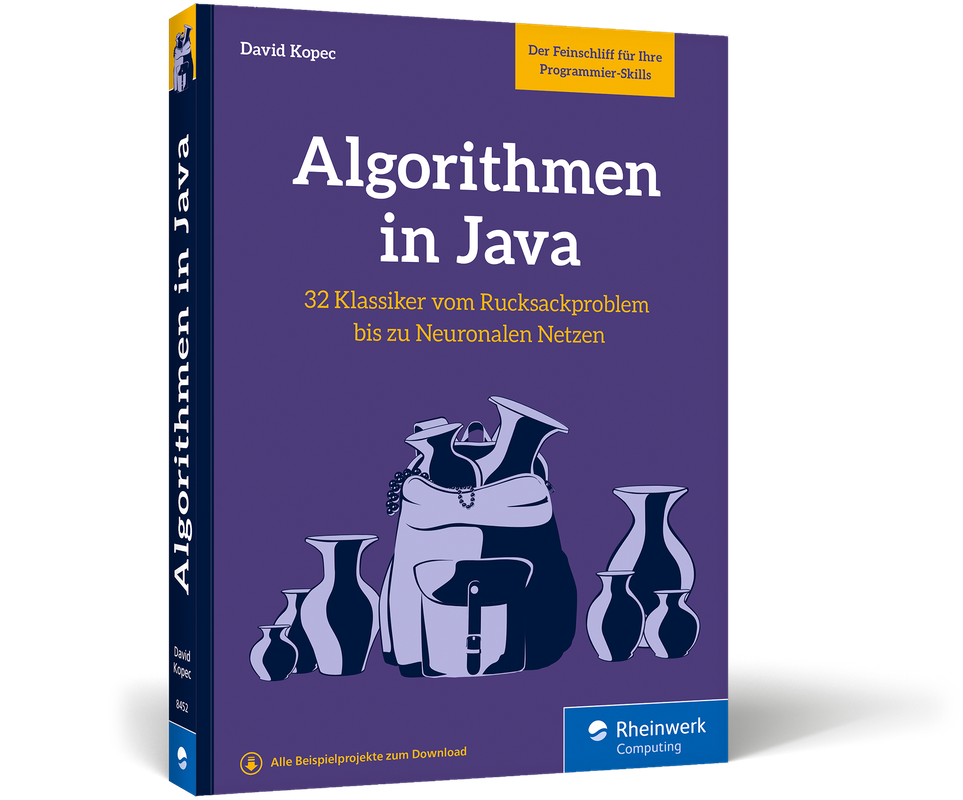
Algorithmen in Java
Programmieren will trainiert werden, und Algorithmen gehören zum Rüstzeug hinzu. Schlagen Sie zwei Fliegen mit einer Klappe und verbessern Sie Ihre Java-Skills anhand klassischer Algorithmen, von der Suche im Binärbaum über k-Means bis zum Rucksackproblem. Dieses Buch ist Grundausbildung und Fundgrube für Coding Workouts zugleich. Profitieren Sie von der Lehr- und Praxiserfahrung des Autors: David Kopec hat 32 Klassiker der Informatik für Sie herausgesucht, die Ihnen wichtige Lösungsstrategien aufzeigen und einen starken Trainingseffekt versprechen.Ideal für alle, die ihre ersten Schritte in der Programmierung hinter sich haben und jetzt voll durchstarten wollen!Aus dem Inhalt:Zum Einstieg: Unknackbare Verschlüsselung, Fibonacci-Folge, die Türme von HanoiSuchalgorithmen: DNS-Suche, Labyrinthe u.v.m.Bedingungserfüllung: Wortsuchrätsel, Acht-Damen-Problem u.v.m.Grafen, kürzeste Wegek-Means-ClusteringEinfache neuronale NetzeMinimax: Tic-tac-toe, Vier gewinntLeseprobe (PDF)

Essential Java for AP CompSci
Gain the essential skills for computer science using one of today's most popular programming languages, Java. This book will prepare you for AP CompSci Complete, but you don’t need to be sitting that class to benefit. Computer science has become a basic life skill that everyone is going to need to learn. Whether you are going into a career or side hustle in business, technology, creativity, architecture, or almost any other field, you will find coding and computer science play a role.So when we learn programming we are going to focus on three things: what is the process; what is the syntax; and what is the flow. The process is represented as a flowchart. We will learn how to make these to help you plan out what you are going to do before you write a line of code. At first, the flowcharts will be pretty simple, but then they will get more complex. The syntax is the code: this is what you write that translates the process you create in a flowchart to the instructions that the computer can understand. Finally, there is the flow. This is where you trace through the code and see how the data and information it stores along the way changes. You can see how the operation of the program cascades from line to line. You will be building charts that will capture the programming flow so you can better understand how the computer processes code to make your next program easier to conceive and code.Along the way to aid in the learning of the essential Java skills, there will be three kinds of project types throughout this book: business software projects for applications where you work for a company and need to complete an internal project for a team such as the sales, marketing, or data science teams; social good projects where you are working for non-profits or for agencies that are trying to research and provide solutions to economic, environmental, medical, or humanitarian projects; and game development projects for games based on player input, random chance, or other mechanics for the use of entertainment.What is unique about computer science is how it has become a skill, and not just a career. While there are jobs and titles of “computer scientist”, the skill of computer science, and specifically programming, are almost everywhere. After reading and using this book, you'll have the essential skills to think like a computer scientist, even if you are not. As a result you’ll be of greater value to your clients, your company, and yourself.WHAT YOU WILL LEARNDiscover the primary building blocks of programming using the Java programming language * See terminology and best practices of software development* Work with object-oriented programming concepts* Use common-language definitions and examples to help drive understanding and comprehension of computer science fundamentalsWHO THIS BOOK IS FORThose who want to learn programming and want to think like a computer scientist. Ideal for anyone taking AP CompSci Complete.Doug Winnie is director of learning experience at H&R Block, responsible for learning and development platforms supporting associates across the organization. Previously, Doug was principal program manager at Microsoft and LinkedIn leading the LinkedIn Learning instructor community, curriculum strategy for technology learning content, and as a member the Windows Insider team supporting educational and career growth for millions of Windows Insiders worldwide.Throughout his career and consulting with companies such as Adobe, PG&E, Safeway, HP, and the US Army, Doug has worked to help developers and designers through education, product management, and interactive development. Doug was honored with two Webby award nominations with projects for Industrial Light and Magic and has written multiple publications to teach beginners how to code. He is also an AP Computer Science teacher, teaching the next generation of developers. Doug lives in the Kansas City metro area and Palm Springs, California.1. WELCOME TO COMPUTER SCIENCE2. SPRINT 01: INTRODUCTION3. SPRINT 02: SETTING UP THE JAVA JDK AND INTELLIJ4. SPRINT 03: SETTING UP GITHUBa. QUIZ 01b. QUIZ 025. SPRINT 04: PROGRAMMING LANGUAGES6. SPRINT 05: HISTORY AND USES OF JAVA7. SPRINT 06: HOW JAVA WORKSa. QUIZ 038. SPRINT 07: FLOWCHARTINGa. ASSIGNMENT 01: PBJ’Db. QUIZ 049. SPRINT 08: HELLO, WORLDa. QUIZ 0510. SPRINT 09: SIMPLE JAVA PROGRAM STRUCTURE11. SPRINT 10: TEXT LITERALS AND OUTPUTa. ASSIGNMENT 02: EE’D12. SPRINT 11: VALUE LITERALS13. SPRINT 12: OUTPUT FORMATTING14. SPRINT 13: COMMENTS AND WHITESPACE15. SPRINT 14: ABSTRACTION OF NUMBERS16. SPRINT 15: BINARYa. QUIZ 0617. SPRINT 16: UNICODE18. SPRINT 17: VARIABLES19. SPRINT 18: MATH. UGH.a. QUIZ 07b. ASSIGNMENT 03: SILO’D20. SPRINT 19: MATH FUNCTIONS21. SPRINT 20: MANAGING TYPEa. ASSIGNMENT 04: SPACE’Db. QUIZ 08c. QUIZ 09d. QUIZ 10e. QUIZ 1122. SPRINT 21: RANDOM NUMBERS23. SPRINT 22: CAPTURE INPUT24. SPRINT 23: CREATING TRACE TABLES25. SPRINT 24: FUNCTIONSa. ASSIGNMENT 05: ORC’D26. SPRINT 25: NESTED FUNCTIONS27. SPRINT 26: FUNCTIONS AND VALUESa. QUIZ 1228. SPRINT 27: FUNCTIONS AND SCOPEa. QUIZ 13b. QUIZ 14c. QUIZ 15d. ASSIGNMENT 06: ULTIMA’De. ASSIGNMENT 07: CYCLONE’D29. SPRINT 28: BOOLEAN VALUES AND EQUALITYa. QUIZ 16b. ASSIGNMENT 08: SPRINT’Dc. USER STORY: 52-PICKUP30. SPRINT 29: SIMPLE CONDITIONAL STATEMENTSa. USER STORY: YAHTZEEb. USER STORY: YAHTZEE TESTINGc. QUIZ 17d. QUIZ 18e. QUIZ 1931. SPRINT 30: MATCHING CONDITIONS WITH THE SWITCH STATEMENT32. SPRINT 31: THE TERNARY OPERATOR33. SPRINT 32: THE STACK AND THE HEAP34. SPRINT 33: TESTING EQUALITY WITH STRINGSa. ASSIGNMENT 09: ESCAPE’Db. USER STORY: ESCAPE’D WHITE BOX35. SPRINT 34: DEALING WITH ERRORS36. SPRINT 35: DOCUMENTING WITH JAVADOC37. SPRINT 36: FORMATTED STRINGS38. SPRINT 37: THE WHILE LOOPa. QUIZ 20b. QUIZ 21c. QUIZ 2239. SPRINT 38: AUTOMATIC PROGRAM LOOPS40. SPRINT 39: THE DO/WHILE LOOPa. ASSIGNMENT 10: SEQUENCE’Db. USER STORY: DICEYc. USER STORY SOLUTION: DICEYd. USER STORY: CONVERTERe. USER STORY SOLUTION: CONVERTER41. SPRINT 40: PROBABILITY42. SPRINT 41: SIMPLIFIED ASSIGNMENT OPERATORS43. SPRINT 42: THE FOR LOOPa. QUIZ 23b. ASSIGNMENT 11: ODDS’D44. SPRINT 43: NESTING LOOPSa. USER STORY: MAP BUILDER45. SPRINT 44: STRINGS AS COLLECTIONSa. ASSIGNMENT 12: PALINDROME’Db. QUIZ 2446. SPRINT 45: MAKE COLLECTIONS USING ARRAYSa. QUIZ 2547. SPRINT 46: CREATING ARRAYS FROM STRINGSa. ASSIGNMENT 13: ELECTION’Db. QUIZ 2648. SPRINT 47: MULTIDIMENSIONAL ARRAYS49. SPRINT 48: LOOPING THROUGH MULTIDIMENSIONAL ARRAYSa. QUIZ 27b. QUIZ 2850. SPRINT 49: BEYOND ARRAYS WITH ARRAYLISTS51. SPRINT 50: INTRODUCING GENERICS52. SPRINT 51: LOOPING WITH ARRAYLISTSa. ASSIGNMENT 14: LIST’D53. SPRINT 52: USING FOR…EACH LOOPSa. ASSIGNMENT 15: NUMBER’Db. QUIZ 29c. QUIZ 3054. SPRINT 53: THE ROLE-PLAYING GAME CHARACTERa. ASSIGNMENT 16: ROLL’D55. SPRINT 54: POLYMORPHISMa. ASSIGNMENT 17: EXTEN’D56. SPRINT 55: MAKE ALL THE THINGS…CLASSES57. SPRINT 56: CLASS, EXTEND THYSELF!a. QUIZ 3158. SPRINT 57: I DON'T COLLECT THOSE; TOO ABSTRACT.59. SPRINT 58: ACCESS DENIED: PROTECTED AND PRIVATEa. QUIZ 32b. QUIZ 3360. SPRINT 59: INTERFACING WITH INTERFACESa. QUIZ 34b. QUIZ 35c. QUIZ 36d. QUIZ 37e. ASSIGNMENT 18: STARSHIP’D61. SPRINT 60: ALL I'M GETTING IS STATIC62. SPRINT 61: AN ALL-STAR CAST, FEATURING NULL63. ANSWER KEY

SAP Mobile Services
Mobile Apps flexibel entwickeln! Dieses Buch stellt Ihnen den kompletten Funktionsumfang der SAP Mobile Services vor (vormals SAP Cloud Platform Mobile Services). Ob Sie native Apps für iOS oder Android programmieren oder Ihren Mitarbeitenden Mobile Cards für den schnellen Zugriff auf Informationen bereitstellen möchten: Für alle App-Typen und SDKs finden Sie ausführliche Beispiele. Die Autoren zeigen Ihnen außerdem, wie Sie Ihre Apps absichern und verwalten. Aus dem Inhalt: Native Apps für iOS und AndroidHybride AppsSAP-Fiori-AppsSAP Mobile CardsPush-BenachrichtigungenOffline-DatenhaltungApp-UpdatesCloud ConnectorNeo- und Cloud-Foundry-UmgebungIdentity Propagation und AuthentifizierungGit Einleitung ... 13 1. Historie der SAP Mobile Services ... 19 1.1 ... Erste Technologien für mobile Apps ... 20 1.2 ... Sybase Unwired Platform ... 22 1.3 ... Syclo Agentry ... 26 1.4 ... SAP Mobile Platform ... 28 1.5 ... SAP Mobile Services ... 31 2. App-Typen ... 39 2.1 ... Native Apps ... 40 2.2 ... Hybride Apps ... 48 2.3 ... SAP Fiori Client ... 51 2.4 ... Mobile Development Kit ... 55 2.5 ... SAP Mobile Cards ... 57 3. Einführung in die SAP Mobile Services ... 59 3.1 ... Funktionsumfang der SAP Mobile Services ... 59 3.2 ... Vergleich zwischen Neo- und Cloud-Foundry-Umgebung ... 107 3.3 ... Migration von der Neo- in die Cloud-Foundry-Umgebung ... 109 4. Entwicklung einer nativen App mit dem SAP BTP SDK for iOS ... 111 4.1 ... Einführung in die SAP Fiori Design Guidelines ... 112 4.2 ... Einführung in SAP Fiori Mentor ... 116 4.3 ... Datenmodell für die im Buch verwendeten Beispiele ... 120 4.4 ... Projekt mit dem SAP BTP SDK Assistant for iOS erstellen ... 123 5. Entwicklung einer nativen App mit dem SAP BTP SDK for Android ... 133 5.1 ... SAP Fiori for Android ... 134 5.2 ... SAP Fiori Mentor für Android ... 136 5.3 ... Projekt mit dem SAP BTP SDK Wizard for Android erstellen ... 140 6. Entwicklung einer hybriden App mit dem Mobile Development Kit ... 157 6.1 ... Entwicklungsumgebung einrichten ... 157 6.2 ... OData-basierte App mit dem Mobile Development Kit erstellen ... 163 7. Entwicklung einer hybriden App mit dem Hybrid Application Toolkit ... 191 7.1 ... Entwicklungsumgebung einrichten ... 192 7.2 ... Eine hybride App in der SAP Web IDE entwickeln ... 196 8. Entwicklung einer Mobile Card ... 215 8.1 ... SAP Mobile Cards installieren und vorbereiten ... 216 8.2 ... Eine Mobile Card erstellen ... 218 9. Integration mit On-Premise- und Cloud-Systemen ... 237 9.1 ... Einführung in den Cloud Connector ... 237 9.2 ... Zugriff auf On-Premise-Systeme ... 255 9.3 ... Zugriff auf Cloud-Systeme ... 270 10. Sicherheit der SAP Mobile Services ... 273 10.1 ... Einführung in die Sicherheitsarchitektur der SAP Business Technology Platform ... 273 10.2 ... Standardrollen für die SAP Mobile Services ... 276 10.3 ... Identity Propagation ... 278 10.4 ... Anwenderauthentifizierung ... 287 10.5 ... SAP Authenticator ... 297 10.6 ... Datenschutz ... 299 11. Softwarelogistik ... 303 11.1 ... Softwarelogistik für mobile Lösungen ... 303 11.2 ... Versionsverwaltung mobiler Apps mit Git ... 305 11.3 ... Continuous Integration und Delivery ... 313 12. Integration von Drittanbieterfunktionalität ... 337 12.1 ... Plug-ins in mobile SAP-Fiori-Apps integrieren ... 339 12.2 ... Plug-ins in iOS-Apps integrieren ... 347 12.3 ... Plug-ins in Android-Apps integrieren ... 350 13. Mobile SAP-Standard-Apps ... 353 13.1 ... SAP Analytics Cloud ... 353 13.2 ... SAP Work Manager ... 356 13.3 ... SAP SuccessFactors Mobile ... 357 13.4 ... Mobile App für SAP Concur ... 359 13.5 ... SAP Sales Cloud ... 360 13.6 ... SAP Jam ... 362 Das Autorenteam ... 365 Index ... 367

Get Started with the MAX78000FTHR Development Board
The MAX78000FTHR from Maxim Integrated is a small development board based on the MAX78000 MCU. The main usage of this board is in artificial intelligence applications (AI) which generally require large amounts of processing power and memory. It marries an Arm Cortex-M4 processor with a floating-point unit (FPU), convolutional neural network (CNN) accelerator, and RISC-V core into a single device. It is designed for ultra-low power consumption, making it ideal for many portable AI-based applications.This book is project-based and aims to teach the basic features of the MAX78000FTHR. It demonstrates how it can be used in various classical and AI-based projects. Each project is described in detail and complete program listings are provided. Readers should be able to use the projects as they are, or modify them to suit their applications. This book covers the following features of the MAX78000FTHR microcontroller development board:> Onboard LEDs and buttons> External LEDs and buttons> Using analog-to-digital converters > I2C projects> SPI projects> UART projects> External interrupts and timer interrupts > Using the onboard microphone> Using the onboard camera> Convolutional Neural Network (CNN) > Artificial Intelligence projectsProf Dr Dogan Ibrahim has a BSc degree in electronic engineering, an MSc degree in automatic control engineering, and a PhD degree in digital signal processing. Dogan has worked in many indus-trial organizations before he returned to academic life. Prof Ibrahim is the author of over 60 technical books and over 200 technical articles on microcontrollers, microprocessors, and related fields. He is a Chartered electrical engineer and a Fellow of the Institution of Engineering Technology.

C++ Schnelleinstieg
* C++ PROGRAMMIEREN LERNEN OHNE VORKENNTNISSE * ALLE GRUNDLAGEN FÜR DEN PROFESSIONELLEN EINSATZ* EINFACHE PRAXISBEISPIELE UND ÜBUNGSAUFGABENMit diesem Buch gelingt Ihnen der einfache Einstieg in die C++-Programmierung.Alle Grundlagen werden in 14 Kapiteln anschaulich und leicht nachvollziehbar anhand von Codebeispielen erläutert. Übungsaufgaben am Ende der Kapitel helfen Ihnen, das neu gewonnene Wissen schnell praktisch anzuwenden und zu vertiefen.Der Autor führt Sie Schritt für Schritt in die Welt der Programmierung ein: von den Grundlagen über Objektorientierung bis zur Entwicklung von Anwendungen mit grafischer Benutzungsoberfläche. Dabei lernen Sie ebenfalls, was guten Programmierstil ausmacht und wie man Fehler in Programmtexten finden und von vornherein vermeiden kann.So sind Sie perfekt auf den Einsatz von C++ im professionellen Umfeld vorbereitet.* Alle Grundlagen einfach erläutert* Objektorientierte Programmierung* Einsatz von Open-Source-Bibliotheken* Grafische Benutzungsoberflächen (GUI)* Internetanfragen und JSON-Parsing* Zeiger und virtuelle Methoden* Fehlersuche und Debugging* Moderner Programmierstil* Programmcode, Lösungen und Glossar zum DownloadPhilipp Hasper ist Gründer eines Augmented-Reality-Startups und hat jahrelange Erfahrung in der akademischen und industriellen Entwicklung von KI-Technologien. Er entwickelt mit C++, Java, Python und Typescript und hat bei zahlreichen Open-Source-Projekten mitgewirkt.

Generating a New Reality
The emergence of artificial intelligence (AI) has brought us to the precipice of a new age where we struggle to understand what is real, from advanced CGI in movies to even faking the news. AI that was developed to understand our reality is now being used to create its own reality.In this book we look at the many AI techniques capable of generating new realities. We start with the basics of deep learning. Then we move on to autoencoders and generative adversarial networks (GANs). We explore variations of GAN to generate content. The book ends with an in-depth look at the most popular generator projects.By the end of this book you will understand the AI techniques used to generate different forms of content. You will be able to use these techniques for your own amusement or professional career to both impress and educate others around you and give you the ability to transform your own reality into something new.WHAT YOU WILL LEARN* Know the fundamentals of content generation from autoencoders to generative adversarial networks (GANs)* Explore variations of GAN* Understand the basics of other forms of content generation* Use advanced projects such as Faceswap, deepfakes, DeOldify, and StyleGAN2WHO THIS BOOK IS FORMachine learning developers and AI enthusiasts who want to understand AI content generation techniquesMICHEAL LANHAM is a proven software and tech innovator with more than 20 years of experience. During that time, he has developed a broad range of software applications in areas including games, graphics, web, desktop, engineering, artificial intelligence (AI), GIS, and machine learning (ML) applications for a variety of industries as an R&D developer. At the turn of the millennium, Micheal began working with neural networks and evolutionary algorithms in game development. He is an avid educator, has written more than eight books covering game development, extended reality, and AI, and teaches at meetups and other events. Micheal also likes to cook for his large family in his hometown of Calgary, Canada. Chapter 1: Deep Learning PerceptronChapter Goal: In this chapter we introduce the basics of deep learning from the perceptron to multi-layer perceptron.No of pages: 30Sub -Topics1. Understanding deep learning and supervised learning.1. Using the perceptron for supervised learning.2. Constructing a multilayer perceptron.3. Discover the basics of activation, loss, optimization and back propagation for problems of regression and classification.Chapter 2: Unleashing Autoencoders and Generative Adversarial NetworksChapter Goal: This chapter introduces the autoencoder and GAN for simple content generation. Along the way we also learn about using convolutional network layers for better feature extraction.No of pages: 30Sub - Topics1. Why we need autoencoders and how they function.2. Improving on the autoencoder with convolutional network layers.3. Generating content with the GAN.4. Explore methods for improving on the vanilla GAN.Chapter 3: Exploring the Latent SpaceChapter Goal: In this chapter we discover the latent space in AI. What it means to move through the AI latent space using variational autoencoders and conditional GANs.No of pages : 30Sub - Topics:1. Understanding variation and the variational autoencoder.2. Exploring the latent space with a VAE.3. Extending a GAN to be conditional.4. Generate interesting foods using a conditional GAN.Chapter 4: GANs, GANs and More GANsChapter Goal: In this chapter we begin uncovering the vast variations in GANs and their applications. We start with basics like the double convolution GAN and work up to the Stack and Progressive GANs.No of pages: 30Sub - Topics:1. Look at samples from the many variations of GANs.2. Setup and use a DCGAN.3. Understand how a StackGAN works.4. Work with and use a ProGAN.Chapter 5: Image to Image Translation with GANsCovers: Pix2Pix and DualGAN, side projects for understanding with ResNET and UNET, advanced network architectures for image classification/generationChapter 6: Translating Images with Cycle ConsistencyCovers: Cycle consistency loss and the CycleGAN, BiCycleGAN and StarGANChapter 7: Styling with GANsCovers: StyleGAN, Attention and the Self-attention GAN with a look at DeOldifyChapter 8: Developing DeepFakesChapter Goal: DeepFakes are taking the world by storm and in this chapter, we explore how to use a DeepFakes project. No of pages: 301. Learn how to isolate faces or other points of interest in images or video.2. Extract and replace faces from images or video.3. Use DeepFakes GAN to generate facial images based on input image.4. Put it all together and allow the user to generate their own DeepFake video.Chapter 9: Uncovering Adversarial Latent AutoencodersChapter Goal: GANs are not the only technique that allows for content manipulation and generations. In this chapter we look at the ALAE method for generating content.No of pages:1. Look at how to extend autoencoders for adversarial learning.2. Understanding how AE can be used to explore the latent space in data.3. Use ALAE to generate conditional content.4. Revisit our previous foods example and see what new foods we can generate.Chapter 10: Video Content with First Order Model MotionChapter Goal: In this chapter we explore a new technique for animating static images called First Order Model Motion. At the end of this chapter we will use this technique to create avatars for Skype or Zoom.No of pages: 301. Discover the basic of First Order Model Motion, what it is and how it works.2. Be able to apply FOMM to a number of static image datasets for various applications.3. Use the project Avatarify for generating real-time avatars from static avatars.4. Use Avatarify real-time in applications like Zoom or Skype.

Einführung in Python 3
EINFÜHRUNG IN PYTHON 3 //- Lehrbuch und Nachschlagewerk- Farbige Syntaxdarstellung- Geeignet für Programmieranfänger, aber auch für Umsteiger von anderen Sprachen wie z. B. C, C++, C#, Java- Systematische Einführung in Python, aufbauend auf den Erfahrungen aus Hunderten von Schulungen des Autors- Praxisnahe Übungen mit ausführlich dokumentierten Musterlösungen- Ihr exklusiver Vorteil: E-Book inside beim Kauf des gedruckten BuchesDie wesentlichen Begriffe und Techniken der Programmierung wie auch die zugrunde liegenden Ideen werden anschaulich erklärt. Anhand typischer Beispiele werden unterschiedliche Problemstellungen verdeutlicht, die sich dann leicht auf andere Anwendungsfälle übertragen lassen. Die Übungsaufgaben mit ausführlich dokumentierten Musterlösungen dienen zur Vertiefung des Stoffs und zeigen exemplarische Vorgehensweisen, die in vielen anderen Bereichen verwendet werden können.Als idealer Einstieg für Programmieranfänger und für Umsteiger behandelt dieses Buch alle grundlegenden Sprachelemente von Python. Auch für Python-Kenner bietet das Buch viele weiterführende Themen wie Funktionale Programmierung mit Dekorateuren, Generatoren, Klasseninstanzen als aufrufbare Objekte, Systemprogrammierung, Forks, Ausnahmehandlungen und Modultests.Entsprechend ihrer Bedeutung ist der Objektorientierung ein umfangreicher Teil des Buchs gewidmet. In anschaulicher und leicht verständlicher Weise wird in die Thematik der OOP eingeführt und dabei der pythonische Stil demonstriert, der sich deutlich von C++ und Java unterscheidet. Außerdem wurden nun auch eigene Kapitel zu Slots, dynamischer Erzeugung von Klassen, Metaklassen und Abstrakten Klassen aufgenommen.Die Funktionale Programmierung wird in einem eigenen Teil behandelt. Dazu wurden die Kapitel über Dekorateure und Generatoren grundlegend überarbeitet und erweitert.AUS DEM INHALT //- Grundlagen: Sequentielle Datentypen, Dictionaries, Mengen, Verzweigungen, Schleifen- Flaches und tiefes Kopieren- Funktionen- Modularisierung- Objektorientierte Programmierung: Grundlagen, Aufrufbare Objekte (Callables), Vererbung, Mehrfachvererbung, Slots, Klassendekoration, Metaklassen, Abstrakte Klassen- Funktionale Programmierung: lambda, map, filter und Listen-Abstraktion, Generatoren und Iteratoren, Dekorateure- Tests und Fehler- Daten konservieren- Reguläre Ausdrücke- Typ-Anmerkungen- Systemprogrammierung- Forks Der Diplom-Informatiker Bernd Klein ist der Inhaber und Gründer des Schulungsanbieters Bodenseo. Er kennt sich bestens mit der Theorie und Praxis von Programmiersprachen aus. In zahlreichen Projekten hat er wertvolle praktische Erfahrungen gesammelt, die in seine Kurse und Bücher einfließen. Seit 2010 hat er sich auf Python konzentriert und sich zum international anerkannten Experten entwickelt.Seine didaktischen Fähigkeiten und seine Sachkompetenz stellt er auf den beiden Webseiten www.python-kurs.eu und www.python-course.eu unter Beweis.