

Programmierung
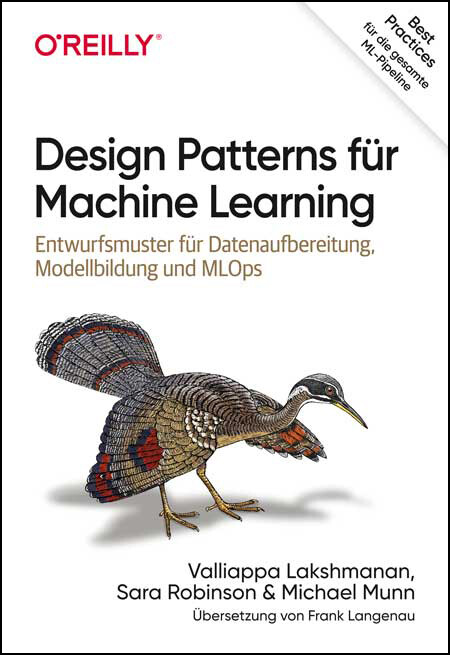
Design Patterns für Machine Learning
Entwurfsmuster für Datenaufbereitung Modellbildung und MLOpsDie Design Patterns in diesem Buch zeigen praxiserprobte Lösungen für wiederkehrende Aufgaben im Machine Learning. Die Autor:innen – ML-Experten bei Google – beschreiben Methoden, die Data Scientists helfen, typische Probleme im gesamten ML-Prozess zu bewältigen. Die Entwurfsmuster verdichten die Erfahrungen von Hunderten von Expert:innen zu klar strukturierten, zugänglichen Best Practices. Das Buch bietet detaillierte Erläuterungen zu 30 Mustern für die Daten- und Problemdarstellung, Operationalisierung, Wiederholbarkeit, Reproduzierbarkeit, Flexibilität, Erklärbarkeit und Fairness. Zu jedem Muster erhält man eine Beschreibung des Problems, eine Vielzahl möglicher Lösungen sowie Empfehlungen, welche Technik die beste für Problemstellungen ist. Aus dem Inhalt:Herausforderungen beim Trainieren, Bewerten und Deployen von ML-Modellen erkennen und überwindenDaten für verschiedene ML-Modelltypen mit Einbettungen, Feature Crosses und mehr darstellenden richtigen Modelltyp für bestimmte Fragestellungen auswähleneine robuste Trainingsschleife mit Checkpoints, Verteilungsstrategie und Hyperparameter-Tuning erstellenskalierbare ML-Systeme deployen, die bei erneutem Training aktuelle Daten berücksichtigenModellvorhersagen für Stakeholder interpretierenModellgenauigkeit, Reproduzierbarkeit, Resilienz und Fairness verbessernAutoren:Valliappa Lakshmanan ist Global Head für Datenanalyse und KI-Lösungen bei Google Cloud. Sara Robinson ist Developer Advocate im Google-Cloud-Team, sie ist spezialisiert auf Machine Learning. Michael Munn ist ML Solutions Engineer bei Google. Er unterstützt Kunden bei der Entwicklung, Implementierung und Bereitstellung von Machine-Learning-Modellen.
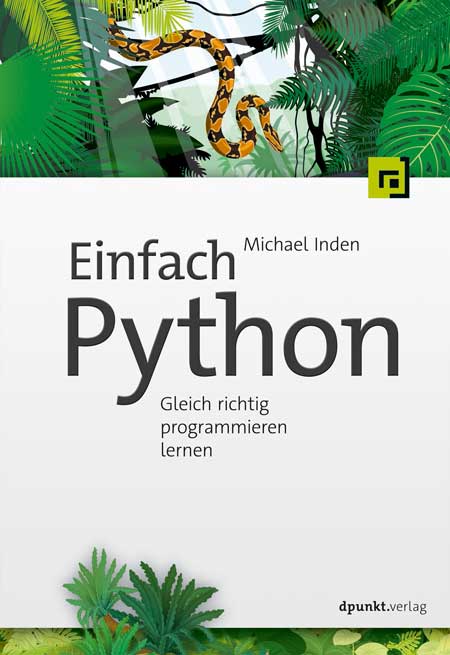
Einfach Python
Gleich richtig programmieren lernen - das Profi-Buch von Michael Inden in Erstauflage, November 2021.Endlich programmieren lernen und die ersten Projekte umsetzen. Hierfür bietet sich Python als eine der populärsten Programmiersprachen an. Mit diesem Buch gelingt es mühelos ein Einstieg, denn man wird auf einer Entdeckungsreise vom erfahrenden Trainer Michael Inden begleitet. Er erklärt die Grundlagen der Python-Programmierung leicht und verständlich. Generell wird die trockene Theorie auf ein Minimum reduziert. Ergänzend werden immer wieder auch Python-spezifische Besonderheiten wie Built-in-Funktionen, Slicing, Comprehensions, Generatoren usw. erklärt, die das Entwicklen erleichtern und Programme gleich von Anfang an Python-like, stilistisch schön – kurz Pythonic – machen. Eine große Rolle spielt der interaktive Einstieg mithilfe der Python-Kommandozeile. Damit können kleine Programme direkt ausprobiert werden und Erfolgserlebnisse stellen sich schnell ein. Dieses Vorgehen eignet sich ideal, um sich Python im Selbststudium sowie im eigenen Tempo anzueignen. Allmählich werden die Themen anspruchsvoller und die zu erstellenden Programme größer. Schließlich erfährt man wie man eine Entwicklungsumgebung einsetzen, und lernt die objektorientierte Programmierung kennen. Mit den erworbenen Grundlagen kann man sich immer gezielter mit eigenen Projekten beschäftigen. Erste Ideen liefern drei etwas umfangreichere Programmierbeispiele aus der Praxis, die zudem einen Einblick in das schrittweise, erfolgreiche Entwickeln von Applikationen geben. Das Buch besteht aus in sich abgeschlossenen, aufeinander aufbauenden Kapiteln zu den wesentlichen Bereichen der Programmiersprache Python und den relevanten Sprachelementen. Aufgaben und Musterlösungen runden viele Kapitel ab, sodass Sie das zuvor Gelernte direkt anhand neuer Problemstellungen praktizieren und Ihr Wissen vertiefen können. Zahlreiche kurze Codebeispiele verdeutlichen die Lerninhalte und laden zum Experimentieren ein. Gleich von Anfang an lernen Sie, Ihren Sourcecode sauber zu strukturieren und einen guten Stil zu entwickeln. Dabei hilft ein Kapitel zu Programmierregeln, sogenannten Coding Conventions und zum Testen mit Pytest.Inhalt (PDF-Link)Autor:Dipl.-Inform. Michael Inden ist Oracle-zertifizierter Java-Entwickler. Nach seinem Studium in Oldenburg hat er bei diversen internationalen Firmen in verschiedenen Rollen etwa als Softwareentwickler, -architekt, Consultant, Teamleiter, CTO sowie Leiter Academy gearbeitet. Zurzeit ist er freiberuflich als Autor und Trainer in Zürich tätig.Michael Inden hat über zwanzig Jahre Berufserfahrung beim Entwurf komplexer Softwaresysteme gesammelt, an diversen Fortbildungen und mehreren Java-One-Konferenzen teilgenommen. Sein besonderes Interesse gilt dem Design qualitativ hochwertiger Applikationen sowie dem Coaching. Sein Wissen gibt er gerne als Trainer in internen und externen Schulungen und auf Konferenzen weiter, etwa bei der JAX/W-JAX, JAX London, Oracle Code One, ch.open sowie bei der Java User Group Switzerland.
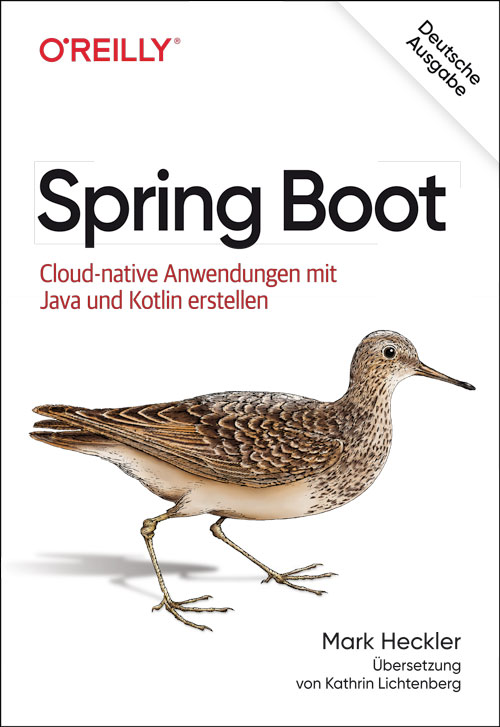
Spring Boot
Cloud-native Anwendungen mit Java und Kotlin erstellenMit mehr als 75 Millionen Downloads pro Monat ist Spring Boot das populärste und am weitesten verbreitete Java-Framework. Dank seiner Benutzerfreundlichkeit und Leistungsfähigkeit hat es die Anwendungsentwicklung von Monolith-Architekturen und Microservices revolutioniert. Doch die Einfachheit von Spring Boot kann zunächst auch irritieren. Was brauchen Entwickler:innen, um sofort produktiv zu werden? Dieses praxisorientierte Buch zeigt, wie das Framework genutzt werden kann, um erfolgreich unternehmenskritische Applikationen zu entwickeln. Mark Heckler von VMware, der Firma hinter Spring, leitet durch die Architektur und die Konzepte von Spring Boot und behandelt auch Themen wie Debugging, Testen und Deployment. Wenn man mit Spring Boot schnell und effektiv Cloudnative Java- oder Kotlin-Anwendungen entwickeln will – inklusive reaktiver Programmierung, dem Erstellen von APIs und dem Einrichten von Datenbankzugriffen aller Art – dann ist dieses Buch genau das Richtige. Zielgruppe:Java-Entwickler*innen Autor:Mark Heckler ist Softwareentwickler und Spring Developer Advocat bei VMware. Als Java Champion und Google Developer Expert für Kotlin konzentriert er sich auf die Entwicklung innovativer, produktionsreifer Software für die Cloud. Mark engagiert sich in Open-Source-Projekten und ist Autor und Kurator des Blogs Hecklers in Development, brewing stronger Java (https://thehecklers.com).Aus dem Inhalt:Wie Spring Boot die Entwicklung und das Deployment Cloud-nativer Anwendungen vereinfachtErstellung reaktiver Anwendungen und Erweiterung der Kommunikation über die Netzwerkgrenzen hinaus, um verteilte Systeme zu erstellenWie der Spring-Boot-typische Ansatz die Produktivität steigert und die Portabilität von Anwendungen verbessertDeploying von Spring-Boot-Anwendungen, schnell und zuverlässig für die Arbeitslast in der ProduktivumgebungÜberwachung des Anwendungs- und Systemzustand für optimale Performance und ZuverlässigkeitDebuggen, testen und sichern von Cloud-basierten Anwendungen mit State-of-the-Art-Techniken

Practical Go
YOUR PRACTICAL, HANDS-ON GUIDE TO WRITING APPLICATIONS USING GOGoogle announced the Go programming language to the public in 2009, with the version 1.0 release announced in 2012. Since its announcement to the community, and the compatibility promise of the 1.0 release, the Go language has been used to write scalable and high-impact software programs ranging from command-line applications and critical infrastructure tools to large-scale distributed systems. It’s speed, simplicity, and reliability make it a perfect choice for developers working in various domains.In Practical Go - Building Scalable Network + Non-Network Applications, you will learn to use the Go programming language to build robust, production-ready software applications. You will learn just enough to building command line tools and applications communicating over HTTP and gRPC.This practical guide will cover:* Writing command line applications* Writing a HTTP services and clients* Writing RPC services and clients using gRPC* Writing middleware for network clients and servers* Storing data in cloud object stores and SQL databases* Testing your applications using idiomatic techniques* Adding observability to your applications* Managing configuration data from your applicationsYou will learn to implement best practices using hands-on examples written with modern practices in mind. With its focus on using the standard library packages as far as possible, Practical Go will give you a solid foundation for developing large applications using Go leveraging the best of the language’s ecosystem.AMIT SAHA is a software engineer at Atlassian, located in Sydney, Australia. He has written Doing Math with Python: Use Programming to Explore Algebra, Statistics, Calculus, and More! (No Starch Press, 2015) and Write Your First Program (PHI Learning, 2013). His other writings have been published in technical magazines, conference proceedings, and research journals. He can be found ONLINE AT HTTPS://ECHORAND.MEIntroduction xviiGetting Started xxiCHAPTER 1 WRITING COMMAND-LINE APPLICATIONS 1Your First Application 1Writing Unit Tests 8Using the Flag Package 14Testing the Parsing Logic 20Improving the User Interface 22Removing Duplicate Error Messages 23Customizing Usage Message 24Accept Name via a Positional Argument 25Updating the Unit Tests 28Summary 32CHAPTER 2 ADVANCED COMMAND-LINE APPLICATIONS 33Implementing Sub-commands 33An Architecture for Sub-command-Driven Applications 37Testing the Main Package 43Testing the Cmd Package 45Making Your Applications Robust 47User Input with Deadlines 48Handling User Signals 52Summary 56CHAPTER 3 WRITING HTTP CLIENTS 57Downloading Data 57Testing the Data Downloader 59Deserializing Received Data 61Sending Data 66Working with Binary Data 72Summary 80CHAPTER 4 ADVANCED HTTP CLIENTS 81Using a Custom HTTP Client 81Downloading from an Overloaded Server 81Testing the Time-Out Behavior 85Configuring the Redirect Behavior 88Customizing Your Requests 91Implementing Client Middleware 92Understanding the RoundTripper Interface 93A Logging Middleware 94Add a Header to All Requests 96Connection Pooling 99Configuring the Connection Pool 103Summary 104CHAPTER 5 BUILDING HTTP SERVERS 105Your First HTTP Server 105Setting Up Request Handlers 108Handler Functions 109Testing Your Server 112The Request Struct 114Method 115Url 115Proto, ProtoMajor, and ProtoMinor 116Header 116Host 116Body 116Form, PostForm 116MultipartForm 117Attaching Metadata to a Request 118Processing Streaming Requests 121Streaming Data as Responses 126Summary 132CHAPTER 6 ADVANCED HTTP SERVER APPLICATIONS 133The Handler Type 133Sharing Data across Handler Functions 134Writing Server Middleware 139Custom HTTP Handler Technique 139The HandlerFunc Technique 140Chaining Middleware 142Writing Tests for Complex Server Applications 147Code Organization 147Testing the Handler Functions 153Testing the Middleware 155Testing the Server Startup 157Summary 159CHAPTER 7 PRODUCTION- READY HTTP SERVERS 161Aborting Request Handling 161Strategies to Abort Request Processing 165Handling Client Disconnects 169Server-Wide Time- Outs 173Implement a Time- Out for All Handler Functions 173Implementing Server Time- Out 174Implementing Graceful Shutdown 179Securing Communication with TLS 184Configuring TLS and HTTP/2 184Testing TLS Servers 188Summary 192CHAPTER 8 BUILDING RPC APPLICATIONS WITH GRPC 193gRPC and Protocol Buffers 193Writing Your First Service 197Writing the Server 198Writing a Client 203Testing the Server 207Testing the Client 211A Detour into Protobuf Messages 214Marshalling and Unmarshalling 214Forward and Backward Compatibility 219Multiple Services 220Error Handling 226Summary 228CHAPTER 9 ADVANCED GRPC APPLICATIONS 229Streaming Communication 229Server- Side Streaming 230Client- Side Streaming 237Bidirectional Streaming 239Receiving and Sending Arbitrary Bytes 247Implementing Middleware Using Interceptors 256Client- Side Interceptors 257Server- Side Interceptors 263Wrapping Streams 269Chaining Interceptors 271Summary 272CHAPTER 10 PRODUCTION- READY GRPC APPLICATIONS 275Securing Communication with TLS 275Robustness in Servers 278Implementing Health Checks 278Handling Runtime Errors 286Aborting Request Processing 289Robustness in Clients 297Improving Connection Setup 298Handling Transient Failures 300Setting Time- Outs for Method Calls 305Connection Management 306Summary 309CHAPTER 11 WORKING WITH DATA STORES 311Working with Object Stores 312Integration with Package Server 313Testing Package Uploads 323Accessing Underlying Driver Types 325Working with Relational Databases 327Integration with Package Server 328Testing Data Storage 339Data Type Conversions 343Using Database Transactions 346Summary 348Appendix A Making Your Applications Observable 349Logs, Metrics, and Traces 349Emitting Telemetry Data 352Command- Line Applications 352HTTP Applications 360gRPC Applications 364Summary 366Appendix B Deploying Applications 367Managing Configuration 367Distributing Your Application 370Deploying Server Applications 372Summary 373Index 375

Design Patterns in Modern C++20
Apply the latest editions of the C++ standard to the implementation of design patterns. As well as covering traditional design patterns, this book fleshes out new design patterns and approaches that will be useful to modern C++ developers. Author DMITRI NESTERUK presents concepts as a fun investigation of how problems can be solved in different ways, along the way using varying degrees of technical sophistication and explaining different sorts of trade-offs.Design Patterns in Modern C++20, Second Edition also provides a technology demo for modern C++, showcasing how some of its latest features (e.g., coroutines, modules and more) make difficult problems a lot easier to solve. The examples in this book are all suitable for putting into production, with only a few simplifications made in order to aid readability.WHAT YOU WILL LEARN* Use creational patterns such as builder, factories, prototype and singleton* Implement structural patterns such as adapter, bridge, decorator, facade and more* Work with the behavioral patterns such as chain of responsibility, command, iterator, mediator and more* Apply functional design patterns such as the Maybe MonadWHO THIS BOOK IS FORThis book is for both beginner and experienced C++ developers.DMITRI NESTERUK is a quantitative analyst, developer, course and book author, and an occasional conference speaker. His interests lie in software development and integration practices in the areas of computation, quantitative finance and algorithmic trading. His technological interests include C# and C++ programming as well high-performance computing using technologies such as CUDA and FPGAs. He has been a C# MVP since 2009.1. IntroductionPart- I: Creational Patterns2. Builder3. Factories4. Prototype5. SingletonPart- II: Structural Patterns6. Adapter7. Bridge8. Composite9. Decorator10. Façade11. Flyweight12. ProxyPart- III: Behavioral Patterns13. Chain of Responsibility14. Command15. Interpreter16. Iterator17. Mediator18. Memento19. Null Object20. Observer21. State22. Strategy23. Template Method24. Visitor

Learn to Program with Assembly
Many programmers have limited effectiveness because they don't have a deep understanding of how their computer actually works under the hood. In Learn to Program with Assembly, you will learn to program in assembly language - the language of the computer itself.Assembly language is often thought of as a difficult and arcane subject. However, author Jonathan Bartlett presents the material in a way that works just as well for first-time programmers as for long-time professionals. Whether this is your first programming book ever or you are a professional wanting to deepen your understanding of the computer you are working with, this book is for you. The book teaches 64-bit x86 assembly language running on the Linux operating system. However, even if you are not running Linux, a provided Docker image will allow you to use a Mac or Windows computer as well.The book starts with extremely simple programs to help you get your grounding, going steadily deeper with each chapter. At the end of the first section, you will be familiar with most of the basic instructions available on the processor that you will need for any task. The second part deals with interactions with the operating system. It shows how to make calls to the standard library, how to make direct system calls to the kernel, how to write your own library code, and how to work with memory. The third part shows how modern programming language features such as exception handling, object-oriented programming, and garbage collection work at the assembly language level.Additionally, the book comes with several appendices covering various topics such as running the debugger, vector processing, optimization principles, a list of common instructions, and other important subjects.This book is the 64-bit successor to Jonathan Bartlett's previous book, Programming from the Ground Up, which has been a programming classic for more than 15 years. This book covers similar ground but with modern 64-bit processors, and also includes a lot more information about how high level programming language features are implemented in assembly language.WHAT YOU WILL LEARN* How the processor operates * How computers represent data internally * How programs interact with the operating system* How to write and use dynamic code libraries* How high-level programming languages implement their features WHO THIS BOOK IS FORAnyone who wants to know how their computer really works under the hood, including first time programmers, students, and professionals.JONATHAN BARTLETT is a software developer, researcher, and writer. His first book, Programming from the Ground Up, has been required reading in computer science programs from DeVry to Princeton. He has been the sole or lead author for eight books on topics ranging from computer programming to calculus. He is a technical lead for ITX, where his specialty is getting stuck projects unstuck.Chapter 1: IntroductionChapter 2: The Truth About ComputersPart I: Assembly Language BasicsChapter 3: Your First ProgramChapter 4: Registers and Simple ArithmeticChapter 5: Comparison, Branching and LoopingChapter 6: Working with Data in MemoryChapter 7: Data RecordsChapter 8: Signed Numbers and Bitwise OperationsChapter 9: More Instructions You Should KnowPart II: Operating System BasicsChapter 10: Making System CallsChapter 11: The Stack and Function CallsChapter 12: Calling Functions from LibrariesChapter 13: Common and Useful Assembler DirectivesChapter 14: Dynamic Memory AllocationChapter 15: Dynamic LinkingPart III: Programming Language TopicsChapter 16: Basic Language Features Represented in Assembly LanguageChapter 17: Tracking Memory AllocationsChapter 18: Object-Oriented ProgrammingChapter 19: Conclusion and AcknowlegmentsPart IV: AppendicesAppendix A: Getting Set Up with DockerAppendix B: The Command LineAppendix C: Debugging with GDBAppendix D: Nasm (Intel) Assembly Language SyntaxAppendix E: Common x86-64 InstructionsAppendix F: Floating Point NumbersAppendix G: The Starting State of the StackAppendix H: ASCII, Unicode, and UTF-8Appendix I: OptimizationAppendix J: A Simplified Garbage CollectorAppendix K: Going to an Even Lower Level

Beginning jOOQ
Learn to use the jOOQ library to manage SQL database operations in Java and JVM applications. This book walks you through what JOOQ is, how to install and get started with it, and then gets you working with it.Practical examples and case studies demonstrate how jOOQ offers a more efficient and versatile alternative to Object-Relational Mapping frameworks like Hibernate and JPA, while providing a natural, native-SQL feeling for the developer. You'll see how to maximize the full potential of your SQL database with advanced query syntax and functions with this lightweight, SQL-friendly framework. Come see how you can use high performance approaches like reactive, data streaming and cloud-native programming to get data from SQL tables.Never write another incorrect SQL statement again and protect your application from SQL injection with the strong typing and inbuilt controls in jOOQ. Learn how to add jOOQ to your existing Hibernate, Spring Boot or Quarkus applications.When you’ve completed this book, you will be able to take the knowledge you’ve gained, along with the freely available source code, and directly apply them to your own work.WHAT YOU WILL LEARN* Comparing equivalent features between Hibernate, JPA and jOOQ* Unlock the power of your SQL database with high performing, flexible and typesafe SQL queries* Seamlessly work with many different SQL database vendors without changing your code* Effortlessly generate Java code based on the content of your database* Write reactive SQL database access code with R2DBC* Integrating jOOQ into popular frameworks and platforms like Hibernate, Spring boot and Quarkus tools like IDEs* Testing jOOQ-based code with modern integration testing frameworks like TestContainers and Docker* Learn how to safely handle data access code within frameworks like the Java Persistence API (JPA)WHO THIS BOOK IS FORIntermediate Java programmers new to jOOQ. Some prior experience with SQL may be helpful but not required.Tayo Koleoso is the Founder and CEO of LettuceWork.io, the platform dedicated to engineering culture. He created the Better Managed Development method for building and sustaining an effective product engineering culture. He's a lifelong learner, engineer, and engineering leader committed to building people and software in a healthy, sustainable, and effective ecosystem. Outside of tech, comedy is the only thing he consumes in large quantity. King of the Hill, Peep Show and 30 Rock are his comfort telly, I tell you what.He got his start in software engineering as a teenage database programmer with Oracle 8i. The jOOQ platform is therefore a natural fit and a return to his roots: his love affair with SQL.1. Welcome to jOOQ – Gives the reader a high-level overview of the jOOQ platform, the goals, features and a comparison with alternatives.• Database Operations in Java – the good parts• Database Operations in Java – the...not-good parts• You have got to be jOOQing• jOOQ Feature Tour2. Getting Started with jOOQ – Provides a crash course in core features of jOOQ• Setup jOOQ• CRUD with jOOQ◦ Lazy◦ Reactive• Transactions• Configuration• Exception Handling• Logging• Packaging and deployment◦ Maven◦ Gradle3. Working with jOOQ – This gives a guided tour of implementing specific features with jOOQ• Data Type Handling• Generating Artifacts• Advanced Database Manipulation◦ Batch Processing▪ Batch Loading▪ Batch Inserts• Advanced Query Syntax Support• SQL Joins• Database Functions• Stored Procedures4. jOOQ integrations - This shows the reader how jOOQ can be combined with specific tools, libraries and platforms• Java Persistence API• Hibernate• Spring Framework• Spring Data JPA5. Testing jOOQ – This will show the user how to execute unit and integration tests in jOOQ

Econometrics and Data Science
Get up to speed on the application of machine learning approaches in macroeconomic research. This book brings together economics and data science.Author Tshepo Chris Nokeri begins by introducing you to covariance analysis, correlation analysis, cross-validation, hyperparameter optimization, regression analysis, and residual analysis. In addition, he presents an approach to contend with multi-collinearity. He then debunks a time series model recognized as the additive model. He reveals a technique for binarizing an economic feature to perform classification analysis using logistic regression. He brings in the Hidden Markov Model, used to discover hidden patterns and growth in the world economy. The author demonstrates unsupervised machine learning techniques such as principal component analysis and cluster analysis. Key deep learning concepts and ways of structuring artificial neural networks are explored along with training them and assessing their performance. The Monte Carlo simulation technique is applied to stimulate the purchasing power of money in an economy. Lastly, the Structural Equation Model (SEM) is considered to integrate correlation analysis, factor analysis, multivariate analysis, causal analysis, and path analysis.After reading this book, you should be able to recognize the connection between econometrics and data science. You will know how to apply a machine learning approach to modeling complex economic problems and others beyond this book. You will know how to circumvent and enhance model performance, together with the practical implications of a machine learning approach in econometrics, and you will be able to deal with pressing economic problems.WHAT YOU WILL LEARN* Examine complex, multivariate, linear-causal structures through the path and structural analysis technique, including non-linearity and hidden states* Be familiar with practical applications of machine learning and deep learning in econometrics* Understand theoretical framework and hypothesis development, and techniques for selecting appropriate models* Develop, test, validate, and improve key supervised (i.e., regression and classification) and unsupervised (i.e., dimension reduction and cluster analysis) machine learning models, alongside neural networks, Markov, and SEM models* Represent and interpret data and modelsWHO THIS BOOK IS FORBeginning and intermediate data scientists, economists, machine learning engineers, statisticians, and business executivesTSHEPO CHRIS NOKERI harnesses big data, advanced analytics, and artificial intelligence to foster innovation and optimize business performance. In his functional work, he has delivered complex solutions to companies in the mining, petroleum, and manufacturing industries. He initially completed a bachelor’s degree in information management. He then graduated with an honors degree in business science at the University of the Witwatersrand on a TATA Prestigious Scholarship and a Wits Postgraduate Merit Award. He was unanimously awarded the Oxford University Press Prize. He has authored two Apress books: Data Science Revealed: With Feature Engineering, Data Visualization, Pipeline Development, and Hyperparameter Tuning, and Implementing Machine Learning for Finance: A Systematic Approach to Predictive Risk and Performance Analysis for Investment Portfolios. Chapter 1 Introduction to Econometrics.- Chapter 2 Univariate Consumption Study Applying Regression.- Chapter 3 Multivariate Consumption Study Applying Regression.- Chapter 4 Forecasting Growth.- Chapter 5 Classifying Economic Data Applying Logistic Regression.- Chapter 6 Finding Hidden Patterns in World Economy and Growth.- Chapter 7 Clustering GNI Per Capita on a Continental Level.- Chapter 8 Solving Economic Problems Applying Artificial Neural Networks.- Chapter 9 Inflation Simulation.- Chapter 10 Economic Causal Analysis Applying Structural Equation Modelling.

PHP 8 Solutions
Make your websites more dynamic by adding a feedback form, creating a private area where members can upload images that are automatically resized, or storing all your content in a database. DAVID POWERS has updated his definitive book to incorporate the latest techniques and changes to PHP with the arrival of PHP 8. New features include named attributes, constructor property promotion, the stricter and more concise match expression, union types, and more.The problem is, you're not a programmer and the thought of writing code sends a chill up your spine. Or maybe you've dabbled a bit in PHP and MySQL, but you can't get past baby steps. If this describes you, then you've just found the right book. PHP powers four out of every five websites that use a server-side language. In combination with the MySQL database it’s ideal for creating dynamic websites. PHP and MySQL are free, easy to use, and provided by many web hosting companies in their standard packages. This book also covers MariaDB, a seamless replacement for MySQL that has been adopted on many web servers.Unfortunately, most PHP books either expect you to be an expert already or force you to go through endless exercises of little practical value. In contrast, this book gives you real value right away through a series of practical examples that you can incorporate directly into your sites, optimizing performance and adding functionality such as file uploading, email feedback forms, image galleries, content management systems, and much more. Each solution is created with not only functionality in mind, but also visual design.But this book doesn't just provide a collection of ready-made scripts: each PHP solution builds on what's gone before, teaching you the basics of PHP and database design quickly and painlessly. You’ll learn how to optimize your code using object-oriented programming (OOP) techniques. By the end of the book, you'll have the confidence to start writing your own scripts or—if you prefer to leave that task to others—to adapt existing scripts to your own requirements. Right from the start, you're shown how easy it is to protect your sites by adopting secure coding practices.WHAT YOU WILL LEARN* Design and build dynamic PHP-based web sites and applications * Get started right away through practical examples that you can reuse* Incorporate PHP 8 elements including named attributes, constructor property promotion, and union types* Understand the subtle, but important differences between switch and match* Work with the latest PHP 8 techniques, innovations, and best practicesWHO THIS BOOK IS FORReaders should ideally have some prior exposure to web development using PHP.DAVID POWERS is the author of more than 30 highly successful video training courses and books on PHP. He began his professional career as a radio and TV journalist for the BBC, spending a large part of it in Japan reporting on the rise and collapse of the bubble economy. His background of reporting on complex issues in plain, jargon-free language reveals itself in his writing about PHP and web development.David first became involved with web development in the early 1990s as Editor of BBC Japanese TV. With no marketing budget, he developed a bilingual web site to promote the channel. After leaving the BBC, he went on to develop a bilingual online database for an international consultancy, as well as teaching web development courses at two universities in the UK. In addition to writing and creating video training courses, he’s a Trustee of a charity in North London that provides educational facilities for retired people and those no longer in full-time employment.1. What is PHP 8?2. Getting Ready to Work with PHP3. How to Write PHP Scripts—The Basics4. PHP 8: A Quick Reference5. Lightening Your Workload with Includes6. Bringing Forms to Life7. Uploading Files8. Using PHP to Manage Files9. Arrays9. Generating Thumbnail Images10. Pages that Remember: Simple Login and Multipage Forms11. Getting Started with a Database12. Connecting to a Database with PHP and SQL13. Creating a Dynamic Photo Gallery14. Managing Content15. Formatting Text and Dates16. Pulling Data from Multiple Tables17. Managing Multiple Database Tables18. Authenticating Users with a Database

Beginning Hibernate 6
Get started with Hibernate, an open source Java persistence layer and gain a clear introduction to the current standard for object-relational persistence in Java. This updated edition includes the new Hibernate 6.0 framework which covers new configuration, new object relational mapping changes, and enhanced integration with the more general Spring, Boot and Quarkus and other Java frameworks.The book keeps its focus on Hibernate without wasting time on nonessential third-party tools, so you’ll be able to immediately start building transaction-based engines and applications. Experienced authors Joseph Ottinger with Dave Minter and Jeff Linwood provide more in-depth examples than any other book for Hibernate beginners. They present their material in a lively, example-based manner—not a dry, theoretical, hard-to-read fashion.WHAT YOU'LL LEARN* Build enterprise Java-based transaction-type applications that access complex data with Hibernate* Work with Hibernate 6 using a present-day build process* Integrate into the persistence life cycle* Search and query with the new version of Hibernate* Keep track of versioned data with Hibernate EnversWHO THIS BOOK IS FORProgrammers experienced in Java with databases (the traditional, or connected, approach), but new to open-source, lightweight Hibernate.JOSEPH B. OTTINGER is an expert software developer, coder and programmer. He has also served as technology evangelist GigaSpaces and a principle engineer at Red Hat. He was Editor in Chief of TheServerSide-dot-com. He is the author of Hibernate Recipes and Beginning Hibernate for Apress and has authored other books as well as articles.JEFF LINWOOD has been involved in software programming since he had a 286 in high school. He got caught up with the Internet when he got access to a UNIX shell account, and it has been downhill ever since. Jeff has published articles on several Jakarta Apache open source projects in Dr. Dobb's Journal, CNET's Builder.com, and JavaWorld. Jeff also co-authored Professional Struts Applications, Building Portals with the Java Portlet API, and Pro Hibernate 3. He was a technical reviewer for Enterprise Java Development on a Budget and Extreme Programming with Ant.DAVE MINTER has adored computers since he was small enough to play in the boxes they came in. He built his first PC from discarded, faulty, and obsolete components, and considers that to be the foundation of his career as an integration consultant. Dave is based in London, where he helps large and small companies build systems that "just work." He co-authored Building Portals with the Java Portlet API and Pro Hibernate 3.* An Introduction to Hibernate 5* Integrating and Configuring Hibernate * Building a Simple Application * The Persistence Life Cycle * An Overview of Mapping * Mapping with Annotations * JPA Integration and Lifecycle Events* Using the Session * Searches and Queries * Advanced Queries Using Criteria * Filtering the Results of Searches * Leaving the Relational Database Behind: NoSQL* Hibernate Envers* Using with Spring and Boot Frameworks* Using with Quarkus/Other Frameworks

Data Science Solutions with Python
Apply supervised and unsupervised learning to solve practical and real-world big data problems. This book teaches you how to engineer features, optimize hyperparameters, train and test models, develop pipelines, and automate the machine learning (ML) process.The book covers an in-memory, distributed cluster computing framework known as PySpark, machine learning framework platforms known as scikit-learn, PySpark MLlib, H2O, and XGBoost, and a deep learning (DL) framework known as Keras.The book starts off presenting supervised and unsupervised ML and DL models, and then it examines big data frameworks along with ML and DL frameworks. Author Tshepo Chris Nokeri considers a parametric model known as the Generalized Linear Model and a survival regression model known as the Cox Proportional Hazards model along with Accelerated Failure Time (AFT). Also presented is a binary classification model (logistic regression) and an ensemble model (Gradient Boosted Trees). The book introduces DL and an artificial neural network known as the Multilayer Perceptron (MLP) classifier. A way of performing cluster analysis using the K-Means model is covered. Dimension reduction techniques such as Principal Components Analysis and Linear Discriminant Analysis are explored. And automated machine learning is unpacked.This book is for intermediate-level data scientists and machine learning engineers who want to learn how to apply key big data frameworks and ML and DL frameworks. You will need prior knowledge of the basics of statistics, Python programming, probability theories, and predictive analytics.WHAT YOU WILL LEARN* Understand widespread supervised and unsupervised learning, including key dimension reduction techniques* Know the big data analytics layers such as data visualization, advanced statistics, predictive analytics, machine learning, and deep learning* Integrate big data frameworks with a hybrid of machine learning frameworks and deep learning frameworks* Design, build, test, and validate skilled machine models and deep learning models* Optimize model performance using data transformation, regularization, outlier remedying, hyperparameter optimization, and data split ratio alterationWHO THIS BOOK IS FORData scientists and machine learning engineers with basic knowledge and understanding of Python programming, probability theories, and predictive analyticsTSHEPO CHRIS NOKERI harnesses advanced analytics and artificial intelligence to foster innovation and optimize business performance. In his functional work, he has delivered complex solutions to companies in the mining, petroleum, and manufacturing industries. He initially completed a bachelor’s degree in information management. Afterward, he graduated with an Honours degree in business science at the University of the Witwatersrand on a TATA Prestigious Scholarship and a Wits Postgraduate Merit Award. They unanimously awarded him the Oxford University Press Prize.Chapter 1: Understanding Machine Learning and Deep Learning.- Chapter 2: Big Data Frameworks and ML and DL Frameworks.- Chapter 3: The Parametric Method – Linear Regression.- Chapter 4: Survival Regression Analysis.-Chapter 5:The Non-Parametric Method - Classification.- Chapter 6:Tree-based Modelling and Gradient Boosting.- Chapter 7: Artificial Neural Networks.- Chapter 8: Cluster Analysis using K-Means.- Chapter 9: Dimension Reduction – Principal Components Analysis.- Chapter 10: Automated Machine Learning.

Java 17 Quick Syntax Reference
Quickly gain the insight necessary to address a multitude of Java coding challenges using this succinct reference guide, Java 17 Quick Syntax Reference, Third Edition. Short, focused code examples will help you learn and master various existing and new Java source code elements.This edition includes the following additions to Java SE and OpenJDK, through Java 17: Pattern matching for switch and instanceof, Sealed classes and interfaces, Switch expressions, Text block multiline strings, Java module system, Private methods in interfaces, and Type inference for local variables.You won’t find any technical jargon, bloated samples, drawn out history lessons or witty stories in this book. What you will find is a language reference that is concise, to the point and highly accessible. The book is packed with useful information and is a must-have for any Java programmer.WHAT YOU WILL LEARN* Run a Java file with a single command* * Learn what a switch expression is and how to use it* Use pattern matching* Code with Java modules* Create text blocks to handle multiline strings* Learn what sealed classes are and how to use these and moreWHO THIS BOOK IS FORThose with prior experience with Java who want a quick and handy reference. Mikael Olsson is a professional web entrepreneur, programmer, and author. He works for an R&D company in Finland where he specializes in software development. In his spare time he writes books and creates websites that summarize various fields of interest. The books he writes are focused on teaching their subject in the most efficient way possible, by explaining only what is relevant and practical without any unnecessary repetition or theory. 1. HelloWorld2. Compile and Run3. Variables4. Operators5. String6. Arrays7. Conditionals8. Loops9. Methods10. Class11. Stack12. Inheritance13. Overriding14. Packages15. Access Levels16. Constants17. Interface18. Abstract19. Enum20. Exception Handling21. Boxing and Unboxing22. Generics23. Modules

Go for Java Programmers
Get an in-depth introduction to the Go programming language and its associated standard runtime libraries. This book is targeted towards programmers that already know the Java programming language and uses that Java knowledge to direct the learning of Go. You will get a deep understanding of the Go language and obtain a good introduction to the extensive Go standard libraries.This book teaches Go through clear descriptions of Go features, contrasting them with similar Java features and via providing extensive code examples. After reading this book you will be knowledgeable enough about Go and its libraries to begin doing effective programming using the Go language.Go for Java Programmers is structured more like a tutorial than a reference document. It covers key features of Go, but not every little detail as a reference might. Its goal is to get you competent enough in Go and its runtime that you can begin to effectively write Go programs.WHAT YOU WILL LEARN* Examine the key Go Runtime libraries and how they compare to Java libraries* See when it is appropriate to use the Go language instead of the Java language* Read and understand programs written in Go* Write many programs in Go* Determine when Go is an appropriate language to develop applications in* Discover how the Go and Java languages and development experience compare and contrastWHO THIS BOOK IS FORPrimarily existing professional Java programmers or students that already know something about Java. A basic understanding of Java is expected. Some basic programming experience with imperative languages is expected.BARRY FEIGENBAUM has decades of software engineering experience. Over his career, he has worked for major industry-leading companies such as IBM and Amazon, and is currently at Dell where he is a Senior Principal Software Engineer. He has worked on mainframe and midrange servers and many applications for personal computers. He has developed software products in many key industry languages, such as assemblers for multiple hardware architectures, C/C++/C#, Python, JavaScript, Java and now Go. He has extensive experience in the full software development lifecycle. Most recently, he has committed himself to leading teams developing mission-critical microservices, most often written in Go, that operate in large clustered environments.He led the early development of the LAN support inside Microsoft Windows (he defined the SMB protocol that is the basis for both the CIFS and the SAMBA technologies). He has served as a software tester, developer and designer as well as a development team lead, architect and manger on multiple occasions. He was a key contributor as a developer, architect and manager to several releases of PC-DOS and OS/2. In these roles, he worked extensively with Microsoft on joint requirements, design, and implementation.Dr. Feigenbaum has a Ph. D. in Computer Engineering with a concentration in OO software design and other degrees in Electrical Engineering. He has published multiple articles in technical magazines and juried journals. He coauthored several books on IBM PC-DOS. He has spoken at numerous technical conferences, such as JavaOne. He has served on industry standard bodies. He taught multiple college level courses on data structures, software engineering and distributed software as an adjunct professor at several universities. He has over twenty issued US patents.He is married, has one son, and lives in Austin, TX.Part I: First look at GoChapter 1: A Brief Look at Go vs. JavaChapter 2: What Java has that Go does notChapter 3: A Deeper Comparison of Go and JavaPart 2: The Go LanguageChapter 4: Key Go AspectsChapter 5: Go Basic FeaturesChapter 6: Go TypesChapter 7: Errors and PanicsChapter 8: Go StatementsChapter 9: Applications for interfacesChapter 10: Go Unit Tests and BenchmarksChapter 11: Going into the FuturePart 3: Go Library SurveyChapter 12: Key Packages ComparisonChapter 13: Key Method/Function ComparisonChapter 14: Go Package SurveyChapter 15: SQL Database AccessChapter 16: Client and Server SupportChapter 17: Go RuntimeAppendix A. Installing GoAppendix B: Some Go FAQsAppendix C: Go Gotchas to look out forAppendix D: Mark-Sweep Pseudo-codeAppendix E: ASCII vs. UTF-8

Job Ready Python
GET READY TO TAKE ON PYTHON WITH A PRACTICAL AND JOB-FOCUSED GUIDEJob Ready Python offers readers a straightforward and elegant approach to learning Python that emphasizes hands-on and employable skills you can apply to real-world environments immediately.Based on the renowned mthree Global Academy and Software Guild training program, this book will get you up to speed in the basics of Python, loops and data structures, object-oriented programming, and data processing. You’ll also get:* Thorough discussions of Extract, Transform, and Load (ETL) scripting in Python * Explorations of databases, including MySQL, and MongoDB—all commonly used database platforms in the field * Simple, step-by-step approaches to dealing with dates and times, CSV files, and JSON files Ideal for Python newbies looking to make a transition to an exciting new career, Job Ready Python also belongs on the bookshelves of Python developers hoping to brush up on the fundamentals with an authoritative and practical new handbook.HAYTHEM BALTI, PHD, is the associate dean at Wiley’s mthree academy. He has created courses used by thousands of Software Guild and mthree alumni to learn Go, Java, Python, and other development and data science skills.KIMBERLY A. WEISS is a veteran course developer, specializing in Computer Science courses since 2002. She was an assistant professor in Computer Science for over ten years before deciding to focus exclusively on course design. She has worked with multiple universities as well as corporate training settings to develop interactive instructional content appropriate for the target learners and course goals. About the Authors vAbout the Technical Writer vAbout the Technical Editor vAcknowledgments viIntroduction xviiPART I: GETTING STARTED WITH PYTHON 1LESSON 1: SETTING UP A PYTHON PROGRAMMING ENVIRONMENT 3Python Overview 4Using Replit Online 4Getting Started with Jupyter Notebook 14A Quick Look at Visual Studio Code 21Using Python from the Command Line 24Summary 26Exercises 26LESSON 2: UNDERSTANDING PROGRAMMING BASICS 29The Future of Computer Programming 30Programming Languages 32Data Types and Variables 37Variables 40Constants 44Summary 46Exercises 46LESSON 3: EXPLORING BASIC PYTHON SYNTAX 49Using with Single- Line Commands 51Using Semicolons 52Continuing with Backslash 54Working with Case Structure 55Adding Comments 56Using the Input Function 57Storing Input 59Understanding Variable Types 61Displaying Variable Values 62Naming Variables 64Summary 65Exercises 65LESSON 4: WORKING WITH BASIC PYTHON DATA TYPES 69Review of Data Types 70Number Data Types 70Identifying Data Types 72Mathematical Operations 74Pemdas 77Common Math Functions 81Math Library Functions 83Using Numbers with User Input 86Boolean Types and Boolean Operations 89Logic Operations 92Comparative Operators 95Summary 96Exercises 97LESSON 5: USING PYTHON CONTROL STATEMENTS 101Control Structures Review 101Understanding Sequence Control Structure 102Understanding Selection Statements 103Understanding Conditional Statements 106If- Else Statements 108Working with Nested Conditions 109Embedding Conditions 112Summary 114Exercises 114LESSON 6: PULLING IT ALL TOGETHER: INCOME TAX CALCULATOR 117Getting Started 118Step 1: Gather Requirements 118Step 2: Design the Program 120Step 3: Create the Inputs 120Step 4: Calculate the Taxable Income 122Step 5: Calculate the Tax Rate 124Step 6: Update the Application 133Step 7: Address the UI 136On Your Own 139Summary 139PART II: LOOPS AND DATA STRUCTURES 141LESSON 7: CONTROLLING PROGRAM FLOW WITH LOOPS 143Iterations Overview 144The Anatomy of a Loop 144The for Loop 145The while Loop 146for vs. while Loops 149Strings and String Operations 151Iterating through Strings 164Summary 167Exercises 167LESSON 8: UNDERSTANDING BASIC DATA STRUCTURES: LISTS 173Data Structure Overview—Part 1 174Creating Lists 175Determining List Length 179Working with List Indexes 179Negative Indexing in Lists 182Slicing Lists 184Adding Items to a List 189Inserting List Items 190Removing List Items 192Concatenating Lists 196List Comprehension 197Sorting Lists 199Copying Lists 200Summary 202Exercises 202LESSON 9: UNDERSTANDING BASIC DATA STRUCTURES: TUPLES 205Tuples and Tuple Operations 206Tuple Index Values 209Negative Indexing in Tuples 210Slicing Tuples 212Immutability 213Concatenating Tuples 216Searching Tuples 217Summary 218Exercises 219LESSON 10: DIVING DEEPER INTO DATA STRUCTURES: DICTIONARIES 223Data Structure Overview— Part 2 224Getting Started with Dictionaries 224Generating a Dictionary 227Retrieving Items from a Dictionary 230Using the keys() Method 233Using the items() Method 234Reviewing the keys(), values(), and items() Methods 236Using the get() Method 239Using the pop() Method 241Working with the in Operator 245Updating a Dictionary 246Duplicating a Dictionary 249Clearing a Dictionary 254Summary 255Exercises 255LESSON 11: DIVING DEEPER INTO DATA STRUCTURES: SETS 259Sets 260Retrieving Items from a Set 261Adding Items to a Set 262Creating an Empty Set 262Understanding Set Uniqueness 263Searching Items in a Set 265Calculating the Length of a Set 267Deleting Items from a Set 268Clearing a Set 270Popping Items in a Set 272Deleting a Set 273Determining the Difference Between Sets 274Intersecting Sets 277Combining Sets 278Summary 279Exercises 279LESSON 12: PULLING IT ALL TOGETHER: PROMPTING FOR AN ADDRESS 283Step 1: Getting Started 284Step 2: Accept User Input 285Step 3: Display the Input Value 286Step 4: Modify the Output 287Step 5: Split a Text Value 288Step 6: Display Only the House Number 290Step 7: Display the Street Name 291Step 8: Add the Period 292Summary 293LESSON 13: ORGANIZING WITH FUNCTIONS 295Functions Overview 295Defining Functions in Python 296Function Syntax 300Default Input Values 301Parameter Syntax 303Arbitrary Arguments 304Keyword Arguments 306Arbitrary Keyword Arguments 306Summary 308Exercises 309PART III: OBJECT- ORIENTED PROGRAMMING IN PYTHON 311LESSON 14: INCORPORATING OBJECT- ORIENTED PROGRAMMING 313Object- Oriented Programming Overview 314Defining Classes 314Creating Objects 316Working with Methods 319Class Attributes 324Summary 330Exercises 330LESSON 15: INCLUDINGInheritance 333Understanding Inheritance 334Creating a Parent Class 335Creating a Child Class 335Inheriting at Multiple Levels 338Overriding Methods 340Summary 343Exercises 344LESSON 16: PULLING IT ALL TOGETHER: BUILDING A BURGER SHOP 349Requirements for Our Application 350Plan the Code 350Create the Classes 351Create the Food Item Class 352Create the Main File 357Display the Output 364Tie the Code Files Together 364Summary 368PART IV: DATA PROCESSING WITH PYTHON 369LESSON 17: WORKING WITH DATES AND TIMES 371Getting Started with Dates and Times 372Getting the Current Date and Time 376Splitting a Date String 377Using datetime Attributes 379Creating Custom datetime Objects 380Compare datetime Values 381Working with UTC Format 383Applying Timestamps 384Arithmetic and Dates 387Calculating the Difference in Days 388Using Date without Time 390Using Time without Date 392Summary 394Exercises 394Calculator 1: Time Duration 396Calculator 2: Add or Subtract Time from a Date 397Calculator 3: Age Calculator 397LESSON 18: PROCESSING TEXT FILES 399File Processing Overview 401Introduction to File Input/Output 402Processing Text Files 404Opening a File 404Reading Text from a File 406Add Content to a File 412Overwriting the Contents of a File 415Creating a New File 417Using the os Module 418Deleting a File 419Summary 421Exercises 421LESSON 19: PROCESSING CSV FILES 425Reading CSV Files 426Using the DictReader Class 430Creating a Dataset List 432Using writerow() 434Appending Data 436Writing Rows as Lists 439Writing Rows from Dictionaries 440Summary 444Exercises 444LESSON 20: PROCESSING JSON FILES 447Processing JSON Files 448Creating a JSON File with dump() 448Converting to JSON with dumps() 449Formatting JSON Data 450Using json.loads() 452Iterating through JSON Data 454Reading and Writing JSON Data 457Summary 460Exercises 461PART V: DATA ANALYSIS AND EXCEPTION HANDLING 465LESSON 21: USING LAMBDAS 467Creating a Lambda Function 468Working with Multiple Inputs 469Placing Lambda Functions inside a Function 471Using the map() Function 472Combining Map and Lambda Functions 475Using the filter() Function 477Combining a Filter and a Lambda 479Using the reduce() Function 480Summary 486Exercises 486LESSON 22: HANDLING EXCEPTIONS 491Built- In Exceptions 492Working with try and except 493Working with Multiple Excepts 495Combining Exception Types 498Using Multiple Operations in a try 500Using the raise Keyword 501Exploring the General Exception Classes 502Adding finally 505Summary 506Exercises 506LESSON 23: PULLING IT ALL TOGETHER: WORD ANALYSIS IN PYTHON 511Examine the Data 512Read the Data 514Tokenize the Dataset 517Count the Words in Each Review 524Summary 528LESSON 24: EXTRACTING, TRANSFORMING, AND LOADING WITH ETL SCRIPTING 531ETL Scripting in Python 532Design and Implement Custom ETL Scripts 532The extract Class 534The transform Class 546The load Class 569Summary 582Exercises 582LESSON 25: IMPROVING ETL SCRIPTING 585Converting to Static Methods for the extract Class 586Converting to Static Methods for the transform Class 588Summary 607Exercises 608PART VI: APPENDICES 611APPENDIX A: FLOWCHARTS 613Flowchart Basics 613Common Flowcharting Shapes 615APPENDIX B: CREATING PSEUDOCODE 621What Is Pseudocode? 621APPENDIX C: INSTALLING MYSQL 623MySQL Installation 623Verify the Installation 628The MySQL Notifier 630APPENDIX D: INSTALLING VINYL DB 631Database Structure 631Create the Database 632APPENDIX E: INSTALLING MONGODB 637Installing MongoDB Community Server 637Running MongoDB 642APPENDIX F: IMPORTING TO MONGODB 643Index 645

JavaScript - Das umfassende Handbuch
Das Lehr- und Nachschlagewerk zu JavaScript!Ein umfassender Einstieg in JavaScript, viele praktische Beispiele und eine Darstellung auch von professionellen Techniken – das zeichnet dieses unverzichtbare Handbuch aus. Lernen Sie JavaScript von Grund auf und nutzen Sie dieses Buch als Nachschlagewerk für die tägliche Entwicklungsarbeit. Auch fortgeschrittene Aspekte wie Objektorientierung und funktionale Programmierung werden berücksichtigt. Die schnellen und praxisnahen Beispielanwendungen können Sie sofort in eigenen Projekten einsetzen. Nebenbei erfahren Sie mehr über aktuelle Trends und Entwicklungen, z. B. den Einsatz bei Mikrocontrollern und den serverseitigen Einsatz von JavaScript (Node.js). Aus dem Inhalt: Grundlagen und SprachkernMit Referenztypen arbeitenWebseiten dynamisch verändernEreignisse verarbeiten und auslösenFormulare verarbeitenBrowserinformationen verarbeitenSeiteninhalte dynamisch verarbeitenAufgaben vereinfachen mit jQueryBilder dynamisch erstellenModerne Web-APIs verwendenObjektorientierte ProgrammierungFunktionale Programmierung Autor: Philip Ackermann ist CTO der Cedalo GmbH und Autor mehrerer Fachbücher und Fachartikel über Java und JavaScript. Seine Schwerpunkte liegen in der Konzeption und Entwicklung von Node.js- und JEE-Projekten in den Bereichen Industrie 4.0 und Internet of Things. Leseprobe (PDF-Link)
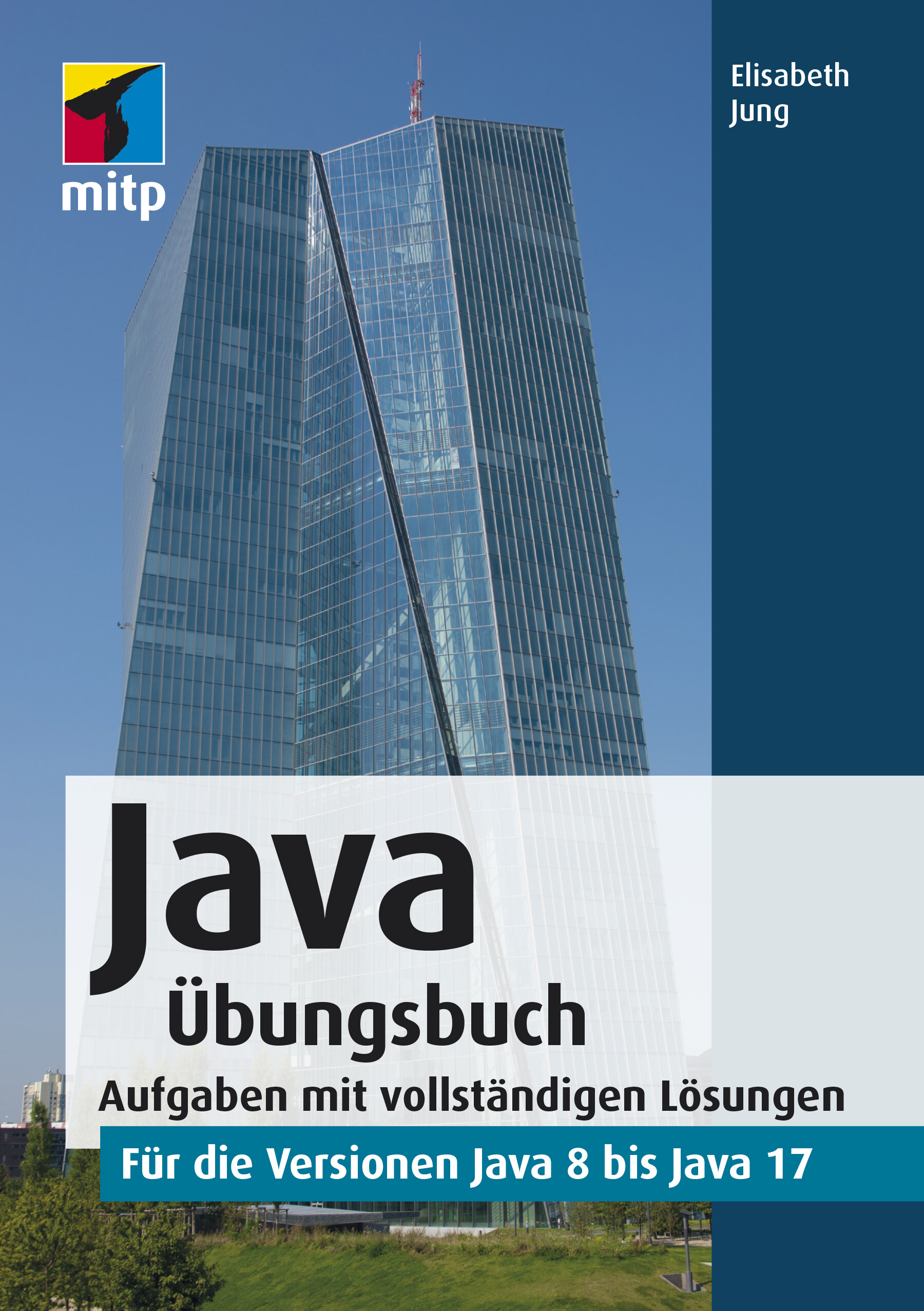
Java Übungsbuch (2. Auflage)
Aufgaben mit vollständigen Lösungen für die Versionen Java 8 bis Java 17.Dieses Buch ist kein Lehrbuch, sondern ein reines Übungsbuch und wendet sich an Leser, die ihre Java-Kenntnisse anhand zahlreicher praktischer Übungen durch „Learning by Doing“ vertiefen und festigen möchten. Es ist ideal, um sich auf Prüfungen vorzubereiten oder das Programmieren mit Java praktisch zu üben.Jedes Kapitel beginnt mit einer kompakten Zusammenfassung des Stoffs, der in den Übungsaufgaben dieses Kapitels verwendet wird. Anschließend haben Sie die Möglichkeit, zwischen Aufgaben in drei verschiedenen Schwierigkeitsstufen – von einfach bis anspruchsvoll – zu wählen. Anhand dieser Aufgaben können Sie Ihr Wissen praktisch testen. Am Ende der Kapitel finden Sie vollständige und kommentierte Musterlösungen.Es werden folgende Themen abgedeckt:Die Kapitel 1 bis 3 enthalten Aufgaben zur objektorientierten Programmierung mit Java und die Neuerungen aus den Versionen 8 bis 13, die sich auf die neue Date&Time API, Textblöcke, Compact Strings und die Weiterentwicklung von Interfaces beziehen.In Kapitel 4 geht es im Detail um Generics und das Collection Framework mit all seinen generischen Klassen und Interfaces sowie mit der Definition von Enumerationen. Kapitel 5 erläutert das Exception Handling.Das Kapitel 6 beschäftigt sich mit den neuen Sprachmitteln von Java 8, Lambdas und Streams, sowie mit weiteren Neuerungen aus den Versionen 8 bis 13 wie Switch Expressions und Local Variable Type Inference.Kapitel 7 bietet einen Einblick in die mit Java 9 vorgenommene Modularisierung der Java-Plattform.Kapitel 8 enthält Aufgaben zu den Weiterentwicklungen aus den Versionen 14 bis 17, die sich auf die Java-Programmiersprache beziehen, dazu gehören die Einführung von Records und Sealed Classes sowie das Pattern Matching.Kapitel 9 enthält viele Aufgaben zu Tests mit JUnit 5 und Gradle sowie eine kurze theoretische Einführung in beide Systeme.Nach dem Durcharbeiten des Buches verfügen Sie über fundierte Programmierkenntnisse und einen umfangreichen Fundus an Beispielcode.Aus dem Inhalt:Klassendefinition und ObjektinstanziierungAbgeleitete Klassen und VererbungAbstrakte Klassen und InterfacesDie Definition von AnnotationenInnere KlassenGenerics und ReflectionTypprüfung und Typsicherheit in JavaLambdasMethoden- und Konstruktor-ReferenzenFunktionale InterfacesLocal Variable Type InferenceDefinition und Nutzung von StreamsDas Modulsystem von JavaRecords und Sealed TypesPattern Matching für den instanceof-OperatorPattern Matching für switchTests mit Junit 5 und Gradle
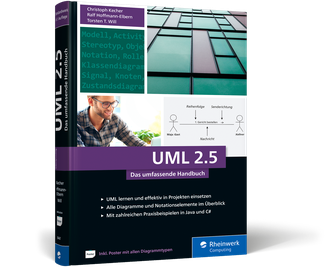
UML 2.5 - Das umfassende Handbuch
Von den Grundlagen bis zum professionellen Einsatz – in unserem Handbuch erfahren Sie alles, was Sie für erfolgreiche Softwaremodellierung mit der UML wissen müssen. Lernen Sie alle Konzepte, Elemente und Diagrammtypen ausführlich kennen und knüpfen Sie anhand von Praxisbeispielen die Verbindung zum Code. Ob Sie etwas nachschlagen oder die UML von Grund auf verstehen möchten, dieses Handbuch bietet Ihnen das gesammelte UML-Wissen im Komplettpaket. Aus dem Inhalt:Grundlagen der UMLDiagrammtypen und NotationselementeDos and Don'ts der SoftwaremodellierungUML mit Java und C#A2-Poster mit DiagrammtypenBeispiele zum DownloadAutoren: Christoph Kecher ist Chief Information Officer (CIO) bei der HSBC Deutschland. Seine Tätigkeitsbereiche umfassen Data Warehouse-Technologien, Java, .NET, UML und Software-Qualitätssicherung. Ralf Hoffmann-Elbern hat schon früh die Softwareentwicklung für sich entdeckt. Nach dem Studium der Physik und einem Ausflug ins Lehramt hat er dieses Hobby zum Beruf gemacht. Torsten T. Will beschäftigte sich schon während seines Diploms in Informatik mit Programmiersprachen und ihren Konzepten. Leseprobe (PDF - Link)
Einstieg in Kotlin - Apps entwickeln mit Android Studio (2. Auflage)
Einfach und strukturiert ohne Vorkenntnisse Kotlin lernen. Mit IntelliJ IDEA lernen Sie die Sprache kennen und steigen dann in die App-Entwicklung mit Android Studio ein – so entwickeln Sie eigene Apps samt Zugriff auf verschiedenste Sensoren, Datenbanken und Multimedia. Kotlin ist Googles bevorzugte Sprache für die App-Entwicklung und zu Recht beliebt: Nicht nur Java-Kenner werden an den modernen Sprach-Features ihre Freude haben. Und für Programmierer ist Kotlin genau das Richtige für den Einstieg in die App-Entwicklung. Aus dem Inhalt:Alle Grundlagen der ProgrammierungIntelliJ IDEA und Android Studio installierenVerzweigungen, Schleifen und Co.Funktionen und funkionale ProgrammierungLayouts und Menüs aufbauenStandard-DialogeSensoren nutzenSystemdienste integrierenSpiele und Trainings entwickelnDatenbanken zur SpeicherungGestensteuerungZugriffsrechte verwaltenAutor: Thomas Theis ist Dipl.-Ing. Technische Informatik. Als Softwareentwickler verfügt er über langjährige Erfahrung, ebenso als IT-Dozent, unter anderem an der Fachhochschule Aachen. Als Kenner vieler verschiedener Programmiersprachen leitet er Seminare zur Programmierung und ist Autor vieler erfolgreicher Fachbücher. Leseprobe (PDF Link)

UML 2.5
Von den Grundlagen bis zum professionellen Einsatz – in unserem Handbuch erfahren Sie alles, was Sie für erfolgreiche Softwaremodellierung mit der UML wissen müssen. Lernen Sie alle Konzepte, Elemente und Diagrammtypen ausführlich kennen und knüpfen Sie anhand von Praxisbeispielen die Verbindung zum Code. Ob Sie etwas nachschlagen oder die UML von Grund auf verstehen möchten, dieses Handbuch bietet Ihnen das gesammelte UML-Wissen im Komplettpaket. Es behandelt den aktuellen Standard UML 2.5 und die Codebeispiele sind in den beiden wichtigsten Sprachen Java und C# verfasst. Aus dem Inhalt: Grundlagen der Softwaremodellierung mit der UML 2.5Alle Diagrammtypen und NotationselementeUML in Projekten einsetzen Implementierungen mit Java oder C#Liste mit den häufigsten Fehlern und Verbesserungsvorschlägen zu jedem DiagrammtypDIN-A2-Poster mit allen DiagrammtypenZum Download auf der Verlagswebsite: Diagramme und Code der gezeigten Beispiele, Übersicht zu UML-Tools und Poster als PDF-Datei Materialien zum Buch ... 13 Vorwort ... 15 1. Einführung ... 19 1.1 ... Weshalb muss Software modelliert werden? ... 19 1.2 ... Die Phasen bei der Softwareentwicklung ... 20 1.3 ... Was ist die UML? ... 22 1.4 ... Die Geschichte der UML ... 23 1.5 ... Von der UML 1.x zur UML 2.5 ... 24 1.6 ... Diagramme der UML 2.5 ... 26 1.7 ... Realisierung in Java und C# ... 33 TEIL I. Strukturdiagramme ... 35 2. Klassendiagramm ... 37 2.1 ... Anwendungsbereiche ... 37 2.2 ... Übersicht ... 38 2.3 ... Notationselemente ... 39 2.4 ... Lesen eines Klassendiagramms ... 111 2.5 ... Irrungen und Wirrungen ... 114 2.6 ... Zusammenfassung ... 116 3. Objektdiagramm ... 121 3.1 ... Anwendungsbereiche ... 121 3.2 ... Übersicht ... 121 3.3 ... Notationselemente ... 122 3.4 ... Lesen eines Objektdiagramms ... 130 3.5 ... Irrungen und Wirrungen ... 131 3.6 ... Zusammenfassung ... 133 4. Kompositionsstrukturdiagramm ... 135 4.1 ... Anwendungsbereiche ... 135 4.2 ... Übersicht ... 135 4.3 ... Notationselemente ... 136 4.4 ... Lesen eines Kompositionsstrukturdiagramms ... 151 4.5 ... Irrungen und Wirrungen ... 152 4.6 ... Zusammenfassung ... 153 5. Komponentendiagramm ... 155 5.1 ... Anwendungsbereiche ... 155 5.2 ... Überblick ... 155 5.3 ... Notationselemente ... 156 5.4 ... Lesen eines Komponentendiagramms ... 166 5.5 ... Irrungen und Wirrungen ... 167 5.6 ... Zusammenfassung ... 169 6. Verteilungsdiagramm ... 171 6.1 ... Anwendungsbereiche ... 171 6.2 ... Übersicht ... 171 6.3 ... Notationselemente ... 172 6.4 ... Lesen eines Verteilungsdiagramms ... 178 6.5 ... Irrungen und Wirrungen ... 179 6.6 ... Zusammenfassung ... 181 7. Paketdiagramm ... 183 7.1 ... Anwendungsbereiche ... 183 7.2 ... Übersicht ... 183 7.3 ... Notationselemente ... 184 7.4 ... Lesen eines Paketdiagramms ... 201 7.5 ... Irrungen und Wirrungen ... 203 7.6 ... Zusammenfassung ... 204 TEIL II. Verhaltensdiagramme ... 207 8. Anwendungsfalldiagramm ... 209 8.1 ... Anwendungsbereiche ... 209 8.2 ... Übersicht ... 210 8.3 ... Notationselemente ... 210 8.4 ... Lesen eines Anwendungsfalldiagramms ... 219 8.5 ... Irrungen und Wirrungen ... 221 8.6 ... Zusammenfassung ... 222 9. Aktivitätsdiagramm ... 225 9.1 ... Anwendungsbereiche ... 225 9.2 ... Übersicht ... 226 9.3 ... Notationselemente ... 228 9.4 ... Lesen eines Aktivitätsdiagramms ... 295 9.5 ... Irrungen und Wirrungen ... 297 9.6 ... Zusammenfassung ... 299 10. Zustandsdiagramm ... 303 10.1 ... Anwendungsbereiche ... 303 10.2 ... Übersicht ... 304 10.3 ... Notationselemente ... 305 10.4 ... Lesen eines Zustandsdiagramms ... 341 10.5 ... Irrungen und Wirrungen ... 343 10.6 ... Zusammenfassung ... 345 TEIL III. Interaktionsdiagramme ... 349 11. Sequenzdiagramm ... 351 11.1 ... Anwendungsbereiche ... 351 11.2 ... Übersicht ... 352 11.3 ... Notationselemente ... 353 11.4 ... Lesen eines Sequenzdiagramms ... 384 11.5 ... Irrungen und Wirrungen ... 386 11.6 ... Zusammenfassung ... 388 12. Kommunikationsdiagramm ... 393 12.1 ... Anwendungsbereiche ... 393 12.2 ... Übersicht ... 393 12.3 ... Notationselemente ... 394 12.4 ... Lesen eines Kommunikationsdiagramms ... 399 12.5 ... Irrungen und Wirrungen ... 400 12.6 ... Zusammenfassung ... 401 13. Timing-Diagramm ... 403 13.1 ... Anwendungsbereiche ... 403 13.2 ... Übersicht ... 403 13.3 ... Notationselemente ... 404 13.4 ... Lesen eines Timing-Diagramms ... 412 13.5 ... Irrungen und Wirrungen ... 413 13.6 ... Zusammenfassung ... 415 14. Interaktionsübersichtsdiagramm ... 417 14.1 ... Anwendungsbereiche ... 417 14.2 ... Übersicht ... 417 14.3 ... Notationselemente ... 419 14.4 ... Lesen eines Interaktionsübersichtsdiagramms ... 421 14.5 ... Irrungen und Wirrungen ... 423 14.6 ... Zusammenfassung ... 424 TEIL IV. Metamodellierung ... 427 15. Profildiagramm ... 429 15.1 ... Anwendungsbereiche ... 429 15.2 ... Übersicht ... 430 15.3 ... Notationselemente ... 431 15.4 ... Lesen eines Profildiagramms ... 439 15.5 ... Irrungen und Wirrungen ... 441 15.6 ... Zusammenfassung ... 442 Index ... 445
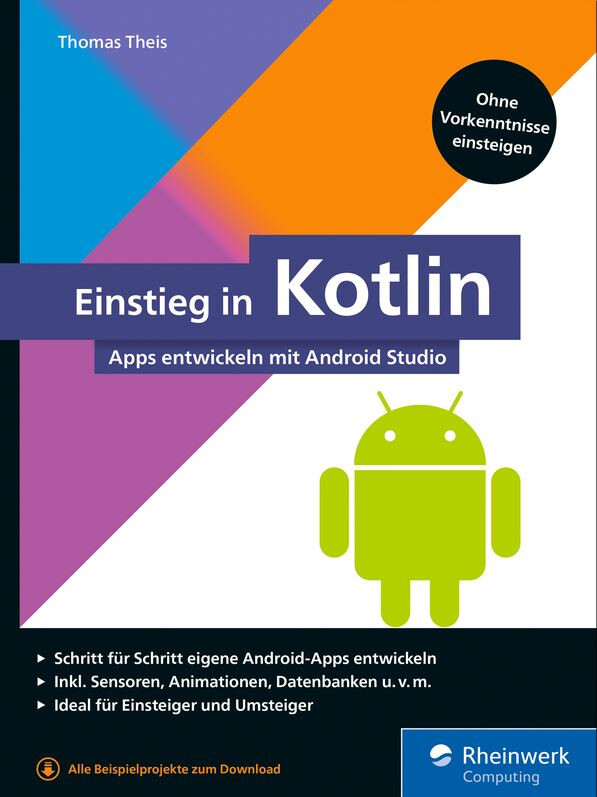
Einstieg in Kotlin
Einfach und strukturiert ohne Vorkenntnisse Kotlin lernen. Alle wichtigen Sprachfeatures Schritt für Schritt erklärt – so entwickeln Sie eigene Apps samt Zugriff auf verschiedenste Sensoren, Datenbanken und Multimedia. Kotlin ist zu Recht beliebt: Nicht nur Java-Kenner werden an Nullsicherheit und Co. ihre Freude haben. Und für Programmierer ist Kotlin genau das richtige für den Einstieg in die App-Entwicklung.Aus dem Inhalt:• Android Studio installieren• Befehle, Schleifen und Co.• Layouts und Menüs aufbauen• Fehler finden und beheben• Eigene Dialoge• Nullsicherheit• Sensoren und Systemdienste auslesen: Lage, Beschleunigung, Standort u.v.m.• Ein Spiel entwickeln• Erweiterungsfunktionen• Gestensteuerung• Zugriffsrechte verwalten

Optimizing Visual Studio Code for Python Development
Learn Visual Studio Code and implement its features in Python coding, debugging, linting, and overall project management. This book addresses custom scenarios for writing programs in Python frameworks, such as Django and Flask.The book starts with an introduction to Visual Studio Code followed by code editing in Python. Here, you will learn about the required extensions of Visual Studio Code to perform various functions such as linting and debugging in Python. Next, you will set up the environment and run your projects along with the support for Jupyter. You will also work with Python frameworks such as Django and go through data science specific-information and tutorials. Finally, you will learn how to integrate Azure for Python and how to use containers in Visual Studio Code.Optimizing Visual Studio Code for Python Development is your ticket to writing Python scripts with this versatile code editor.WHAT YOU'LL LEARN* Execute Flask development in Visual Studio Code for control over libraries used in an application* Optimize Visual Studio Code to code faster and better* Understand linting and debugging Python code in Visual Studio Code* Work with Jupyter Notebooks in Visual Studio CodeWHO THIS BOOK IS FORPython developers, beginners, and experts looking to master Visual Studio CodeSufyan bin Uzayr is a web developer with over 10 years of experience in the industry. He specializes in a wide variety of technologies, including JavaScript, WordPress, Drupal, PHP, and UNIX/Linux shell and server management, and is the author of four previous books. Sufyan is the Director of Parakozm, Kazakistan a design and development consultancy firm that offers customized solutions to a global clientele. He is also the CTO at Samurai Servers, a server management and security company catering mainly to enterprise-scale audience. He takes a keen interest in technology, politics, literature, history and sports, and in his spare time he enjoys teaching coding and English to students.OPTIMIZING VISUAL STUDIO CODE FOR PYTHON DEVELOPMENTCHAPTER ONE – INTRODUCTION TO VISUAL STUDIO CODEo Basic introduction to Visual Studio CodeCHAPTER TWO – GETTING STARTED WITH PYTHON PROGRAMS IN VS CODEo Getting started with code editingo Required extensionso Lintingo DebuggingCHAPTER THREE – SETTING UP THE ENVIRONMENT AND TESTINGo Setting up your environmento Running your projectso Support for JupyterCHAPTER FOUR – WORKING WITH PYTHON FRAMEWORKSo Django Developmento Flask Developmento Data Science specific information and tutorialsCHAPTER FIVE – WORKING WITH CONTAINERS AND MS AZUREo Integrating Azure for your Python projectso Using containers in VS Codeo Conclusion

LEGO®-Roboter bauen, steuern und programmieren mit Raspberry Pi und Python
* BAU- UND PROGRAMMIERANLEITUNGEN FÜR MEHR ALS 10 SPANNENDE ROBOTER-PROJEKTE* LABYRINTHE LÖSEN, PAPPKARTEN PER BILDERKENNUNG ABSCHIEẞEN, FORMEN MIT EINEM NEURONALEN NETZ ERKENNEN U.V.M.* PROGRAMMCODE UND BAUANLEITUNGEN FÜR ALLE ROBOTER ZUM DOWNLOADLEGO®-Steine - sei es als selbstgebaute LEGO®-Fahrzeuge, -Roboter oder als LEGO®-Fertigmodelle - lassen sich hervorragend mit Elektronikkomponenten zum Leben erwecken und programmieren. Hierfür ist der Mikrocontroller Raspberry Pi besonders gut geeignet. Anhand konkreter Projekte zeigt Ihnen der Autor, wie Sie Sensoren und Motoren von LEGO® sowie weitere Elektronikkomponenten mit dem Raspberry Pi verbinden und Ihre Roboter programmieren. Durch den Einsatz der Programmiersprache Python können die Roboter einfache und komplexe Aufgaben lösen bis hin zu Linienverfolgung mit einem neuronalen Netz oder Bilderkennung.Im ersten Teil des Buches erhalten Sie eine kurze Einführung in den Mikrocontroller Raspberry Pi sowie den BrickPi, der für die Verbindung von LEGO®-Sensoren mit dem Raspberry Pi benötigt wird. Außerdem vermittelt der Autor die Grundlagen zu allen Elektronikkomponenten, mit denen Sie Ihre LEGO®-Modelle oder -Roboter ausstatten können. Dazu zählen unter anderem mittlere und große LEGO®-Motoren sowie folgende Komponenten: Color-Sensor, Touch-Sensor und Infrarot-Sensor von LEGO®, Kompass-Sensor und Gyro-Sensor von Hitechnic, Raspberry-Pi-Kamera, Fototransistor, LEDs und Motoren.Im zweiten Teil des Buches finden Sie eine kurze Einführung in die Grundlagen der Programmierung mit Python, gefolgt von einem umfangreichen Projektteil mit 11 spannenden Robotern, die diverse Aufgaben lösen, wie zum Beispiel:* Gegenstände erkennen und diesen ausweichen* Lösen eines Labyrinths mithilfe von künstlicher Intelligenz* Linienverfolgung und Formen erkennen mit einem neuronalen Netz* Pappkarten abschießen per Bilderkennung* Sammeln farbiger Joghurtbecher* Texte morsen inkl. Anleitung zum Basteln eines eigenen Touch-SensorsBei allen Projekten erläutert der Autor sowohl den Bau der Roboter als auch die entsprechende Programmierung.HARDWARE:Für die Projekte im Buch werden sowohl die LEGO®-eigenen Komponenten als auch günstige handelsübliche Motoren und Sensoren eingesetzt. Sie können einen eigenen Roboter bauen, die LEGO®-Roboter im Buch nachbauen oder als Grundlage ein LEGO®-Fertigmodell verwenden. Für alle im Buch verwendeten LEGO®-Roboter gibt es die Bauanleitungen zum kostenlosen Download.Thomas Kaffka hat als Softwareingenieur sowie Projektleiter in Softwarehäusern und Wirtschaftsprüfungs- und Beratungsgesellschaften gearbeitet. Er ist ein echter Maker und beschäftigt sich mit verschiedenen Themen wie etwa dem Bau von LEGO®-Robotern, der Künstlicher Intelligenzforschung sowie dem 3D-Druck.

Cryptography and Cryptanalysis in MATLAB
Master the essentials of cryptography and cryptanalysis and learn how to put them to practical use. Each chapter of this book starts with an introduction to the concepts on which cryptographic algorithms are based and how they are used in practice, providing fully working examples for each of the algorithms presented. Implementation sections will guide you through the entire process of writing your own applications and programs using MATLAB.Cryptography and Cryptanalysis in MATLAB will serve as your definitive go-to cryptography reference, whether you are a student, professional developer, or researcher, showing how a multitude of cryptographic challenges can be overcome using the powerful tools of MATLAB.WHAT YOU WILL LEARN* Discover MATLAB’s cryptography functions* Work with conversion mechanisms in MATLABImplement cryptographic algorithms using arithmetic operations * Understand the classical, simple cryptosystems that form the basis of modern cryptography* Develop fully working solutions (encryption/decryption operations)* Study pseudo-random generators and their real-life implementations* Utilize hash functions by way of practical examples* Implement solutions to defend against practical cryptanalysis methods and attacks* Understand asymmetric and symmetric encryption systems and how to use themLeverage visual cryptography, steganography, and chaos-based cryptographyWHO THIS BOOK IS FORThose who are new to cryptography/analysis. Some prior exposure to MATLAB recommended.MARIUS IULIAN MIHAILESCU, PHD is CEO at Dapyx Solution Ltd., a company based in Bucharest, Romania and involved in information security- and cryptography-related research projects. He is a lead guest editor for applied cryptography journals and a reviewer for multiple publications with information security and cryptography profiles. He authored and co-authored more than 30 articles in conference proceedings, 25 articles in journals, and three books. For more than six years he has served as a lecturer at well-known national and international universities (University of Bucharest, “Titu Maiorescu” University, Kadir Has University in, Istanbul, Turkey). He has taught courses on programming languages (C#, Java, C++, Haskell), and object-oriented system analysis and design with UML, graphs, databases, cryptography and information security. He served for three years as IT Officer at Royal Caribbean Cruises Ltd. where he dealt with IT infrastructures, data security, and satellite communications systems. He received his PhD in 2014 and his thesis was on applied cryptography over biometrics data. He holds two MSc in information security and software engineering.STEFANIA LOREDANA NITA, PHD is a software developer at the Institute of Computer Science of the Romanian Academy and a Fellow PhD with her thesis on advanced cryptographic schemes using searchable encryption and homomorphic encryption. She has served more than two years as an assistant lecturer at the University of Bucharest where she taught courses on subjects such as advanced programming techniques, simulation methods, and operating systems. She has authored and co-authored more than 15 workpapers at conferences and journals, and has authored two books on he Haskell programming language. She is a lead guest editor for special issues on information security and cryptography such as Advanced Cryptography and Its Future: Searchable and Homomorphic Encryption. She holds an MSc in software engineering and two BSc in computer science and mathematics.NEW ToCChapter 01 – IntroductionChapter 02 – MATLAB Cryptography FunctionsChapter 03 – Conversions used in CryptographyChapter 04 – Basic Arithmetic FoundationsChapter 05 – Number TheoryChapter 06 – Classical Cryptography6.1. Caesar Cipher6.2. VigenereChapter 07 – Pseudo Random GeneratorsChapter 08 – Hash FunctionsChapter 09 – Formal Techniques for CryptographyChapter 10 – Symmetric Encryption Schemes10.1. Case Study: The Data Encryption Standard (DES)10.2. Advanced Encryption Standard (AES)Chapter 11 – Asymmetric Encryption Schemes11.1. RSA11.2. El Gamal11.3. Knapsack11.4. Merkle-HellmanChapter 12 – Visual CryptographyChapter 13 – SteganographyChapter 14 – Chaos-based CryptographyPART 1 - FOUNDATIONS.1. Cryptography Fundamentals2. Mathematical Background and Its Applicability3. Large Integer Arithmetic4. Floating-point Arithmetic5. New Features in MATLAB 106. Secure Coding Guidelines7. Cryptography Libraries in MATLABPART 2 – PRO CRYPTOGRAPHY.8. Elliptic-curve Cryptography and Public Key Algorithms9. Lattice-based Cryptography10. Searchable Encryption11. Homomorphic Encryption12. Learning with Errors and Ring Learning with Errors Cryptography13. Chaos-based Cryptography14. Big Data Cryptography15. Cloud Computing Cryptography.PART 3 – PRO CRYPTANALYSIS16. Introduction to Cryptanalysis17. General notions for Conducting Cryptanalysis Attacks18. Linear and Differential Cryptanalysis19. Integral Cryptanalysis20. Attacks21. Text Characterization22. Basic Implementations of Cryptanalysis Methods.

Basic Python for Data Management, Finance, and Marketing
Learn how to gather, manipulate, and analyze data with Python. This book is a practical guide to help you get started with Python from ground zero and to the point where you can use coding for everyday tasks.Python, the most in-demand skill by employers, can be learned in a matter of months and a working knowledge will help you to advance your career. This book will teach you to crunch numbers, analyze big-data, and switch from spreadsheets to a faster and more efficient programming language. You'll benefit from the numerous real-life examples designed to meet current world challenges and from step-by-step guidance to become a confident Python user.Python is used in all aspects of financial industry, from algo trading, reporting and risk management to building valuations models and predictive machine learning programs. Basic Python for Data Management, Finance, and Marketing highlights how this language has become a useful skill with digital marketers, allowing them to analyze data more precisely and run more successful campaigns.WHAT YOU'LL LEARN* Get started with Python from square one* Extend what's possible on excel with Python* Automate tasks with Python* Analyze data more preciselyWHO THIS BOOK IS FORProfessionals who want to find a job in the modern world or advance their careers within field of Python programming language.Art Yudin is a FinTech enthusiast who has a great passion for coding and teaching. He earned a Master of Science in Banking and Finance from Adelphi University, Garden City, New York.Mr. Yudin previously held asset management positions with international financial institutions such as Merrill Lynch and Allianz Investments. Currently, Art Yudin develops FinTech software for well known financial giants. Art Yudin has founded Practical Programming in New York. Practical Programing is a Python bootcamp. Art leads classes and workshops in Python at Practical Programming in New York and Chicago.BASIC PYTHON FOR DATA MANAGEMENT, FINANCE, AND MARKETING1. Getting started with Python- Variables and numeric data types- Python containers to hold our data- Definite loops- Building a mortgage calculator2. Writing your own Python scripts- Custom functions- Indefinite loops- Immutable containers - tuples- Pseudo code to problem solving3. Extending Excel with Python- Dictionaries- Reading and writing csv files with Python- CSV and Urllib modules4. Data Analysis with NumPy and Pandas- NumPy as an extension of Python- Series and DataFrame- Manipulate and plot data with Pandas5. Solving common problems with Pandas- Concatinate and merge datasets- Group by keys- How to use logic in Pandas6. Gathering data with Python- Web Scraping with Python- Reading PDF files with Python- Cleaning data- Storing data7. Building predictive models- User authentication- Linear reression- K-nearest- CART – decision tree- Matplotlib to plot data8. Automating tasks with Python- Sending emails- Deploying your script to a server- Running tasks at specific time